. 2014 May 21;82(4):773-80.
doi: 10.1016/j.neuron.2014.04.043.

Loss-of-function variants in schizophrenia risk and SETD1A as a candidate susceptibility gene

Affiliations

Loss-of-function variants in schizophrenia risk and SETD1A as a candidate susceptibility gene

Atsushi Takata et al. Neuron. .

Abstract

Loss-of-function (LOF) (i.e., nonsense, splice site, and frameshift) variants that lead to disruption of gene function are likely to contribute to the etiology of neuropsychiatric disorders. Here, we perform a systematic investigation of the role of both de novo and inherited LOF variants in schizophrenia using exome sequencing data from 231 case and 34 control trios. We identify two de novo LOF variants in the SETD1A gene, which encodes a subunit of histone methyltransferase, a finding unlikely to have occurred by chance, and provide evidence for a more general role of chromatin regulators in schizophrenia risk. Transmission pattern analyses reveal that LOF variants are more likely to be transmitted to affected individuals than controls. This is especially true for private LOF variants in genes intolerant to functional genetic variation. These findings highlight the contribution of LOF mutations to the genetic architecture of schizophrenia and provide important insights into disease pathogenesis.


Figures

Figure 1
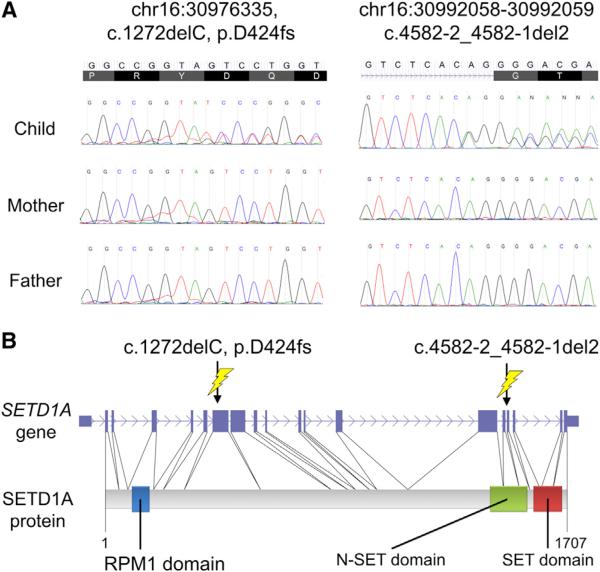
Figure 1. Two De Novo LOF Indels in SETD1A
(A) Two de novo LOF indels in the SETD1A gene confirmed by Sanger sequencing. (B) Structure of the SETD1A gene and the SETD1A protein along with the positions of the two LOF indels. The de novo frameshift indel variant (D424fs) (left) creates an early stop codon and leads to protein truncation. The de novo indel variant c.4582-2_4582-1 del2 variant (right) changes the canonical splice acceptor site sequence adjacent to exon 16 from AG to GG.
Figure 2
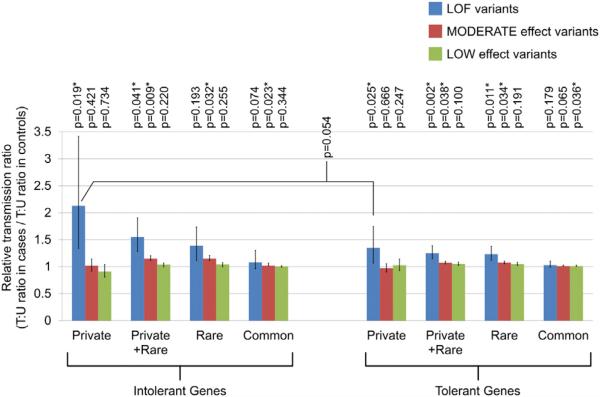
Figure 2. Prominent Overtransmission of Private LOF Variants in Intolerant Genes
Relative transmission ratios (RTRs) are displayed for variants categorized by their functionality (blue: loss-of-function [LOF] variants; red: MODERATE-effect variants; and green: LOW-effect variants), minor allele frequencies (private, rare, or common), and gene intolerance. Detailed definition for LOF, MODERATE-, and LOW-effect variants is provided in the Supplemental Experimental Procedures. *p < 0.05. Error bars indicate 95% confidential intervals. p values for RTRs were calculated by one-sided permutation analysis with random shuffling of the case-control status.

References

    1. Abecasis GR, Auton A, Brooks LD, DePristo MA, Durbin RM, Handsaker RE, Kang HM, Marth GT, McVean GA, 1000 Genomes Project Consortium An integrated map of genetic variation from 1,092 human genomes. Nature. 2012;491:56–65. - PMC - PubMed
    1. Adzhubei IA, Schmidt S, Peshkin L, Ramensky VE, Gerasimova A, Bork P, Kondrashov AS, Sunyaev SR. A method and server for predicting damaging missense mutations. Nat. Methods. 2010;7:248–249. - PMC - PubMed
    1. Albers CA, Lunter G, MacArthur DG, McVean G, Ouwehand WH, Durbin R. Dindel: accurate indel calls from short-read data. Genome Res. 2011;21:961–973. - PMC - PubMed
    1. Ben-David E, Shifman S. Combined analysis of exome sequencing points toward a major role for transcription regulation during brain development in autism. Mol. Psychiatry. 2013;18:1054–1056. - PubMed
    1. Bottas A, Cooke RG, Richter MA. Comorbidity and patho-physiology of obsessive-compulsive disorder in schizophrenia: is there evidence for a schizo-obsessive subtype of schizophrenia? J. Psychiatry Neurosci. 2005;30:187–193. - PMC - PubMed

Publication types

Substances