


Review
doi: 10.1097/PPO.0000000000000048.
Microbiome, inflammation, and cancer
Affiliations
- PMID: 24855005
- PMCID: PMC4112188
- DOI: 10.1097/PPO.0000000000000048
Item in Clipboard
Review
Microbiome, inflammation, and cancer
Cancer J.
2014 May-Jun.
Abstract
Inflammation has long been suspected to play a major role in the pathogenesis of cancer. Only recently, however, have some mechanisms of its tumor promoting effects become known. Microbes, both commensal and pathogenic, are critical regulators of the host immune system and, ultimately, of inflammation. Consequently, microbes have the potential power to influence tumor progression as well, through a wide variety of routes, including chronic activation of inflammation, alteration of tumor microenvironment, induction of genotoxic responses, and metabolism. In this review, we will provide a general overview of commensal microbiota, inflammation, and cancer, as well as how microbes fit into this emerging field.
Figures
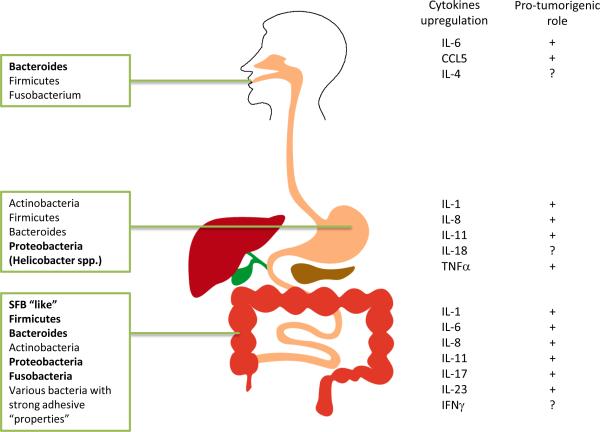
Normal bacterial composition in various organs of the body (left). Bacterial
population increased in dysbiosis are in bold. Cytokines and chemokines
upregulated in the process of inflammation and cancer are shown in the right of
the figure..
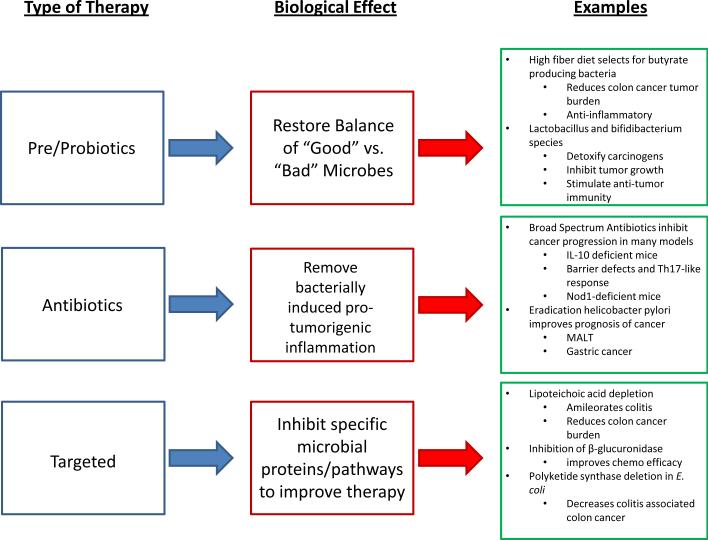
Three potential intervention points to improve patient responses against cancer,
along with what the desired effect, and important examples from the literature.
(Author: Need reference(s)?)
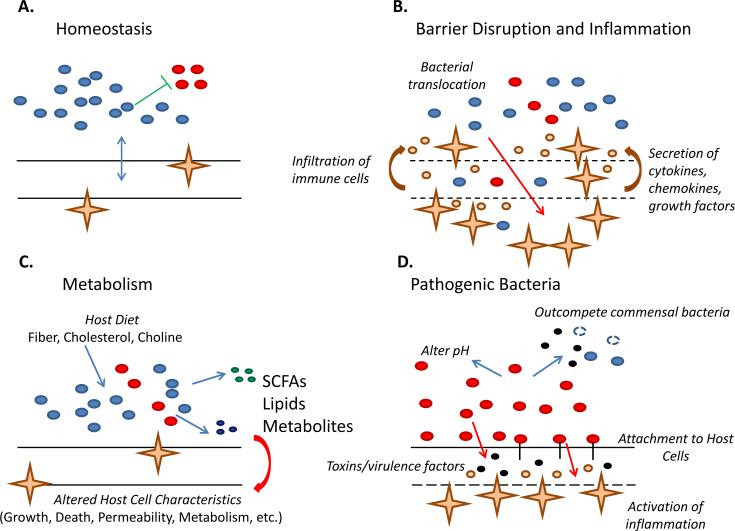
A.)
Homeostasis. Beneficial bacteria occupy a dominant niche,
inhibiting the growth of potentially pathogenic organisms. The integrity of the
host organ is maintained and the immune system tolerates and limits bacterial
expansion. B.)
Barrier Disruption and Inflammation. The barrier integrity of
the host organ is compromised, due to tumor growth for example, allowing
translocation of bacteria through the barrier, deeper into the organ. This
elicits a robust immune response, as immune cells rush into the area, secreting
a wide variety of cytokines, chemokines, and growth factors. This can lead to a
chronic state of inflammation, and actually support tumor growth.
C.)
Metabolism. Microbes metabolize dietary intake from the host
(fiber, cholesterol, and choline). These are converted into bacterial
byproducts, such as short chain fatty acids (SCFAs: butyrate, acetate), lipids,
and other metabolites, which modulate host cell behavior. D.)
Pathogenic Bacteria. Here, dysbiosis occurs where pathogenic
bacteria outcompete commensals by altering the pH and secreting toxins. Some
bacteria can attach to the host epithelial layer, or even invade, and induce an
immune response. Others actively secrete toxins or possess virulence factors
that help break down host tissue and invade further into subsequent layers. The
net result is a pro-tumorigenic microenvironment that can promote the
progression of cancer.
A.)
Homeostasis. Beneficial bacteria occupy a dominant niche,
inhibiting the growth of potentially pathogenic organisms. The integrity of the
host organ is maintained and the immune system tolerates and limits bacterial
expansion. B.)
Barrier Disruption and Inflammation. The barrier integrity of
the host organ is compromised, due to tumor growth for example, allowing
translocation of bacteria through the barrier, deeper into the organ. This
elicits a robust immune response, as immune cells rush into the area, secreting
a wide variety of cytokines, chemokines, and growth factors. This can lead to a
chronic state of inflammation, and actually support tumor growth.
C.)
Metabolism. Microbes metabolize dietary intake from the host
(fiber, cholesterol, and choline). These are converted into bacterial
byproducts, such as short chain fatty acids (SCFAs: butyrate, acetate), lipids,
and other metabolites, which modulate host cell behavior. D.)
Pathogenic Bacteria. Here, dysbiosis occurs where pathogenic
bacteria outcompete commensals by altering the pH and secreting toxins. Some
bacteria can attach to the host epithelial layer, or even invade, and induce an
immune response. Others actively secrete toxins or possess virulence factors
that help break down host tissue and invade further into subsequent layers. The
net result is a pro-tumorigenic microenvironment that can promote the
progression of cancer.
References
-
- Artis D. Epithelial-cell recognition of commensal bacteria and maintenance of immune homeostasis in the gut. Nat Rev Immunol. 2008;8:411–420. - PubMed
Publication types
MeSH terms
Grants and funding
LinkOut - more resources
Full Text Sources
Other Literature Sources
