


In vivo effects of synthetic cannabinoids JWH-018 and JWH-073 and phytocannabinoid Δ9-THC in mice: inhalation versus intraperitoneal injection
- PMID: 24857780
- PMCID: PMC4340656
- DOI: 10.1016/j.pbb.2014.05.010
In vivo effects of synthetic cannabinoids JWH-018 and JWH-073 and phytocannabinoid Δ9-THC in mice: inhalation versus intraperitoneal injection
Abstract
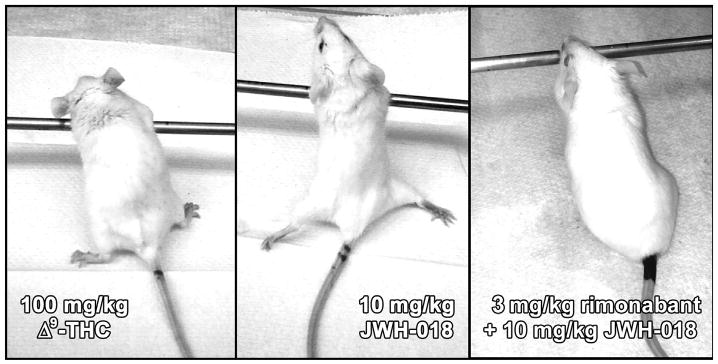
Human users of synthetic cannabinoids (SCBs) JWH-018 and JWH-073 typically smoke these drugs, but preclinical studies usually rely on injection for drug delivery. We used the cannabinoid tetrad and drug discrimination to compare in vivo effects of inhaled drugs with injected doses of these two SCBs, as well as with the phytocannabinoid Δ(9)-tetrahydrocannabinol (Δ(9)-THC). Mice inhaled various doses of Δ(9)-THC, JWH-018 or JWH-073, or were injected intraperitoneally (IP) with these same compounds. Rectal temperature, tail flick latency in response to radiant heat, horizontal bar catalepsy, and suppression of locomotor activity were assessed in each animal. In separate studies, mice were trained to discriminate Δ(9)-THC (IP) from saline, and tests were performed with inhaled or injected doses of the SCBs. Both SCBs elicited Δ(9)-THC-like effects across both routes of administration, and effects following inhalation were attenuated by pretreatment with the CB1 antagonist/inverse agonist rimonabant. No cataleptic effects were observed following inhalation, but all compounds induced catalepsy following injection. Injected JWH-018 and JWH-073 fully substituted for Δ(9)-THC, but substitution was partial (JWH-073) or required relatively higher doses (JWH-018) when drugs were inhaled. These studies demonstrate that the SCBs JWH-018 and JWH-073 elicit dose-dependent, CB1 receptor-mediated Δ(9)-THC-like effects in mice when delivered via inhalation or via injection. Across these routes of administration, differences in cataleptic effects and, perhaps, discriminative stimulus effects, may implicate the involvement of active metabolites of these compounds.
Keywords: Antinociception; Behavior; Cannabinoids; Drug discrimination; Hypothermia; Locomotor activity.
Copyright © 2014 Elsevier Inc. All rights reserved.
Figures



References
-
- Brents LK, Gallus-Zawada A, Radominska-Pandya A, Vasiljevik T, Prisinzano TE, Fantegrossi WE, et al. Monohydroxylated metabolites of the K2 synthetic cannabinoid JWH-073 retain intermediate to high cannabinoid 1 receptor (CB1R) affinity and exhibit neutral antagonist to partial agonist activity. Biochem Pharmacol. 2012;83(7):952–61. - PMC - PubMed
-
- Eissenstat MA, Bell MR, D'Ambra TE, Estep KG, Haycock DA, Olefirowicz EM, et al. Aminoalkylindoles (AAIs): structurally novel cannabinoid-mimetics. NIDA Res Monogr. 1990;105:427–8. - PubMed
Publication types
MeSH terms
Substances
Grants and funding
LinkOut - more resources
Full Text Sources
Other Literature Sources
