Review
. 2014 Jul 29;426(15):2703-16.
doi: 10.1016/j.jmb.2014.05.014. Epub 2014 May 22.

New applications for phage integrases

Affiliations
Review

New applications for phage integrases

Paul C M Fogg et al. J Mol Biol. .

Abstract

Within the last 25 years, bacteriophage integrases have rapidly risen to prominence as genetic tools for a wide range of applications from basic cloning to genome engineering. Serine integrases such as that from ϕC31 and its relatives have found an especially wide range of applications within diverse micro-organisms right through to multi-cellular eukaryotes. Here, we review the mechanisms of the two major families of integrases, the tyrosine and serine integrases, and the advantages and disadvantages of each type as they are applied in genome engineering and synthetic biology. In particular, we focus on the new areas of metabolic pathway construction and optimization, biocomputing, heterologous expression and multiplexed assembly techniques. Integrases are versatile and efficient tools that can be used in conjunction with the various extant molecular biology tools to streamline the synthetic biology production line.

Keywords: bacteriophages; genome engineering; integrases; integrating vectors; synthetic biology.


Figures

None
Graphical abstract
Fig. 1
Fig. 1
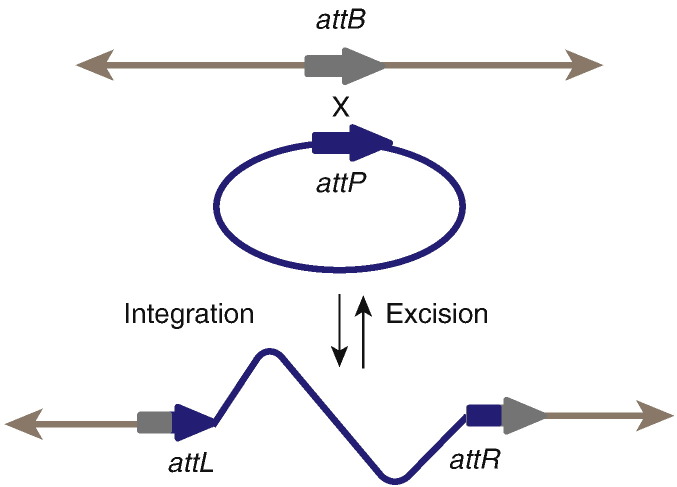
Overview of phage integration and excision. After injection, the phage genome is circularized (blue circle) and can then integrate via the phage attachment site (attP; blue arrow) into the bacterial host attachment site (attB; grey arrow). The integration reaction produces the prophage flanked by the new attachment sites, attL and attR, which are hybrids containing half of attP and half of attB. Excision occurs between attL and attR to regenerate attP on the excised phage genome and attB on the host chromosome. Both integration and excision require integrase, the enzyme that mediates the site-specific DNA recombination. Excision also requires a phage-encoded accessory protein, an RDF or a Xis.
Fig. 2
Fig. 2
Tyrosine recombinase att site structure and the control of integration versus excision. (a) Overview of Cre/FLP att site requirements. The recombination sites for Cre (loxP) and FLP (FRT) recombinases are substantially simpler than the λ model. The minimal recombination requirements are two identical 34 bp sites (each substrate here is colour-coded either red or black) composed of 13 bp inverted repeats (arrows) flanking an 8 bp asymmetrical core sequence (boxes) where the crossover occurs . (b) Diagram of the recombination intermediate. During both integration and excision, tyrosine recombinases catalyse pairwise, sequential cleavage and exchange of single DNA strands from the respective att sites. This process produces a DNA structure resembling a four-way Holliday junction, which is subsequently resolved to the recombined products. The green ovals represent λ Int subunits that make up the active tetramer. (c) Overview of the important features of the λ Int attB and attP attachment sites required for effective recombination. Both sites have left and right arms (B- and B′-arms, red lines; P-arm, blue line; P′-arm, black line) separated by a central identical sequence of 15 bp, which contains the site of recombination (data not shown). Here, the attL/R sites are annotated using the λ convention (attL = BP′ and attR = PB′). The attP site is approximately 240 bp in length and, in the integration reaction, λ Int binds to the arm binding sites (green arrows), and IHF binds to its cognate sites (yellow). In excision, attL has binding sites for λ Int and IHF and attR has a binding site for λ Int on the P′-arm, which is in a different position and inverted compared to the site used for Int binding in integration. attR also has binding sites for Fis (purple) and Xis (orange).
Fig. 3
Fig. 3
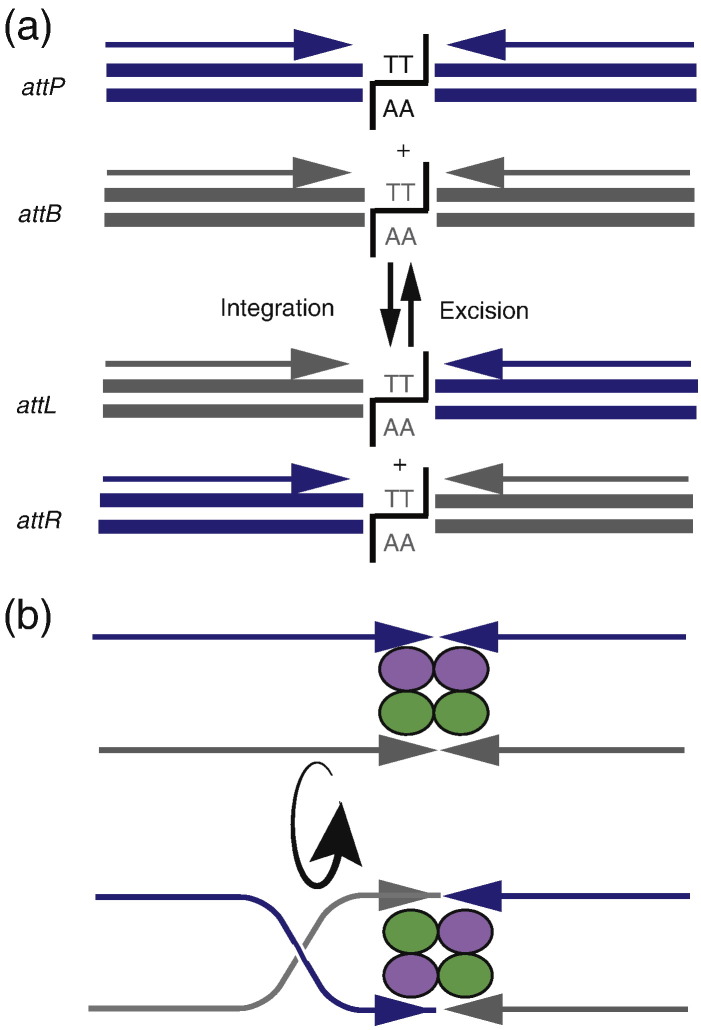
Breakage and rejoining of the attachment sites by serine integrases. (a) Organization of the attachment sites used by the serine integrases. The attachment sites are less than 50 bp in length and attP (blue) and attB (grey) are inverted repeats. The thick blue and grey lines represent the two strands of DNA with the central dinucleotides shown, in this case, two T:A base pairs. The black lines represent the position of the staggered breaks made when integrase cuts all four strands of the two substrates concertedly. Exchange of the half sites represents the integration reaction (down-pointing arrow) and the excision reaction (up-pointing arrow). The bases in the staggered ends base pair in the recombinant arrangement and integrase can then rejoin the phosphodiester backbone to generate the products. (b) The DNA half sites are exchanged by subunit rotation. Within the active tetramer of integrase subunits, one pair of subunits, still bound to the half sites from opposing substrates, rotate 180° compared to the other pair of subunits. This action brings together the DNA ends originating from different substrates, which can then be joined to form products.
Fig. 4
Fig. 4
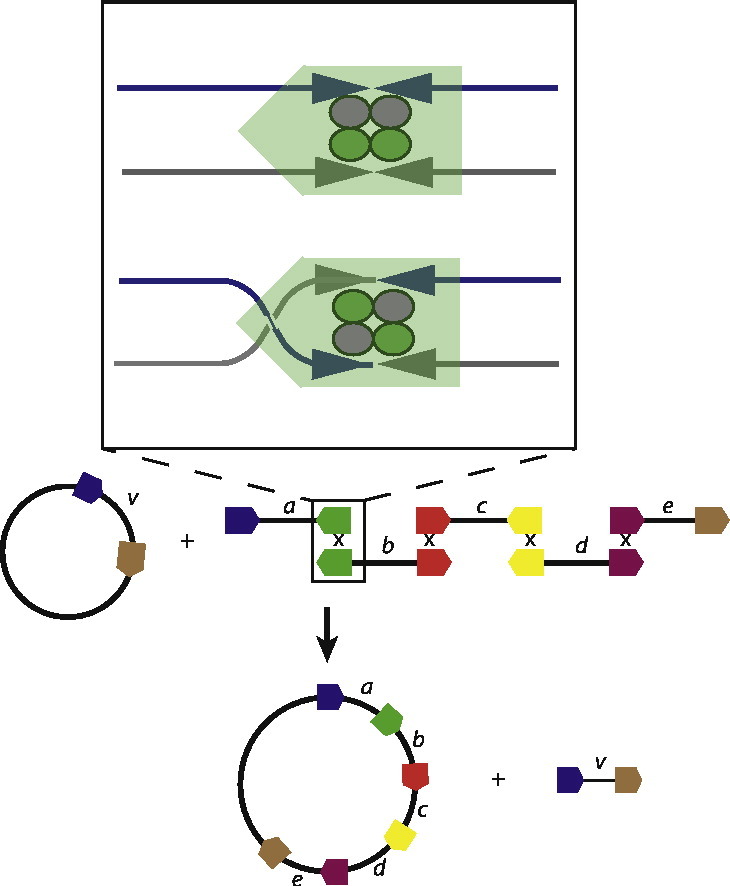
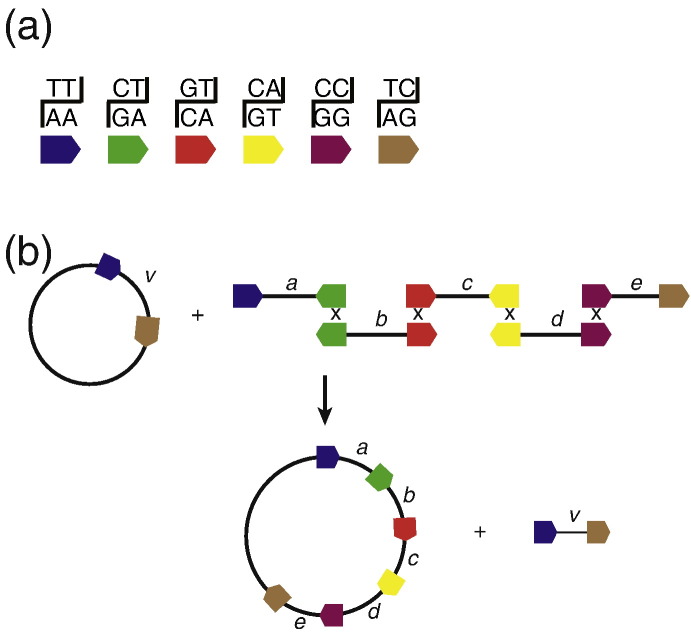
Use of serine integrases for DNA assembly. Attachment sites will only recombine if their dinucleotides involved in the staggered break can base pair in the recombinants (Fig. 3). It is therefore possible to match attP and attB sites together with identity of the two nucleotide bases at the crossover site. (a) Six possible dinucleotides at the centre of the attachment sites for use with ϕC31 integrase have been colour-coded. Thus, only attP and attB with the code navy blue will recombine, only those with the code green will recombine and so on (note that attP or attB sites do not recombine with themselves). (b) Use of the dinucleotide specificity to assembly DNA in a predictable and ordered way. The five DNA fragments shown here encoding five different fragments encoding either single or multiple genes from a metabolic pathway can be recombined together using a single integrase in an in vitro recombination reaction. Addition of the sixth fragment containing the vector allows the assembly to be amplified in E. coli. Adapted from Colloms et al. with permission.
Fig. 5
Fig. 5
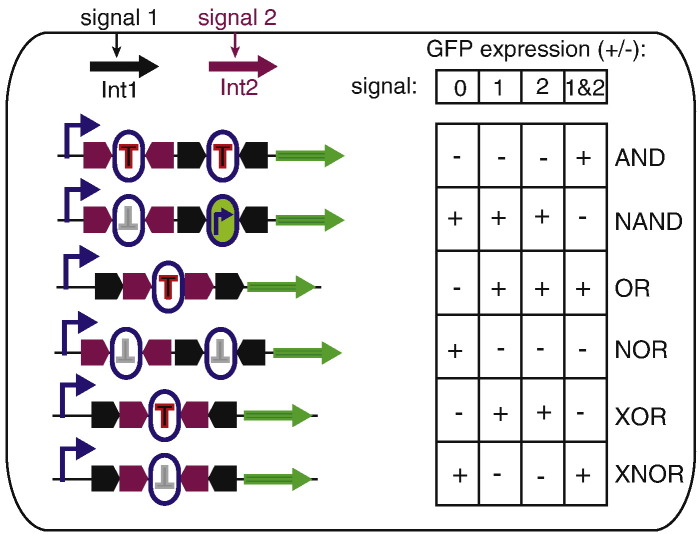
Using integrases to construct Boolean logic gates in E. coli. Extracellular signals activate the synthesis of two different integrases (Int1 and Int2) that have different cognate and non-cross-reacting recombination sites (shown as either pink or black block arrows). If the recombination sites are oriented head to head, inversion occurs (AND, NAND, NOR, XOR and XNOR gates), but if they are head to tail, deletion occurs (OR gate). Between the recombination sites is either a unidirectional transcription terminator (red T in oval when active; grey inverted T when inactive) or a promoter (black arrow inside the green oval). The green arrow represents a reporter gene such as EGFP. Adapted from Bonnet et al. with permission.

References

    1. Suttle C.A. Marine viruses—major players in the global ecosystem. Nat Rev Microbiol. 2007;5:801–812. - PubMed
    1. Hambly E., Suttle C.A. The viriosphere, diversity, and genetic exchange within phage communities. Curr Opin Microbiol. 2005;8:444–450. - PubMed
    1. Ptashne M. 3rd ed. Cold Spring Harbor Laboratory Press; Cold Spring Harbor, NY: 2004. A genetic switch: phage lambda revisited.
    1. Smith M.C.M. Conservative site-specific recombination. In: Lennarz W.J., Lane M.D., editors. vol. 1. Academic Press; Waltham, MA: 2013. pp. 555–561. (Encyclopedia of Biological Chemistry).
    1. Campbell A.M. Episomes. Adv Genet Inc Mol Genet Med. 1962;11:101–145.

Publication types