


Increasing water use efficiency along the C3 to C4 evolutionary pathway: a stomatal optimization perspective
- PMID: 24860185
- PMCID: PMC4085968
- DOI: 10.1093/jxb/eru205
Increasing water use efficiency along the C3 to C4 evolutionary pathway: a stomatal optimization perspective
Abstract
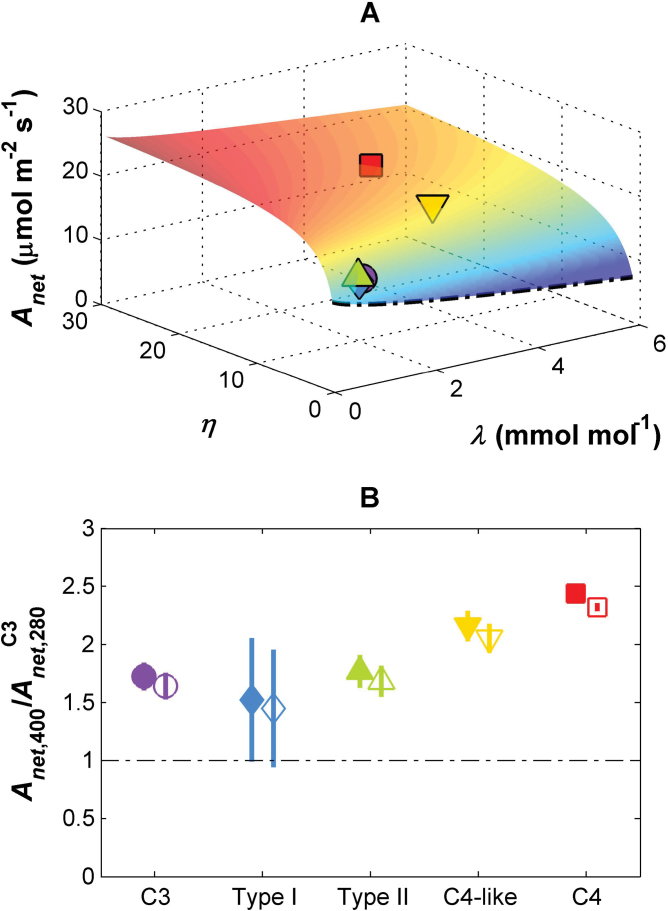
C4 photosynthesis evolved independently numerous times, probably in response to declining atmospheric CO2 concentrations, but also to high temperatures and aridity, which enhance water losses through transpiration. Here, the environmental factors controlling stomatal behaviour of leaf-level carbon and water exchange were examined across the evolutionary continuum from C3 to C4 photosynthesis at current (400 μmol mol(-1)) and low (280 μmol mol(-1)) atmospheric CO2 conditions. To this aim, a stomatal optimization model was further developed to describe the evolutionary continuum from C3 to C4 species within a unified framework. Data on C3, three categories of C3-C4 intermediates, and C4 Flaveria species were used to parameterize the stomatal model, including parameters for the marginal water use efficiency and the efficiency of the CO2-concentrating mechanism (or C4 pump); these two parameters are interpreted as traits reflecting the stomatal and photosynthetic adjustments during the C3 to C4 transformation. Neither the marginal water use efficiency nor the C4 pump strength changed significantly from C3 to early C3-C4 intermediate stages, but both traits significantly increased between early C3-C4 intermediates and the C4-like intermediates with an operational C4 cycle. At low CO2, net photosynthetic rates showed continuous increases from a C3 state, across the intermediates and towards C4 photosynthesis, but only C4-like intermediates and C4 species (with an operational C4 cycle) had higher water use efficiencies than C3 Flaveria. The results demonstrate that both the marginal water use efficiency and the C4 pump strength increase in C4 Flaveria to improve their photosynthesis and water use efficiency compared with C3 species. These findings emphasize that the advantage of the early intermediate stages is predominantly carbon based, not water related.
Keywords: C3 photosynthesis; C3–C4 intermediates; leaf gas exchange; photosynthetic model; stomatal conductance; water use efficiency..
© The Author 2014. Published by Oxford University Press on behalf of the Society for Experimental Biology.
Figures




References
-
- Busch FA, Sage TL, Cousins AB, Sage RF. 2013. C3 plants enhance rates of photosynthesis by reassimilating photorespired and respired CO2 . Plant, Cell and Environment 36, 200–212 - PubMed
-
- Campbell GS, Norman JM. 1998. An introduction to environmental biophysics, 2nd edn Berlin: Springer
-
- Campbell CD, Sage RF, Kocacinar F, Way DA. 2005. Estimation of the whole-plant CO2 compensation point of tobacco (Nicotiana tabacum L.). Global Change Biology 11, 1956–1967
-
- Cheng L, Fuchigami LH, Breen PJ. 2001. The relationship between photosystem II efficiency and quantum yield for CO2 assimilation is not affected by nitrogen content in apple leaves. Journal of Experimental Botany 52, 1865–1872 - PubMed
-
- Christin PA, Osborne CP, Sage RF, Arakaki M, Edwards EJ. 2011. C4 eudicots are not younger than C4 monocots. Journal of Experimental Botany 62, 3171–3181 - PubMed
Publication types
MeSH terms
Substances
LinkOut - more resources
Full Text Sources
Other Literature Sources
Miscellaneous
