Review
. 2014 May 13:5:213.
doi: 10.3389/fmicb.2014.00213. eCollection 2014.

Retrospective and prospective perspectives on zoonotic brucellosis

Affiliations
Review

Retrospective and prospective perspectives on zoonotic brucellosis

Edgardo Moreno. Front Microbiol. .

Abstract

Members of the genus Brucella are pathogenic bacteria exceedingly well adapted to their hosts. The bacterium is transmitted by direct contact within the same host species or accidentally to secondary hosts, such as humans. Human brucellosis is strongly linked to the management of domesticated animals and ingestion of their products. Since the domestication of ungulates and dogs in the Fertile Crescent and Asia in 12000 and 33000 ya, respectively, a steady supply of well adapted emergent Brucella pathogens causing zoonotic disease has been provided. Likewise, anthropogenic modification of wild life may have also impacted host susceptibility and Brucella selection. Domestication and human influence on wild life animals are not neutral phenomena. Consequently, Brucella organisms have followed their hosts' fate and have been selected under conditions that favor high transmission rate. The "arm race" between Brucella and their preferred hosts has been driven by genetic adaptation of the bacterium confronted with the evolving immune defenses of the host. Management conditions, such as clustering, selection, culling, and vaccination of Brucella preferred hosts have profound influences in the outcome of brucellosis and in the selection of Brucella organisms. Countries that have controlled brucellosis systematically used reliable smooth live vaccines, consistent immunization protocols, adequate diagnostic tests, broad vaccination coverage and sustained removal of the infected animals. To ignore and misuse tools and strategies already available for the control of brucellosis may promote the emergence of new Brucella variants. The unrestricted use of low-efficacy vaccines may promote a "false sense of security" and works towards selection of Brucella with higher virulence and transmission potential.

Keywords: Brucella; Brucella-vaccines; brucellosis; domestication; zoonosis.


Figures
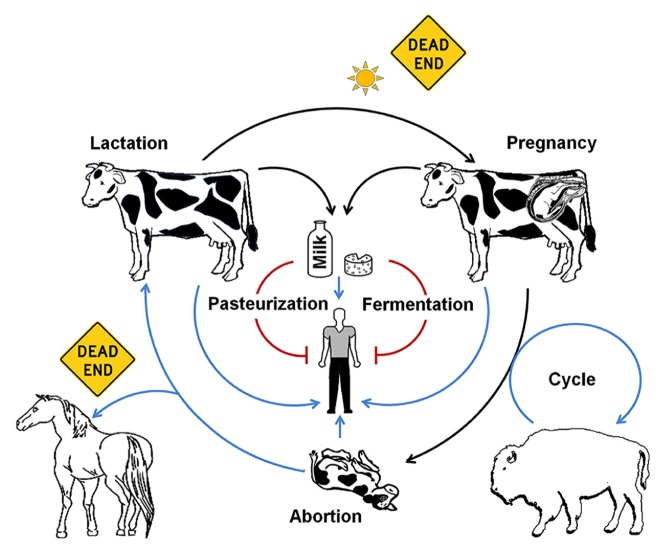
FIGURE 1
FIGURE 1
Brucella (B. abortus) life host cycle. After host infection the invading Brucella replicates within cells of the reticuloendothelial system where it remains for a protracted period of time. After pregnancy, the bacterium invades trophoblasts and the mammary gland. In these sites the bacterium extensively replicates inducing abortion and shedding through milk (black arrows). The heavy contaminated placenta and fetus become the main source of infection for humans and other animal hosts (blue arrows). Humans may acquire the bacterium through ingestion of unpasteurized dairy products. Brucella may live up to several weeks, as long as enough organic material is available and the bacterium is protected from the sun’s rays. When exposed to sun’s rays in the open, Brucella organisms steadily die (doted black arrow). Pasteurization or fermentation of dairy products eliminates Brucella organisms and the risk of human contamination (red blunt arrows). Cross contamination of wild life animals (e.g., bison at lower right) may maintain the bacteria cycling within wild herds, and then of epidemiological relevance. Humans and other animals (e.g., horses) are considered dead ends for the bacterium, and therefore there are not of epidemiological relevance.
FIGURE 2
FIGURE 2
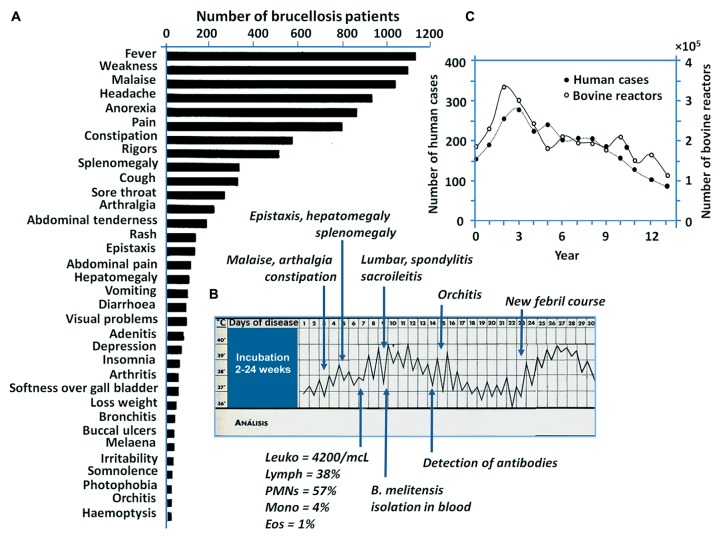
Brucellosis in humans. (A) The bar graphic displays the most frequent 34 signs of brucellosis recorded in 1500 patients with proved disease (adapted from Dalrymple-Champneys, 1960). (B) The clinical chart displays the typical “undulant fever” suffered by one patient with subsequent clinical signs of brucellosis (adapted from Pedro-Pons et al., 1968). (C) Human brucellosis cases and bovines displaying positive Brucella infections in United States during 13 year lapse period (1976–1986; adapted from Nicoletti, 1989). In contrast to the silent course of brucellosis in non-pregnant domestic animals, brucellosis in humans courses with a broad collection of clinical symptoms. Notice that the increase and decrease of human brucellosis cases roughly correlates with the increase or decrease of the infection in cattle.
FIGURE 3
FIGURE 3
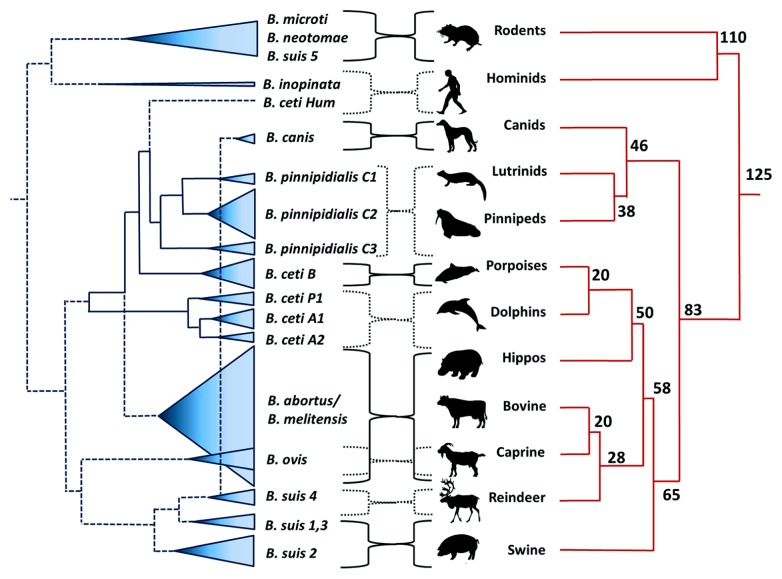
Dispersion of Brucella species confronted to the phylogeny of their preferred host mammal. The dispersion of the various Brucella species is depicted as cones proportional to the number of strains analyzed. The numbers in the mammal phylogenetic tree represent millions of years. B. suis biovar 2 also has affinity for hares (lagomorphos). B. ceti Hum (human type) does not correspond phylogenetically to B. ceti group and this single isolate requires taxonomic definition. The source of the two isolates of B. inopinata is unknown. Notice that phylogenetic relationship between the two clades is not perfect suggesting that carnivore mammals acquire brucellosis (probably by depredation) after the initial dispersion of cetaceans and ungulates from an ancestral mesonychid, close to 65–60 million ya. Phylogenetic dendrogram was adapted from Guzmán-Verri et al. (2012).
FIGURE 4
FIGURE 4
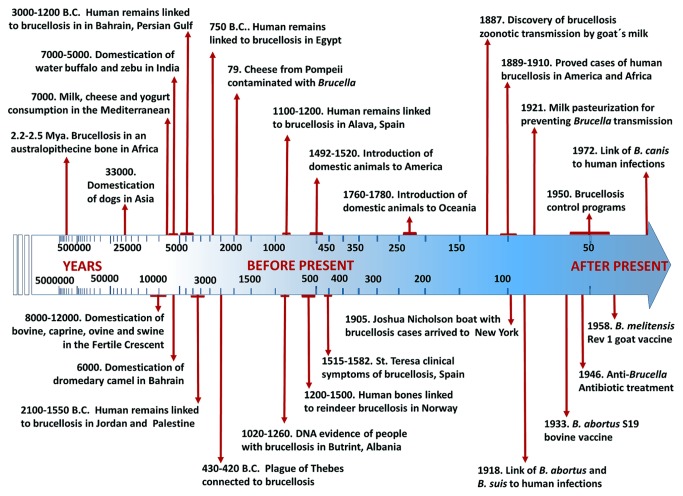
Timeline of events associated with zoonotic brucellosis. The scale increases logarithmically from 5 million years in the past to 50 years estimated as the “present” (in 1950). Dates are designated as indicated in the main text.
FIGURE 5
FIGURE 5
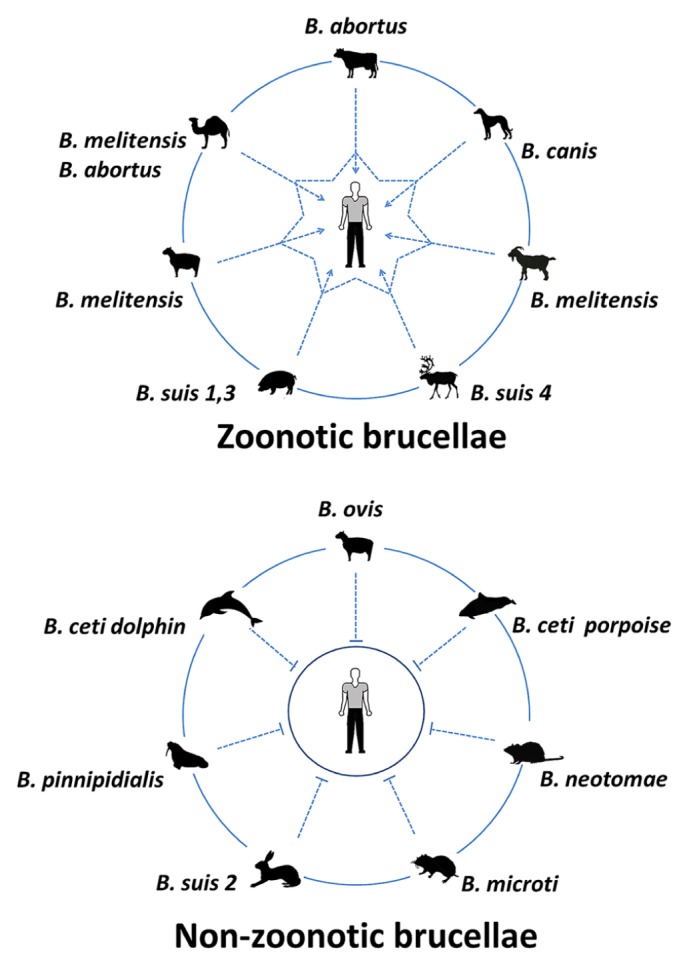
Zoonotic and non-zoonotic Brucella species. The most virulent species with higher zoonotic spectrum are those from domesticated animals; while those displaying lower pathogenicity and zoonotic potential are those from wild life animals. One exception is B. ovis which is a pathogen for rams and does not infect other hosts.
FIGURE 6
FIGURE 6
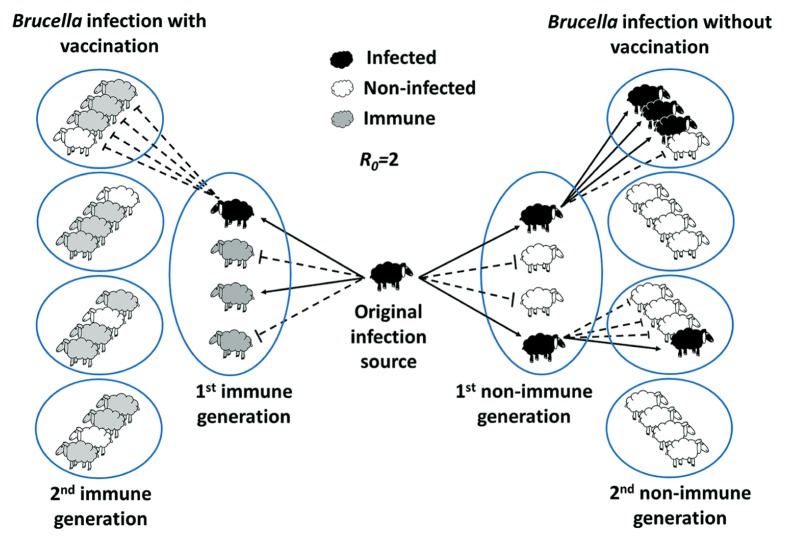
Herd immunity theory and the basic reproductive ratio (R0) in Brucella herd infections. Herd immunity theory proposes that the protective effect of Brucella vaccinated individuals in a given population extends beyond to unvaccinated population. R0 corresponds to the average number of new Brucella infections caused by single infected source. If acquired immunity is present in the herd, the population is no longer entirely susceptible. The greater the proportion of individuals is immune to Brucella, the smaller the probability that a susceptible host will come into contact with an infectious animal. Then, the transmission from one animal to other is likely to be disrupted when an appropriate number of the population (predicted on the basis of R0) are immune to the bacterium. For instance, if R0 = 2 (an estimated R0 for B. melitensis transmission in sheep), then a geometric increase in infections occurs over time (right panel). If 75% of the population is protected by the vaccine (minimal protection rate estimated for Rev1 vaccine), then the bacteria fails to grow in the host animal and be transmitted (left panel). It is predicted that vaccines with lower protection rate require larger coverture and greater actions of culling of the animals. New productive infections are depicted by black solid arrows; unproductive transmission is indicated by dashed blunt arrows.
FIGURE 7
FIGURE 7
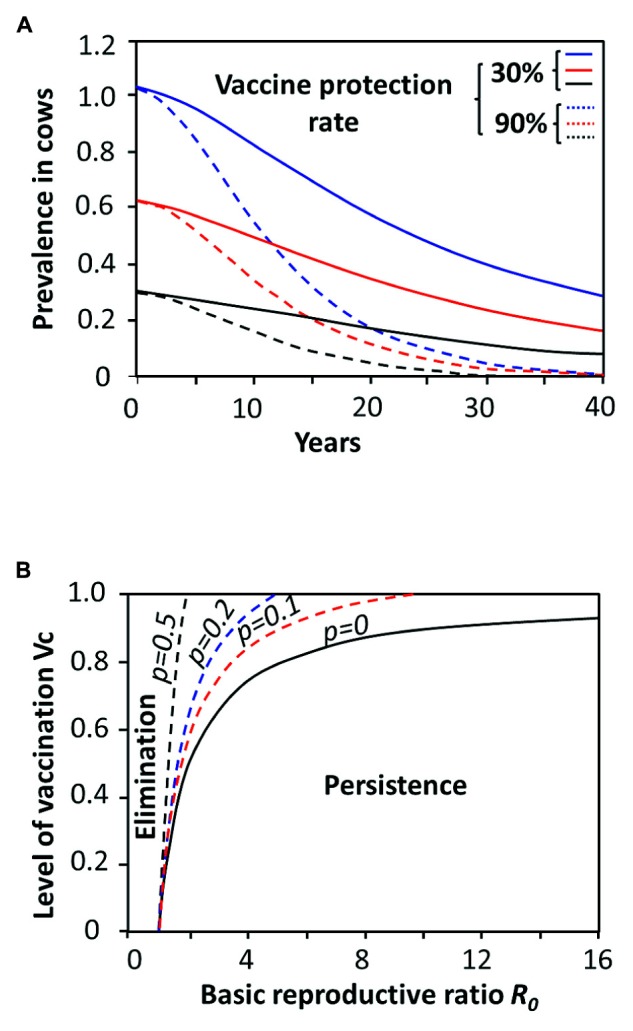
Sceneries for vaccine performances against brucellosis according to various models. (A) Predicted model for bovine brucellosis eradication in Mato Grosso (blue), Rodôni (red), and Goiás (black) Brazilian States with different experimental prevalences using two vaccine protection rates. Protection rate by low-efficacy vaccines or low coverage vaccination are not capable to eradicate brucellosis in four decades (solid lines), independently of the initial prevalence. The critical threshold applies to both: (i) the proportion of the population that needs to be vaccinated, and; (ii) the protective quality of the vaccine (adapted from Amaku et al., 2009). (B) Prediction for the elimination or persistence or of brucellosis according to R0 and the critical level of vaccination Vc. The Vc needed to protect a given population of animals is calculated by Vc = 1 - 1/R0. Those vaccines that fail to generate immunity in a fraction p of the immunized individuals, require higher coverage defined by R0 - 1/R0(1 - p). However, if p is too big it may be impossible to eradicate the Brucella infection. Parameters such as culling of the infected animals and diminishing of the density of the susceptible animals have a significant impact in both (A) and (B) since by reducing the value of p (not shown). The solid black line represents the outcome of an ideal no “leaking” vaccine (adapted from Keeling et al., 2013).
FIGURE 8
FIGURE 8
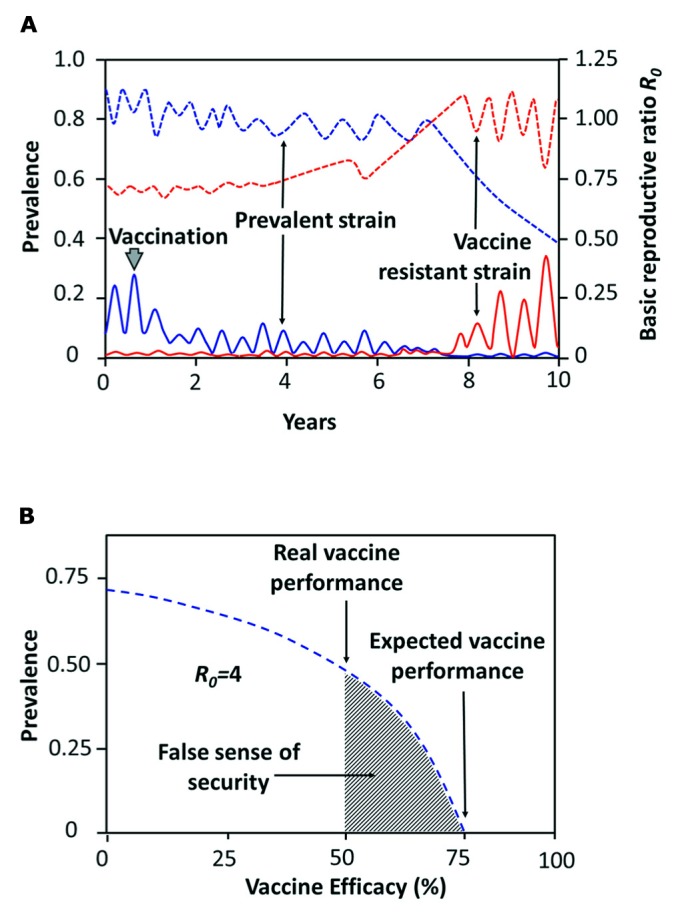
Prediction for emergence of resistant-vaccine Brucella strains and the false sense of security. (A) Immunization with low efficacy vaccines may change the competitive balance between Brucella virulent strains. Before vaccination (6–8 months of age) one prevalent strain is observed (blue line). After vaccination of 100% of the susceptible animals with a low efficacy vaccine that only gives 30–40% protection rate, the vaccine-resistant strain (red line) may eventually emerge with a competitive advantage that is only evident after a large proportion of the population has been vaccinated over the years. The vaccine resistant-strain arises from the Brucella pool, either through mutation of the prevalent strain or by selection of previously existing strains. Only after the R0 of the vaccine-resistant strain has exceeded that of the prevalent strain, then a new brucellosis epidemic event develops. Solid blue and red lines correspond to the prevalence ordinate; dashed lines correspond to the R0 ordinate (adapted from Scherer and McLean, 2002). (B) Reduction in brucellosis prevalence below the critical vaccination threshold (expected vaccine performance) with an anti-Brucella vaccine efficacy of 75% and R0 = 4. In a bovine close homogeneous population a lower value for R0 would be associated with a lower Brucella prevalence. The false sense of security (shadow area) for a given vaccine lays between the expected vaccine performance (e.g., 75%) and the real vaccine performance (e.g., 50%).

Comment in

References

    1. Abdel-Maksoud M., House B., Wasfy M., Abdel-Rahman B., Pimentel G., Roushdy G., et al. (2012). In vitro antibiotic susceptibility testing of Brucella isolates from Egypt between 1999 and 2007 and evidence of probable rifampin resistance. Ann. Clin. Microbiol. Antimicrob. 11 24 10.1186/1476-0711-11-24 - DOI - PMC - PubMed
    1. Adams G., Schutta C. J. (2010). Natural resistance against brucellosis: a review. Open Vet. Sci. J. 4 61–71
    1. Adone R., Ciuchini F., Marianelli C., Tarantino M., Pistoia C., Marcon G., et al. (2005). Protective properties of rifampin-resistant rough mutants of Brucella melitensis. Infect. Immun. 73 4198–4204 10.1128/IAI.73.7.4198-4204.2005 - DOI - PMC - PubMed
    1. Ahmetagic S., Tihic N., Ahmetagic A., Custovic A., Smriko-Nuhanovic A., Mehinovic N., et al. (2012). Human brucellosis in Tuzla Canton. Med. Arh. 66 309–314 10.5455/medarh.2012.66.309-314 - DOI - PubMed
    1. Al Dahouk S., Hofer E., Tomaso H., Vergnaud G., Le Flèche P., Cloeckaert A., et al. (2012). Intraspecies biodiversity of the genetically homologous species Brucella microti. Appl. Environ. Microbiol. 78 1534–1543 10.1128/AEM.06351-11 - DOI - PMC - PubMed