


Calcium kinetics during bed rest with artificial gravity and exercise countermeasures
- PMID: 24861908
- PMCID: PMC4521405
- DOI: 10.1007/s00198-014-2754-x
Calcium kinetics during bed rest with artificial gravity and exercise countermeasures
Abstract
We assessed the potential for countermeasures to lessen the loss of bone calcium during bed rest. Subjects ingested less calcium during bed rest, and with artificial gravity, they also absorbed less calcium. With exercise, they excreted less calcium. To retain bone during bed rest, calcium intake needs to be maintained.
Introduction: This study aims to assess the potential for artificial gravity (AG) and exercise (EX) to mitigate loss of bone calcium during space flight.
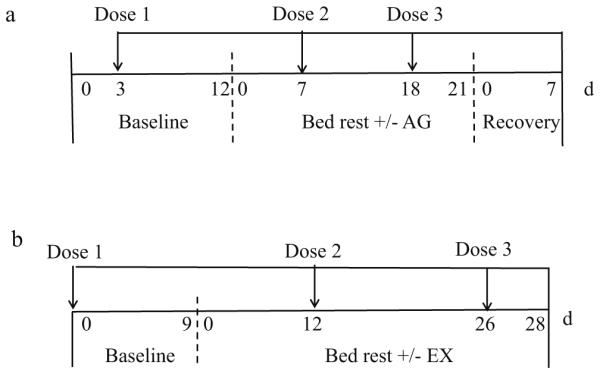
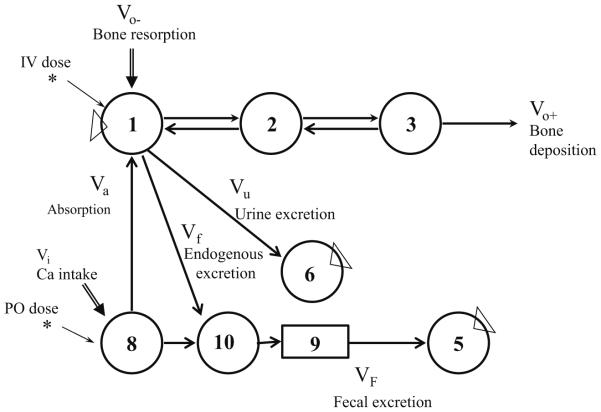
Methods: We performed two studies: (1) a 21-day bed rest (BR) study with subjects receiving 1 h/day AG (n = 8) or no AG (n = 7) and (2) a 28-day BR study with 1 h/day resistance EX (n = 10) or no EX (n = 3). In both studies, stable isotopes of Ca were administered orally and intravenously, at baseline and after 10 days of BR, and blood, urine, and feces were sampled for up to 14 days post dosing. Tracers were measured using thermal ionization mass spectrometry. Data were analyzed by compartmental modeling.
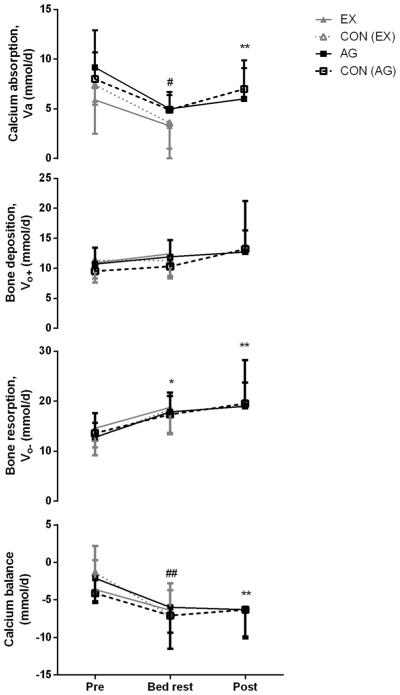
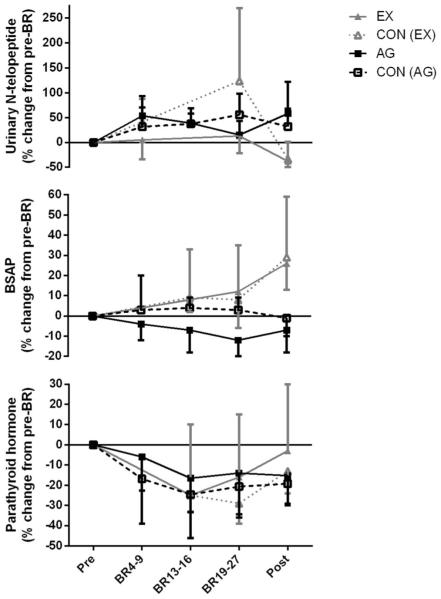
Results: Less Ca was absorbed during BR, resulting in lower Ca balance in BR+AG (-6.04 ± 3.38 mmol/day, P = 0.023). However, Ca balance did not change with BR+EX, even though absorbed Ca decreased and urinary Ca excretion increased, because endogenous excretion decreased, and there was a trend for increased bone deposition (P = 0.06). Urinary N-telopeptide excretion increased in controls during BR, but not in the EX group. Markers of bone formation were not different between treatment groups for either study. Ca intake decreased during BR (by 5.4 mmol/day in the AG study and 2.8 mmol/day in the EX study), resulting in lower absorbed Ca.
Conclusions: During BR (or space flight), Ca intake needs to be maintained or even increased with countermeasures such as exercise, to enable maintenance of bone Ca.
Figures
References
-
- Smith SM, Heer MA, Shackelford L, Sibonga JD, Ploutz-Snyder L, Zwart SR. Benefits for bone from resistance exercise and nutrition in long-duration spaceflight: evidence from biochemistry and densitometry. J Bone Miner Res. 2012;27:1896–1906. - PubMed
-
- Smith SM, Zwart SR, Heer M, Hudson EK, Shackelford L, Morgan JL. Men and women in space: bone loss and kidney stone risk after long-duration spaceflight. J Bone Miner Res. 2014 doi:10.1002/jbmr.2185. - PubMed
-
- Shackelford LC, LeBlanc AD, Driscoll TB, Evans HJ, Rianon NJ, Smith SM, Spector E, Feeback DL, Lai D. Resistance exercise as a countermeasure to disuse-induced bone loss. J Appl Physiol. 2004;97:119–129. - PubMed
-
- Smith SM, Zwart SR, Heer M, Lee SMC, Baecker N, Meuche S, Macias BR, Shackelford LC, Schneider S, Hargens AR. WISE-2005: supine treadmill exercise within lower body negative pressure and flywheel resistive exercise as a countermeasure to bed rest-induced bone loss in women during 60-day simulated microgravity. Bone. 2008;42:572–581. - PubMed
-
- Armbrecht G, Belavy DL, Gast U, Bongrazio M, Touby F, Beller G, Roth HJ, Perschel FH, Rittweger J, Felsenberg D. Resistive vibration exercise attenuates bone and muscle atrophy in 56 days of bed rest: biochemical markers of bone metabolism. Osteoporos Int. 2010;21:597–607. - PubMed
Publication types
MeSH terms
Substances
Grants and funding
LinkOut - more resources
Full Text Sources
Other Literature Sources
Medical
