Vitamin D deficiency remains prevalent despite increased laboratory testing in New South Wales, Australia
- PMID: 24862752
- PMCID: PMC4291993
- DOI: 10.11622/smedj.2014071
Vitamin D deficiency remains prevalent despite increased laboratory testing in New South Wales, Australia
Abstract
Introduction: The aim of the present study was to assess the prevalence of vitamin D deficiency and toxicity, the frequency of 25-hydroxyvitamin D (25[OH]D) testing, and 25(OH)D variations with respect to patient gender, patient age and season in New South Wales, Australia.
Methods: A retrospective analysis of pathology records was performed to ascertain patient age, patient gender, sample collection date, plasma or serum 25(OH)D levels, calcium and parathyroid hormone (PTH) levels, and test numbers between 2001 and 2010. Linear regression with Bonferroni correction was used to calculate and compare age-adjusted mean 25(OH)D levels. Relationships of 25(OH)D with PTH and calcium were tested using Spearman's rank correlation.
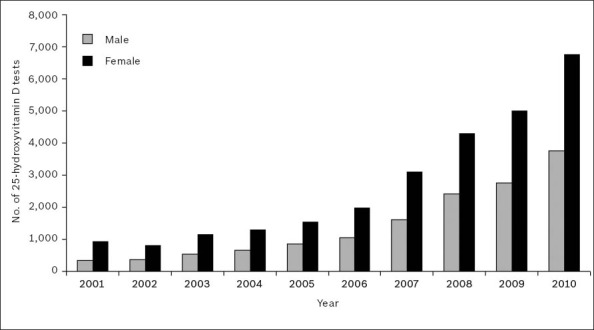
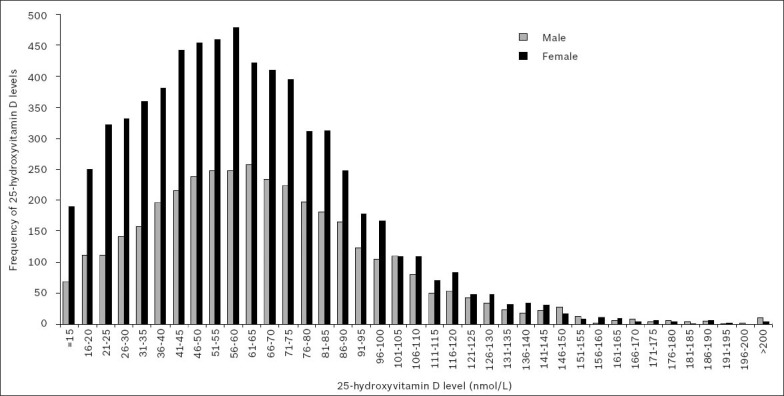
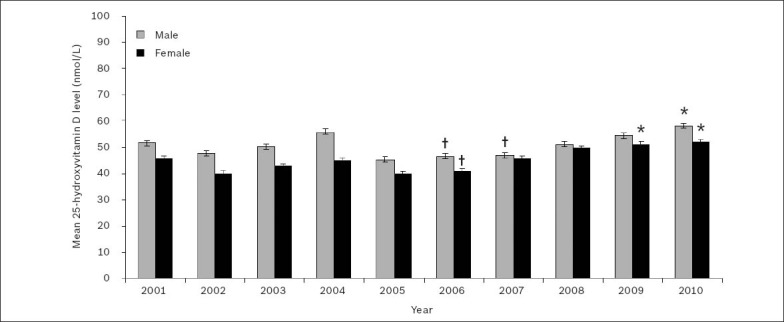
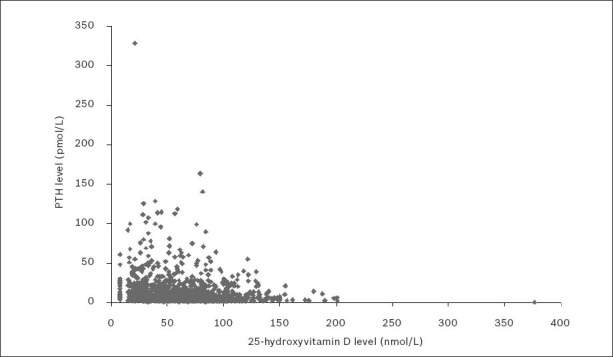
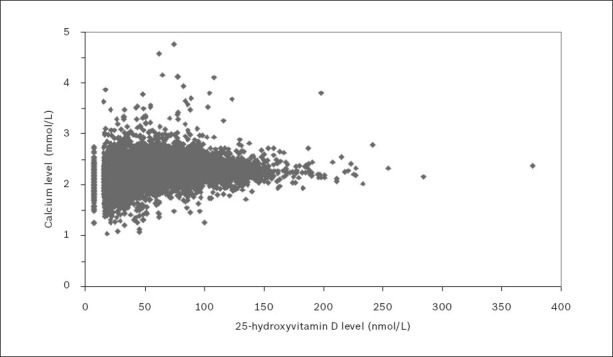
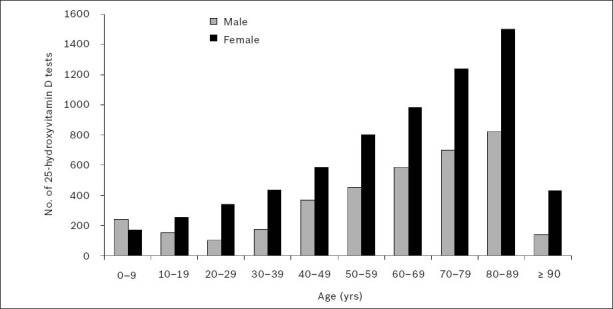
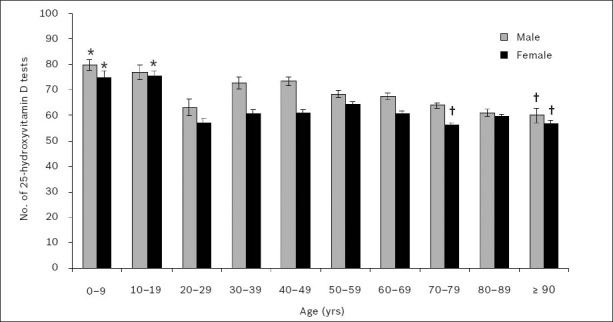
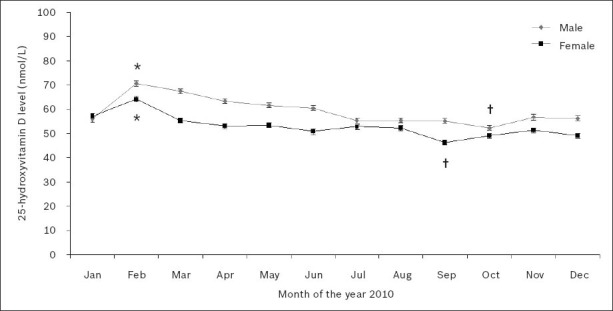
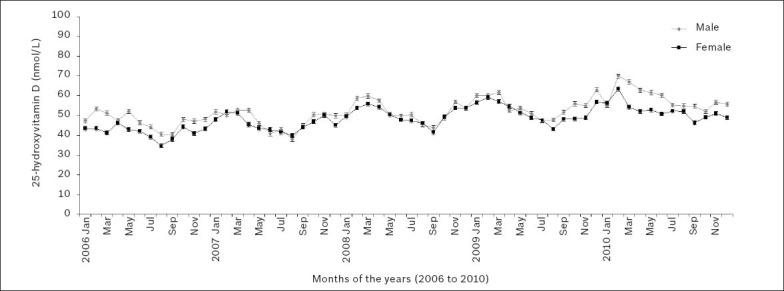
Results: 25(OH)D testing increased by 730% over the ten-year study period. In 2010, many men (33%) and women (40%) were, to some degree, vitamin D deficient (≤ 50 nmol/L). Vitamin D toxicity was rare, with only one instance noted. 25(OH)D levels correlated positively with calcium and negatively with PTH levels. 25(OH)D levels decreased with age. In 2010, 25(OH)D levels were highest in February and lowest in September/October. Cyclical variation was observed for 25(OH)D levels between 2006 and 2010.
Conclusion: We found that vitamin D deficiency was prevalent in both men and women, with a higher prevalence in the latter, despite the substantial increased demand for 25(OH)D testing in our population over the decade. Vitamin D deficiency was associated with elevated PTH levels. Vitamin D toxicity was rare and only observed once during our study period. 25(OH)D levels decreased with age and varied with season, with the highest levels observed in late summer and the lowest in early spring.
Figures
References
-
- Holick MF. High prevalence of vitamin D inadequacy and implications for health. Mayo Clin Proc. 2006;81:353–73. - PubMed
-
- Stroud ML, Stilgoe S, Stott VE, Alhabian O, Salman K. Vitamin D - a review. Aust Fam Physician. 2008;37:1002–5. - PubMed
-
- Omdahl JL, Morris HA, May BK. Hydroxylase enzymes of the vitamin D pathway: expression, function, and regulation. Annu Rev Nutr. 2002;22:139–66. - PubMed
-
- Prosser DE, Jones G. Enzymes involved in the activation and inactivation of vitamin D. Trends Biochem Sci. 2004;29:664–73. - PubMed
MeSH terms
Substances
LinkOut - more resources
Full Text Sources
Medical