. 2014 Apr;16(4):319-28.
doi: 10.1016/j.neo.2014.04.002.

Antitumor immunity induced after α irradiation

Affiliations

Antitumor immunity induced after α irradiation

Jean-Baptiste Gorin et al. Neoplasia. 2014 Apr.

Abstract

Radioimmunotherapy (RIT) is a therapeutic modality that allows delivering of ionizing radiation directly to targeted cancer cells. Conventional RIT uses β-emitting radioisotopes, but recently, a growing interest has emerged for the clinical development of α particles. α emitters are ideal for killing isolated or small clusters of tumor cells, thanks to their specific characteristics (high linear energy transfer and short path in the tissue), and their effect is less dependent on dose rate, tissue oxygenation, or cell cycle status than γ and X rays. Several studies have been performed to describe α emitter radiobiology and cell death mechanisms induced after α irradiation. But so far, no investigation has been undertaken to analyze the impact of α particles on the immune system, when several studies have shown that external irradiation, using γ and X rays, can foster an antitumor immune response. Therefore, we decided to evaluate the immunogenicity of murine adenocarcinoma MC-38 after bismuth-213 ((213)Bi) irradiation using a vaccination approach. In vivo studies performed in immunocompetent C57Bl/6 mice induced a protective antitumor response that is mediated by tumor-specific T cells. The molecular mechanisms potentially involved in the activation of adaptative immunity were also investigated by in vitro studies. We observed that (213)Bi-treated MC-38 cells release "danger signals" and activate dendritic cells. Our results demonstrate that α irradiation can stimulate adaptive immunity, elicits an efficient antitumor protection, and therefore is an immunogenic cell death inducer, which provides an attractive complement to its direct cytolytic effect on tumor cells.


Figures

Figure 1
Figure 1
Tumor cells irradiated with 213Bi give rise to antitumor protection in vivo. (A and B) Tumor volume progression for control (A) and immunized mice (B) after MC-38 engraftment. Volume was calculated as (length × width × height × π)/6. (C) Kaplan-Meier analysis of mice immunized with 213Bi-treated cells (square) versus control C57Bl/6 (circles) after subcutaneous challenge with 2 × 10⁵ live MC-38. Median survival was 37 days for controls and was not reached for the immunized group. P value determined by the log-rank test was extremely significant (P < .0001). (D) Tumor-free fraction of mice after a second challenge with live MC38. P < .0001.
Figure 2
Figure 2
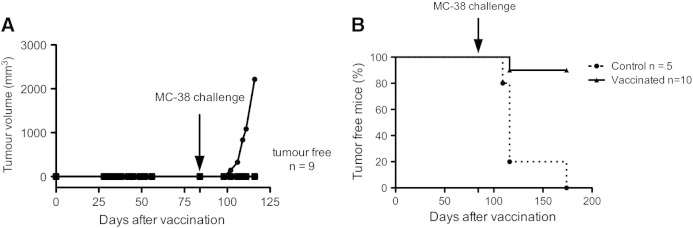
Tumor cells irradiated with 213Bi do not give rise to tumors and allow for long-term antitumor protection. (A and B) Tumor volume progression for vaccinated mice (A), which did not receive live MC-38 engraftment before day 84. Kaplan-Meier analysis of mice immunized with 213Bi-treated cells (triangles) versus control C57Bl/6 (circles) after subcutaneous challenge with 2 × 10⁵ live MC-38. P value determined by the log-rank test was highly significant (P < .0001).
Figure 3
Figure 3
Immunization with α-irradiated MC38 fails in nude mice. (A and B) Tumor volume progression for control (n = 5) (A) and immunized nude mice (n = 5) (B) after MC38 engraftment. (C) Kaplan-Meier analysis of mice immunized with 213Bi-treated cells (square) versus control nude mice (circles) after subcutaneous challenge with 2 × 10⁵ live MC-38. Median survival was 13 days for both the control and immunized groups. P = .5716.
Figure 4
Figure 4
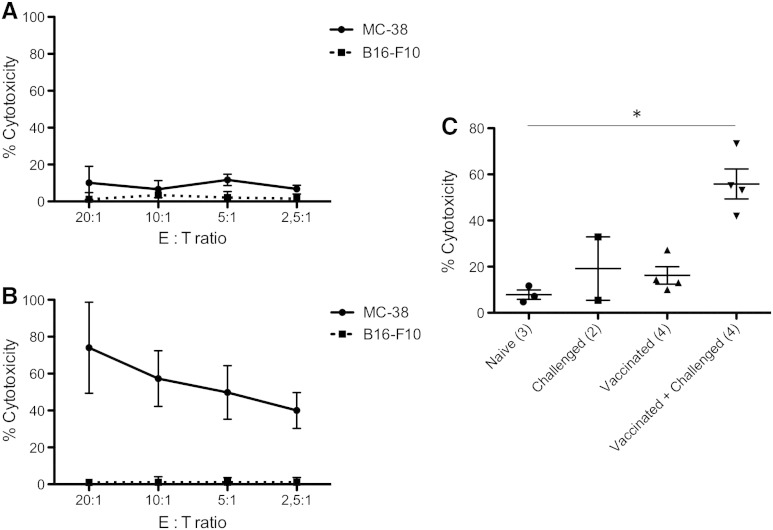
Antitumor response is dependent on cytotoxic T cells. (A and B) 51Cr release assay against MC-38 or the irrelevant cell line B16-F10 was performed on T cells purified from naïve mice (A) or mice that had been immunized with 213Bi-treated MC-38 and subsequently challenged with live MC-38 (B). Assays were performed at different E:T ratios ; data points represent means ± SD of triplicate measurements for three naïve mice (A) and four vaccinated + challenged mice (B). (C) Scatterplot of mean percentage of T cell cytotoxicity against MC-38 at the E:T ratio of 10:1 for different groups of mice. In parentheses, number of mice in each group. P < .05 between naïve mice and mice that have been immunized and challenged. P value was determined by nonparametric Mann-Whitney test. Mean cytotoxicity was 7.87% for naïve mice, 19.15% for challenged mice, 16.2% for vaccinated mice, and 55.85% for vaccinated + challenged mice.
Figure 5
Figure 5
213Bi-irradiated MC-38 elicit DC maturation. (A–C) Triplicate analysis of RFI for CD40 (A), CD80 (B), and CD86 (C). RFI is calculated as geometric mean of fluorescence intensity of the specific antibody divided by that of the control isotype. (D and E) Snapshot of BMDC after 24 hours in culture with 5 × 10⁶ control MC38 (D) or 5 × 10⁶ irradiated MC-38 (E). *P ≤ .05 determined using Mann-Whitney nonparametric test.
Figure 6
Figure 6
DAMP release after irradiation. (A and B) Evolution of Hsp70 (A) and HMGB1 (B) concentrations determined by ELISA on MC-38 conditioned media after irradiation with 213Bi (squares) and on controls (circles). Data points represent means ± SD of triplicate measurements. ***P < .001 as determined by two-way analysis of variance and Bonferonni posttests. Results are representative of two independent experiments.

References

    1. Goldberg Z., Lehnert B.E. Radiation-induced effects in unirradiated cells: a review and implications in cancer. Int J Oncol. 2002;21:337–349. - PubMed
    1. Morgan W.F. Is there a common mechanism underlying genomic instability, bystander effects and other nontargeted effects of exposure to ionizing radiation? Oncogene. 2003;22:7094–7099. - PubMed
    1. Mothersill C., Seymour C.B. Radiation-induced bystander effects—implications for cancer. Nat Rev Cancer. 2004;4:158–164. - PubMed
    1. Barbet J., Bardiès M., Bourgeois M., Chatal J.F., Chérel M., Davodeau F., Faivre-Chauvet A., Gestin J.F., Kraeber-Bodéré F. Radiolabeled antibodies for cancer imaging and therapy. Methods Mol Biol. 2012;907:681–697. - PubMed
    1. Sharkey R.M., Goldenberg D.M. Cancer radioimmunotherapy. Immunotherapy. 2011;3:349–370. - PMC - PubMed

Publication types

Substances