Impact of detubulation on force and kinetics of cardiac muscle contraction
- PMID: 24863933
- PMCID: PMC4035744
- DOI: 10.1085/jgp.201311125
Impact of detubulation on force and kinetics of cardiac muscle contraction
Abstract
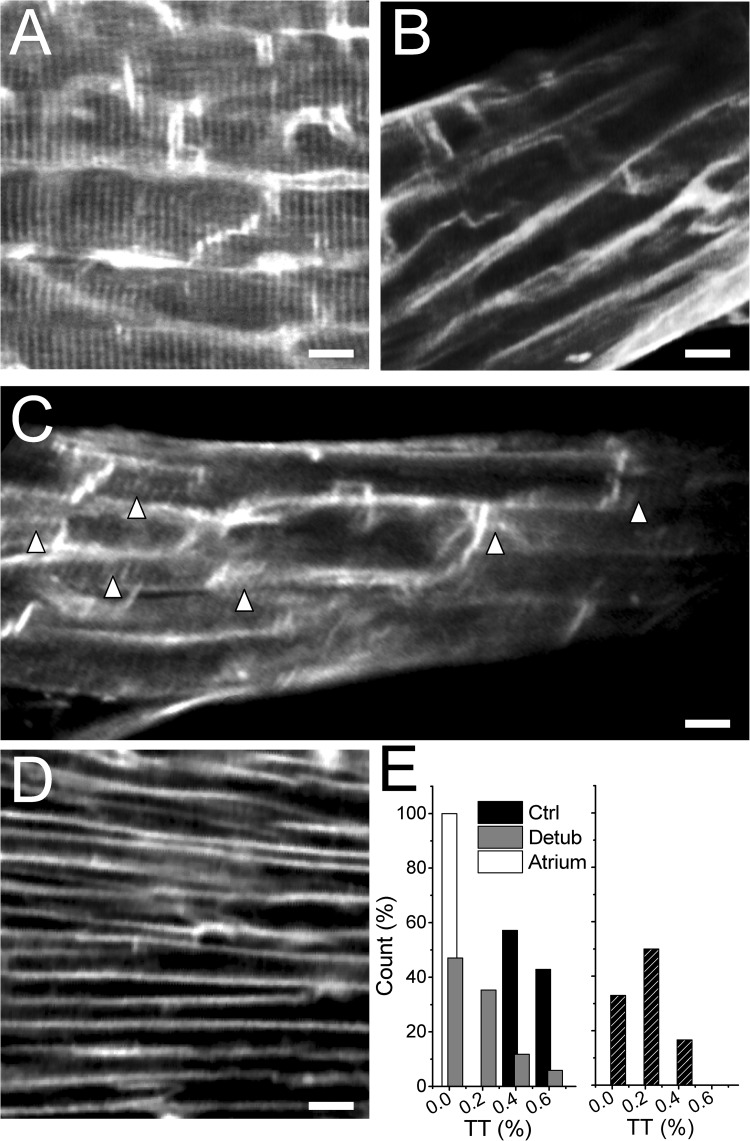
Action potential-driven Ca(2+) currents from the transverse tubules (t-tubules) trigger synchronous Ca(2+) release from the sarcoplasmic reticulum of cardiomyocytes. Loss of t-tubules has been reported in cardiac diseases, including heart failure, but the effect of uncoupling t-tubules from the sarcolemma on cardiac muscle mechanics remains largely unknown. We dissected intact rat right ventricular trabeculae and compared force, sarcomere length, and intracellular Ca(2+) in control trabeculae with trabeculae in which the t-tubules were uncoupled from the plasma membrane by formamide-induced osmotic shock (detubulation). We verified disconnection of a consistent fraction of t-tubules from the sarcolemma by two-photon fluorescence imaging of FM4-64-labeled membranes and by the absence of tubular action potential, which was recorded by random access multiphoton microscopy in combination with a voltage-sensitive dye (Di-4-AN(F)EPPTEA). Detubulation reduced the amplitude and prolonged the duration of Ca(2+) transients, leading to slower kinetics of force generation and relaxation and reduced twitch tension (1 Hz, 30°C, 1.5 mM [Ca(2+)]o). No mechanical changes were observed in rat left atrial trabeculae after formamide shock, consistent with the lack of t-tubules in rodent atrial myocytes. Detubulation diminished the rate-dependent increase of Ca(2+)-transient amplitude and twitch force. However, maximal twitch tension at high [Ca(2+)]o or in post-rest potentiated beats was unaffected, although contraction kinetics were slower. The ryanodine receptor (RyR)2 Ca-sensitizing agent caffeine (200 µM), which increases the velocity of transverse Ca(2+) release propagation in detubulated cardiomyocytes, rescued the depressed contractile force and the slower twitch kinetics of detubulated trabeculae, with negligible effects in controls. We conclude that partial loss of t-tubules leads to myocardial contractile abnormalities that can be rescued by enhancing and accelerating the propagation of Ca(2+)-induced Ca(2+) release to orphan RyR2 clusters.
© 2014 Ferrantini et al.
Figures



References
-
- Brette F., Komukai K., Orchard C.H. 2002. Validation of formamide as a detubulation agent in isolated rat cardiac cells. Am. J. Physiol. Heart Circ. Physiol. 283:H1720–H1728 - PubMed
Publication types
MeSH terms
Grants and funding
LinkOut - more resources
Full Text Sources
Other Literature Sources
Miscellaneous