


Defining the role of Porphyromonas gingivalis peptidylarginine deiminase (PPAD) in rheumatoid arthritis through the study of PPAD biology
- PMID: 24864075
- PMCID: PMC4368502
- DOI: 10.1136/annrheumdis-2014-205385
Defining the role of Porphyromonas gingivalis peptidylarginine deiminase (PPAD) in rheumatoid arthritis through the study of PPAD biology
Abstract
Background: Antibodies to citrullinated proteins are a hallmark of rheumatoid arthritis (RA). Porphyromonas gingivalis peptidylarginine deiminase (PPAD) has been implicated in the initiation of RA by generating citrullinated neoantigens and due to its ability to autocitrullinate.
Objectives: To define the citrullination status and biology of PPAD in P gingivalis and to characterise the anti-PPAD antibody response in RA and associated periodontal disease (PD).
Methods: PPAD in P gingivalis cells and culture supernatant were analysed by immunoblotting and mass spectrometry to detect citrullination. Recombinant PPAD (rPPAD), inactive mutant PPAD (rPPAD(C351S)), and N-terminal truncated PPAD (rPPAD(Ntx)) were cloned and expressed in Escherichia coli. Patients with RA and healthy controls were assayed for IgG antibodies to citrullinated rPPAD and unmodified rPPAD(C351S) by ELISA. Anti-PPAD antibodies were correlated with anti-cyclic citrullinated peptide (third-generation) antibody levels, RA disease activity and PD status.
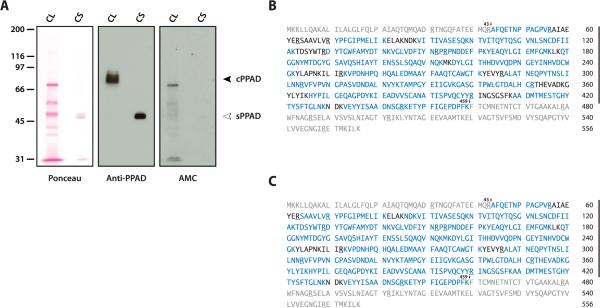
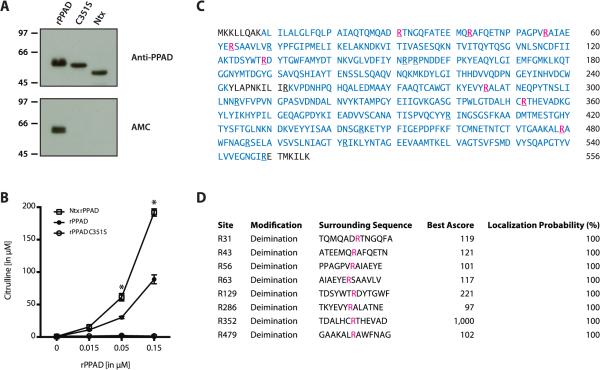
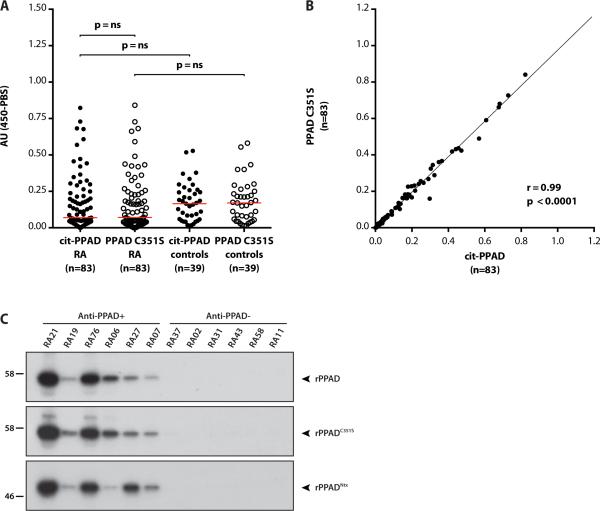
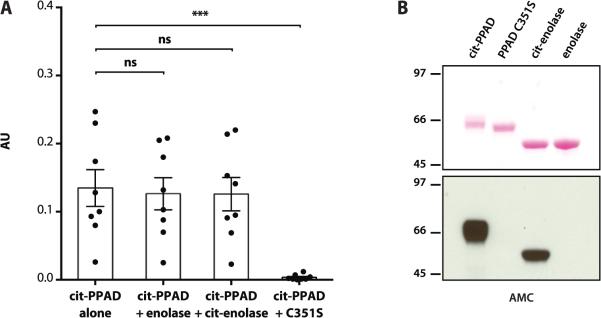
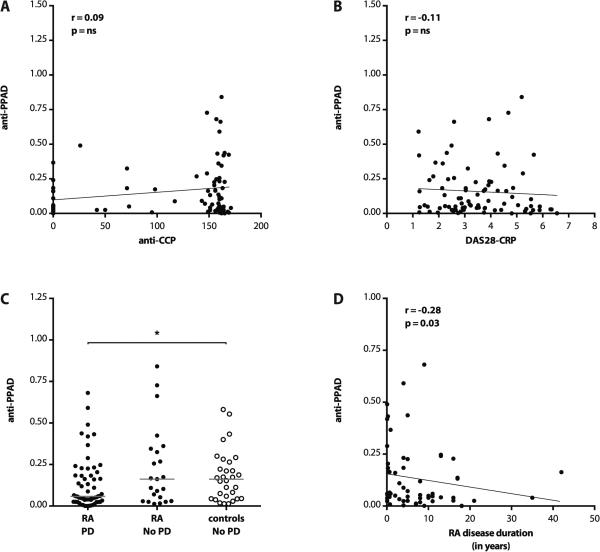
Results: PPAD from P gingivalis is truncated at the N-terminal and C-terminal domains and not citrullinated. Only when artificially expressed in E coli, full-length rPPAD, but not truncated (fully active) rPPAD(Ntx), is autocitrullinated. Anti-PPAD antibodies show no heightened reactivity to citrullinated rPPAD, but are exclusively directed against the unmodified enzyme. Antibodies against PPAD do not correlate with anti-cyclic citrullinated peptide levels and disease activity in RA. By contrast, anti-PPAD antibody levels are significantly decreased in RA patients with PD.
Conclusions: PPAD autocitrullination is not the underlying mechanism linking PD and RA. N-terminal processing protects PPAD from autocitrullination and enhances enzyme activity. Anti-PPAD antibodies may have a protective role for the development of PD in patients with RA.
Keywords: Ant-CCP; Autoimmune Diseases; Rheumatoid Arthritis.
Published by the BMJ Publishing Group Limited. For permission to use (where not already granted under a licence) please go to http://group.bmj.com/group/rights-licensing/permissions.
Figures
Comment in
-
PPAD remains a credible candidate for inducing autoimmunity in rheumatoid arthritis: comment on the article by Konig et al.Ann Rheum Dis. 2015 Jan;74(1):e7. doi: 10.1136/annrheumdis-2014-206665. Epub 2014 Oct 13. Ann Rheum Dis. 2015. PMID: 25311822 No abstract available.
-
PPAD is not targeted as a citrullinated protein in rheumatoid arthritis, but remains a candidate for inducing autoimmunity.Ann Rheum Dis. 2015 Jan;74(1):e8. doi: 10.1136/annrheumdis-2014-206681. Epub 2014 Nov 7. Ann Rheum Dis. 2015. PMID: 25381231 No abstract available.
References
-
- Imboden JB. The Immunopathogenesis of Rheumatoid Arthritis. Annu Rev Pathol Mech Dis. 2009;4:417–34. - PubMed
-
- Aletaha D, Neogi T, Silman AJ, et al. 2010 Rheumatoid arthritis classification criteria: an American College of Rheumatology/European League Against Rheumatism collaborative initiative. Arthritis Rheum. 2010;62:2569–81. - PubMed
-
- Arend WP, Firestein GS. Pre-rheumatoid arthritis: predisposition and transition to clinical synovitis. Nat Rev Rheumatol. 2012;8:573–86. - PubMed
-
- Nishimura K, Sugiyama D, Kogata Y, et al. Meta-analysis: diagnostic accuracy of anti-cyclic citrullinated peptide antibody and rheumatoid factor for rheumatoid arthritis. Ann Intern Med. 2007;146:797–808. - PubMed
Publication types
MeSH terms
Substances
Grants and funding
LinkOut - more resources
Full Text Sources
Other Literature Sources
Medical
