Review
. 2014 May 26;15(6):9184-208.
doi: 10.3390/ijms15069184.

Molecular mechanisms of liver fibrosis in HIV/HCV coinfection

Affiliations
Review

Molecular mechanisms of liver fibrosis in HIV/HCV coinfection

Claudio M Mastroianni et al. Int J Mol Sci. .

Abstract

Chronic hepatitis C virus (HCV) infection is an important cause of morbidity and mortality in people coinfected with human immunodeficiency virus (HIV). Several studies have shown that HIV infection promotes accelerated HCV hepatic fibrosis progression, even with HIV replication under full antiretroviral control. The pathogenesis of accelerated hepatic fibrosis among HIV/HCV coinfected individuals is complex and multifactorial. The most relevant mechanisms involved include direct viral effects, immune/cytokine dysregulation, altered levels of matrix metalloproteinases and fibrosis biomarkers, increased oxidative stress and hepatocyte apoptosis, HIV-associated gut depletion of CD4 cells, and microbial translocation. In addition, metabolic alterations, heavy alcohol use, as well drug use, may have a potential role in liver disease progression. Understanding the pathophysiology and regulation of liver fibrosis in HIV/HCV co-infection may lead to the development of therapeutic strategies for the management of all patients with ongoing liver disease. In this review, we therefore discuss the evidence and potential molecular mechanisms involved in the accelerated liver fibrosis seen in patients coinfected with HIV and HCV.


Figures
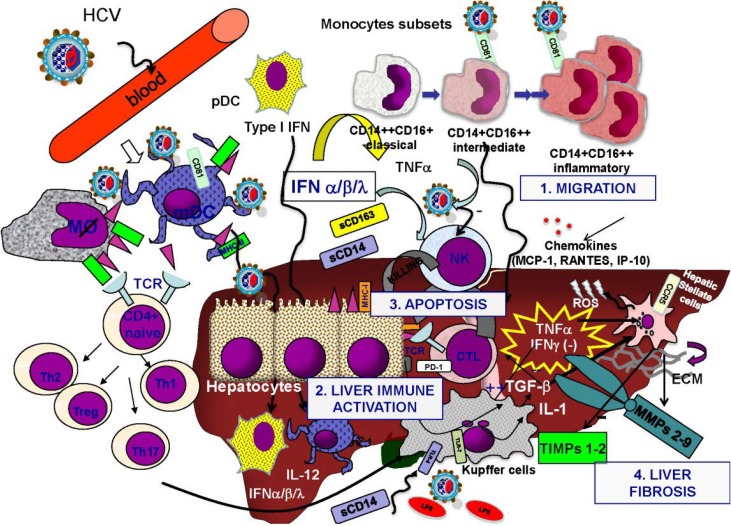
Figure 1
Figure 1
Immunopathogenesis of hepatitis C virus (HCV)-induced liver damage. HCV directlyinteracts with monocytes/macrophage/dendritic cell compartment via CD81 or toll-like receptor (TLR)-7 inducinga pro-inflammatory state and allowing the presentation to naive T and B cells. The increased circulation of chemokines leads to the migration of all these cells into the liver. Natural killer (NK) cells play a central role in control viral replication, but HCV is able to inhibit NK functions. HCV in the liver causes infection of hepatocytes that are a target for the activated effector cells, such as cytotoxic T lymphocytes (CTL), NK, myeloid dendritic cells (mDC) inducing apoptosis. A complex state of chronic immune activation is maintained in the liver and includes also Kupffer cells. In this milieu of pro-inflammatory cytokines (interleukin (IL)-1, tumor necrosis factor (TNF)-α, transforming growth factor (TGF)-β1, IL-12) and oxidative stress (ROS), hepatic stellate cells (HSC) are activated to produce extracellular matrix and to induce a dysregulation of the imbalance between matrix metalloproteinases (MMPs) and tissue inhibitors of matrix metalloproteinases (TIMPs), thus leading to liver fibrosis. Th, T helper; IFN, interferon; sCD, soluble CD; RANTES, regulated on activation normal T cell expressed and secreted; CCR5, CC chemokine receptor type 5; ECM, extracellular matrix; LPS, lipopolysaccharide; pDC, plasmacytoid dendritic cells; IP, Interferon-gamma-induced protein; TCR, T-cell receptor.
Figure 2
Figure 2
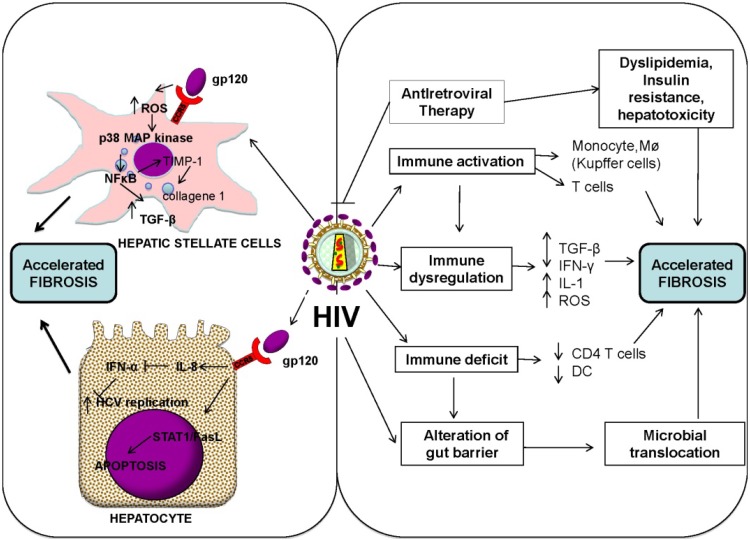
Effect of human immunodeficiency virus (HIV) on liver fibrosis. HIV may induce a direct effect on both hepatic stellate cells and hepatocytes by the interaction between viral proteins (gp 120) and CCR5 (CC chemokine receptor type 5) (left panel). On the other hand, liver fibrosis could be accelerated by indirect mechanisms, such as HIV immune activation, immune dysfunction and immune deficiency, microbial translocation and toxic effect of antiretroviral drugs (right panel).
Figure 3
Figure 3
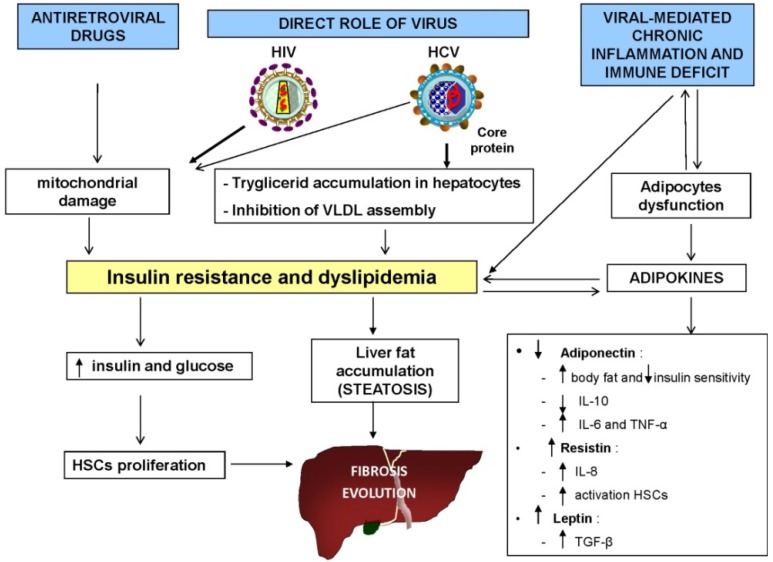
Impact of metabolic alterations and insulin resistance on liver fibrosis progression. Interplay between HIV/HCV coinfection, toxic effects of antiretroviral drugs, and chronic inflammation may play a critical role in the development of hepatic steatosis and fibrosis progression.

References

    1. Kim A.Y., Chung R.T. Coinfection with HIV-1 and HCV—A one-two punch. Gastroenterology. 2009;137:795–781. - PMC - PubMed
    1. Chen J.Y., Feeney E.R., Chung R.T. HCV and HIV co-infection: Mechanisms and management. Nat. Rev. Gastroenterol. Hepatol. 2014 doi: 10.1038/nrgastro.2014.17. - DOI - PMC - PubMed
    1. Hernandez M.D., Sherman K.E. HIV/HCV coinfection natural history and disease progression. Curr. Opin. HIV AIDS. 2011;6:478–482. doi: 10.1097/COH.0b013e32834bd365. - DOI - PMC - PubMed
    1. Benhamou Y., Bochet M., di Martino V., Charlotte F., Azria F., Coutellier A., Vidaud M., Bricaire F., Opolon P., Katlama C., et al. Liver fibrosis progression in human immunodeficiency virus and hepatitis C virus coinfected patients. Hepatology. 1999;30:1054–1058. doi: 10.1002/hep.510300409. - DOI - PubMed
    1. Kovacs A., Al-Harthi L., Christensen S., Mack W., Cohen M., Landay A. CD8+ T cell activation in women coinfected with human immunodeficiency virus type 1 and hepatitis C virus. J. Infect. Dis. 2008;197:1402–1407. - PMC - PubMed

MeSH terms