. 2014 May 27;5(3):e01041-14.
doi: 10.1128/mBio.01041-14.

Functional genomics with a comprehensive library of transposon mutants for the sulfate-reducing bacterium Desulfovibrio alaskensis G20

Affiliations

Functional genomics with a comprehensive library of transposon mutants for the sulfate-reducing bacterium Desulfovibrio alaskensis G20

Jennifer V Kuehl et al. mBio. .

Abstract

The genomes of sulfate-reducing bacteria remain poorly characterized, largely due to a paucity of experimental data and genetic tools. To meet this challenge, we generated an archived library of 15,477 mapped transposon insertion mutants in the sulfate-reducing bacterium Desulfovibrio alaskensis G20. To demonstrate the utility of the individual mutants, we profiled gene expression in mutants of six regulatory genes and used these data, together with 1,313 high-confidence transcription start sites identified by tiling microarrays and transcriptome sequencing (5' RNA-Seq), to update the regulons of Fur and Rex and to confirm the predicted regulons of LysX, PhnF, PerR, and Dde_3000, a histidine kinase. In addition to enabling single mutant investigations, the D. alaskensis G20 transposon mutants also contain DNA bar codes, which enables the pooling and analysis of mutant fitness for thousands of strains simultaneously. Using two pools of mutants that represent insertions in 2,369 unique protein-coding genes, we demonstrate that the hypothetical gene Dde_3007 is required for methionine biosynthesis. Using comparative genomics, we propose that Dde_3007 performs a missing step in methionine biosynthesis by transferring a sulfur group to O-phosphohomoserine to form homocysteine. Additionally, we show that the entire choline utilization cluster is important for fitness in choline sulfate medium, which confirms that a functional microcompartment is required for choline oxidation. Finally, we demonstrate that Dde_3291, a MerR-like transcription factor, is a choline-dependent activator of the choline utilization cluster. Taken together, our data set and genetic resources provide a foundation for systems-level investigation of a poorly studied group of bacteria of environmental and industrial importance.

Importance: Sulfate-reducing bacteria contribute to global nutrient cycles and are a nuisance for the petroleum industry. Despite their environmental and industrial significance, the genomes of sulfate-reducing bacteria remain poorly characterized. Here, we describe a genetic approach to fill gaps in our knowledge of sulfate-reducing bacteria. We generated a large collection of archived, transposon mutants in Desulfovibrio alaskensis G20 and used the phenotypes of these mutant strains to infer the function of genes involved in gene regulation, methionine biosynthesis, and choline utilization. Our findings and mutant resources will enable systematic investigations into gene function, energy generation, stress response, and metabolism for this important group of bacteria.


Figures

FIG 1
FIG 1
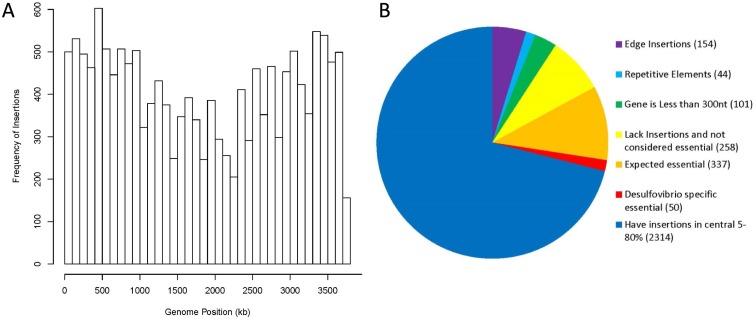
Coverage of the D. alaskensis G20 transposon mutant collection. (A) Distribution of 15,477 mapped transposon insertions along the chromosome. (B) Number of protein-coding genes that are essential, are dispensable and have an insertion, or are of unknown essentiality. Edge insertions represent genes with an insertion(s) in either the first 5% or last 20% of the gene. Repetitive elements are nonunique regions of D. alaskensis G20 in which it is hard to map transposon insertion sites. Putative essential genes were subcategorized as expected essential or Desulfovibrio-specific essential. nt, nucleotides.
FIG 2
FIG 2
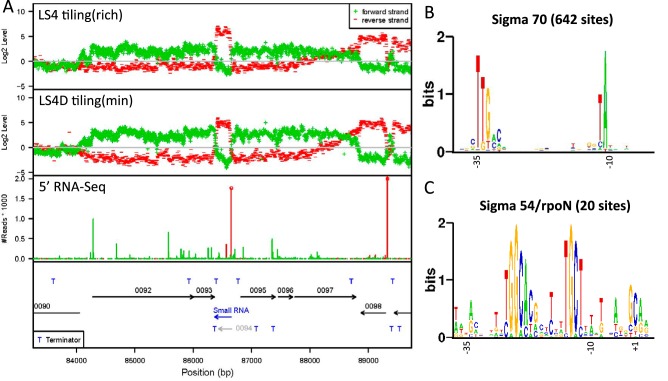
Identifying D. alaskensis G20 promoter motifs with transcriptome map. (A) A 7-kb region of the D. alaskensis G20 genome with tiling microarray data from two conditions, LS4 (rich) and LS4D (minimum), 5′ RNA-Seq data, and gene annotations. High-confidence TSSs are marked in the 5′ RNA-Seq data with a circle on top of the line. The spurious Dde_0094 annotation (gray) and the new small RNA identified in our data (blue) are marked. Rho-independent transcriptional terminators (marked as blue T’s) were predicted with TransTermHP (64). (B) D. alaskensis G20 σ70 promoter motif generated from 642 sites. These 642 sites were identified from a preliminary set of 1,172 D. alaskensis G20 TSSs. (C) Same as panel B for the D. alaskensis σ54 promoter motif generated from 20 sites.
FIG 3
FIG 3
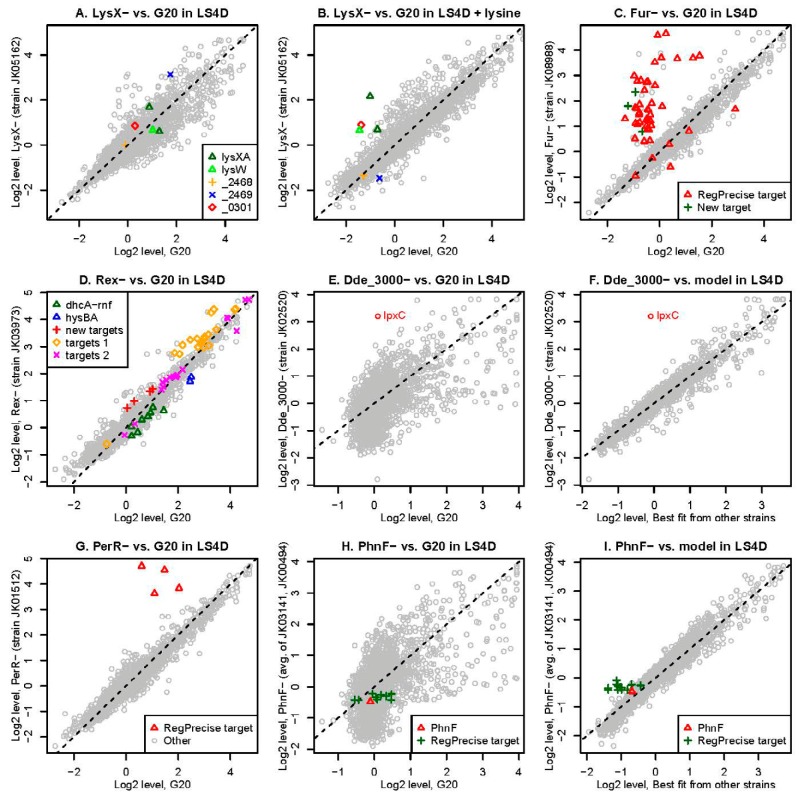
Validating and expanding D. alaskensis G20 regulons. In each panel, the y axis shows the normalized log2 expression levels in regulator mutants: LysX (A and B), Fur (C), Rex (D), Dde_3000 (E and F), PerR (G), or PhnF (H and I). In most panels, the x axis shows the normalized log2 expression of wild-type D. alaskensis G20 (G20). In panels F and I, the x axis represents the expected expression level from a linear model that includes the expression data from the other mutant strains and wild-type D. alaskensis G20. The putative targets for each regulator are color coded. For PhnF, we averaged the expression data from two different mutant strains.
FIG 4
FIG 4
Dde_3007 is required for methionine biosynthesis in D. alaskensis G20. (A) Comparison of gene fitness for 2,379 genes in LS4D minimal medium (x axis) versus LS4D minimal medium supplemented with 0.2% (wt/vol) Casamino Acids. Genes putatively involved in methionine (blue) and amino acid biosynthesis (red) are marked. Putative amino acid biosynthesis genes were identified using TIGRfam subroles (65). (B) Same as panel A for LS4D minimal medium (x axis) versus LS4D minimal medium supplemented with 1 µM methionine. (C) Growth on minimal LS4D medium of wild-type D. alaskensis G20 (top), JK00771 (Dde_3007 transposon mutant, right), JK00771 with pJK2 (Dde_3007, bottom), JK00771 with pMO9075 (empty vector, left). (D) Same as panel C with LS4D plus homocysteine medium. (E) Predicted pathway of methionine biosynthesis in D. alaskensis G20. Unknown enzymes are marked in red.
FIG 5
FIG 5
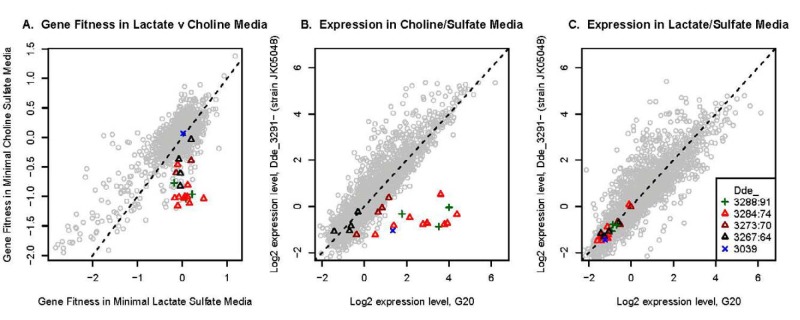
Identification of genes required for choline utilization in D. alaskensis G20. (A) Scatter plot of gene fitness values in lactate-sulfate medium (x axis) versus choline-sulfate medium (y axis). Genes are color coded according to the legend in panel C. (B) Comparison of gene expression for wild-type D. alaskensis G20 (x axis) and a transposon mutant of Dde_3291 (y axis; strain JK05048) grown in choline-sulfate medium. Genes are color coded according to the legend in panel C. (C) Same as panel B for growth in lactate-sulfate medium.

References

    1. Postgate JR. 1984. The sulphate-reducing bacteria, 2nd ed. Cambridge University Press, Cambridge, United Kingdom
    1. Jørgensen BB. 1982. Mineralization of organic matter in the sea bed—the role of sulphate reduction. Nature 296:643–645. 10.1038/296643a0 - DOI
    1. Jia W, Whitehead RN, Griffiths L, Dawson C, Bai H, Waring RH, Ramsden DB, Hunter JO, Cauchi M, Bessant C, Fowler DP, Walton C, Turner C, Cole JA. 2012. Diversity and distribution of sulphate-reducing bacteria in human faeces from healthy subjects and patients with inflammatory bowel disease. FEMS Immunol. Med. Microbiol. 65:55–68. 10.1111/j.1574-695X.2012.00935.x - DOI - PubMed
    1. Scanlan PD, Shanahan F, Marchesi JR. 2009. Culture-independent analysis of desulfovibrios in the human distal colon of healthy, colorectal cancer and polypectomized individuals. FEMS Microbiol. Ecol. 69:213–221. 10.1111/j.1574-6941.2009.00709.x - DOI - PubMed
    1. Loubinoux J, Bronowicki JP, Pereira IA, Mougenel JL, Faou AE. 2002. Sulfate-reducing bacteria in human feces and their association with inflammatory bowel diseases. FEMS Microbiol. Ecol. 40:107–112. 10.1111/j.1574-6941.2002.tb00942.x - DOI - PubMed

Publication types

Associated data