. 2014 Jul 1;5(5):619-24.
doi: 10.4161/viru.29363. Epub 2014 May 27.

The yrpAB operon of Yersinia ruckeri encoding two putative U32 peptidases is involved in virulence and induced under microaerobic conditions

Affiliations

The yrpAB operon of Yersinia ruckeri encoding two putative U32 peptidases is involved in virulence and induced under microaerobic conditions

Roberto Navais et al. Virulence. .

Abstract

In an attempt to dissect the virulence mechanisms of Yersinia ruckeri two adjacent genes, yrpA and yrpB, encoding putative peptidases belonging to the U32 family, were analyzed. Similar genes, with the same genetic organization were identified in genomic analysis of human-pathogenic yersiniae. RT-PCR studies indicated that these genes form an operon in Y. ruckeri. Transcriptional studies using an yrpB::lacZY fusion showed high levels of expression of these genes in the presence of peptone in the culture medium, as well as under oxygen-limited conditions. These two factors had a synergic effect on gene induction when both were present simultaneously during bacterial incubation, which indicates the important role that environmental conditions in the fish gut can play in the regulation of specific genes. LD 50 experiments using an yrpA insertional mutant strain demonstrated the participation of this gene in the virulence of Y. ruckeri.

Keywords: Yersinia ruckeri; protease genes; regulation; virulence.


Figures
None
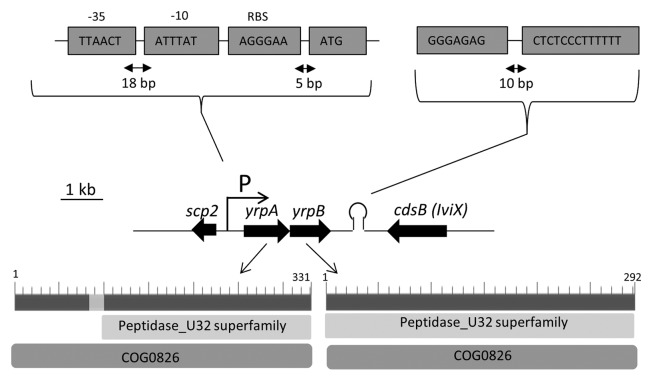
Figure 1. Chromosomal arrangement of the region containing genes yrpA and yrpB in Y. ruckeri 150. Arrows indicate the direction of transcription. Putative −10 and −35 promoter and rho-independent terminator sequences are shown. Scp2 and cdsB genes encode for a sterol carrier protein and an l-cysteine desulfidase, respectively. The number of amino acids and the collagenase (COG0826) and U32 peptidase (cIo3113) domains of the products of both genes are shown in the lower part of the figure.
None
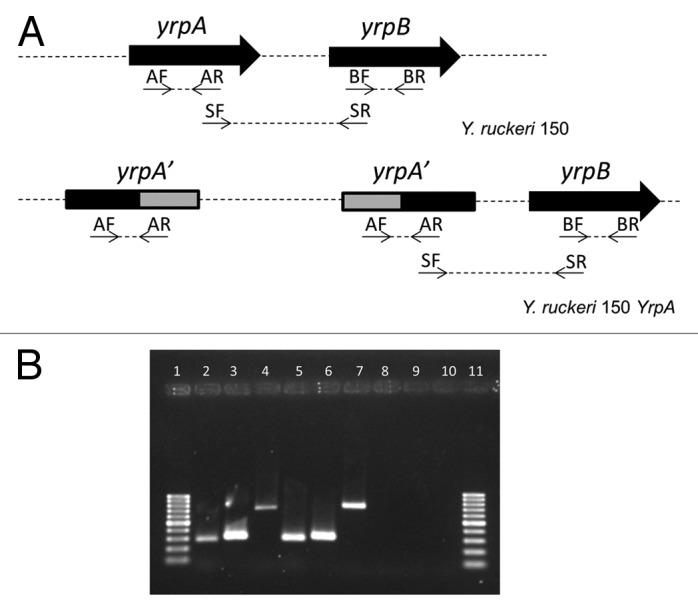
Figure 2. Agarose gel electrophoresis of the RT-PCR amplification products. (A) The positions of the primers used, within the yrpAB operon, are indicated both in the parental (Y. ruckeri 150) and in the yrpA mutant strains (Y. ruckeri 150 YrpA). Gray areas represent the internal fragment of the yrpA used to carry out the insertional mutagenesis of this gene. (B) RT-PCR results. Lanes 1 and 11: molecular weight marker corresponding to sizes ranging from 1000 to 100 bp. Lanes 2–4: PCR products obtained from RT-PCR experiments with Y. ruckeri 150 using primers: AF and AR (lane 2), BF and BR (lane 3), and SF and SR (lane 4). Lanes 5–7: PCR products obtained from RT-PCR experiments with Y. ruckeri yrpA; AF and AR primers (lane 5), BF and BR primers (lane 6), SF and SR (lane 7). Lanes 8 and 9: control reactions to assess DNA contamination in Y. ruckeri 150 RNA (lane 8) and Y. ruckeri yrpA RNA (lane 9). For this purpose SF and SR primers were used and the reverse transcription step was omitted. Lane 10: negative control of RT-PCR using 1 µL of water instead of RNA.
None
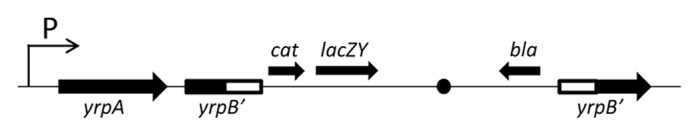
Figure 3. Chromosomal organization of the transcriptional fusion between the yrpAB operon and the lacZY genes in the ∆yrpB strain. Arrows indicate the direction of the transcription and white areas represent the internal fragment of the yrpB used to carry out the insertional mutagenesis of this gene. yrpB′, truncated yrpB gene; cat, chloramphenicol acetyltransferase gene (promoterless); lacZY, genes for lactose fermentation (promoterless); bla, ampicillin resistance gene; P, putative promoter. The black dot represents the origin of replication of the pJP5603 plasmid.

Comment in

References

    1. Méndez J, Guijarro JA. In vivo monitoring of Yersinia ruckeri in fish tissues: progression and virulence gene expression. Environ Microbiol Rep. 2013;5:179–85. doi: 10.1111/1758-2229.12030. - DOI - PubMed
    1. Fernández L, Secades P, Lopez JR, Márquez I, Guijarro JA. Isolation and analysis of a protease gene with an ABC transport system in the fish pathogen Yersinia ruckeri: insertional mutagenesis and involvement in virulence. Microbiology. 2002;148:2233–43. - PubMed
    1. Fernández L, Prieto M, Guijarro JA. The iron- and temperature-regulated haemolysin YhlA is a virulence factor of Yersinia ruckeri. Microbiology. 2007;153:483–9. doi: 10.1099/mic.0.29284-0. - DOI - PubMed
    1. Dahiya I, Stevenson RMW. The ZnuABC operon is important for Yersinia ruckeri infections of rainbow trout, Oncorhynchus mykiss (Walbaum) J Fish Dis. 2010;33:331–40. doi: 10.1111/j.1365-2761.2009.01125.x. - DOI - PubMed
    1. Dahiya I, Stevenson RMW. The UvrY response regulator of the BarA-UvrY two-component system contributes to Yersinia ruckeri infection of rainbow trout (Oncorhynchus mykiss) Arch Microbiol. 2010;192:541–7. doi: 10.1007/s00203-010-0582-8. - DOI - PubMed

Publication types

MeSH terms

LinkOut - more resources