


Multifield optimization intensity modulated proton therapy for head and neck tumors: a translation to practice
- PMID: 24867532
- PMCID: PMC4171724
- DOI: 10.1016/j.ijrobp.2014.04.019
Multifield optimization intensity modulated proton therapy for head and neck tumors: a translation to practice
Abstract
Background: We report the first clinical experience and toxicity of multifield optimization (MFO) intensity modulated proton therapy (IMPT) for patients with head and neck tumors.
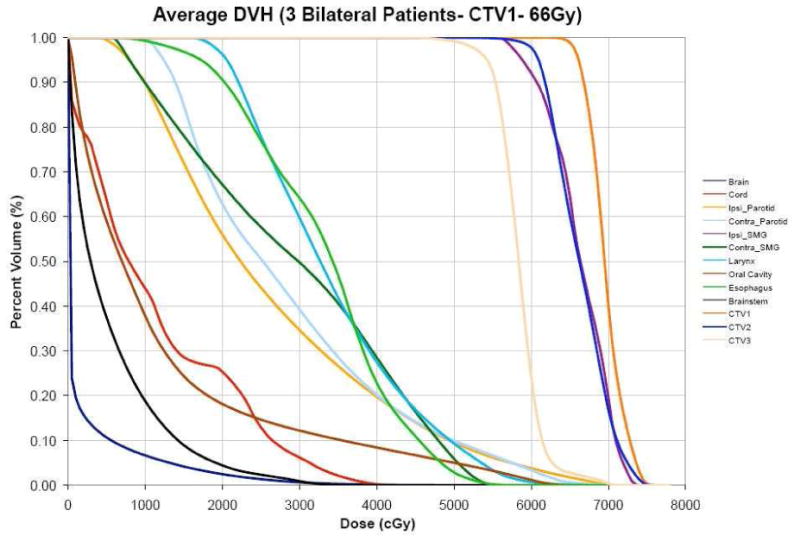
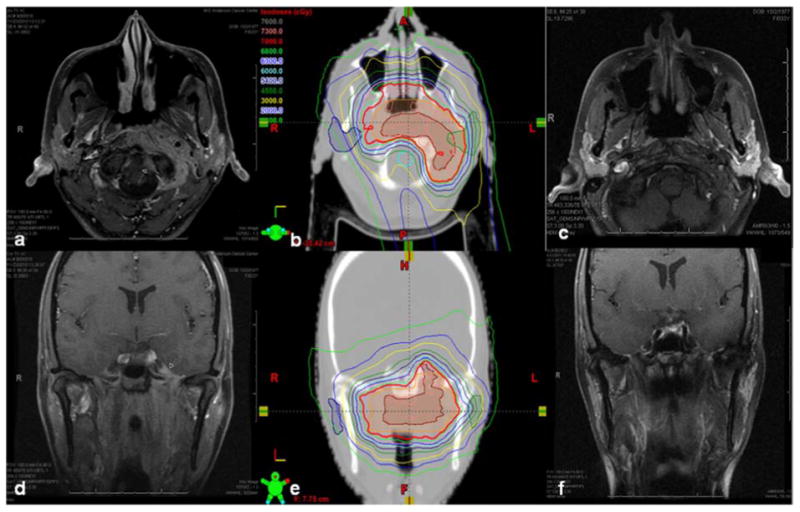
Methods and materials: Fifteen consecutive patients with head and neck cancer underwent MFO-IMPT with active scanning beam proton therapy. Patients with squamous cell carcinoma (SCC) had comprehensive treatment extending from the base of the skull to the clavicle. The doses for chemoradiation therapy and radiation therapy alone were 70 Gy and 66 Gy, respectively. The robustness of each treatment plan was also analyzed to evaluate sensitivity to uncertainties associated with variations in patient setup and the effect of uncertainties with proton beam range in patients. Proton beam energies during treatment ranged from 72.5 to 221.8 MeV. Spot sizes varied depending on the beam energy and depth of the target, and the scanning nozzle delivered the spot scanning treatment "spot by spot" and "layer by layer."
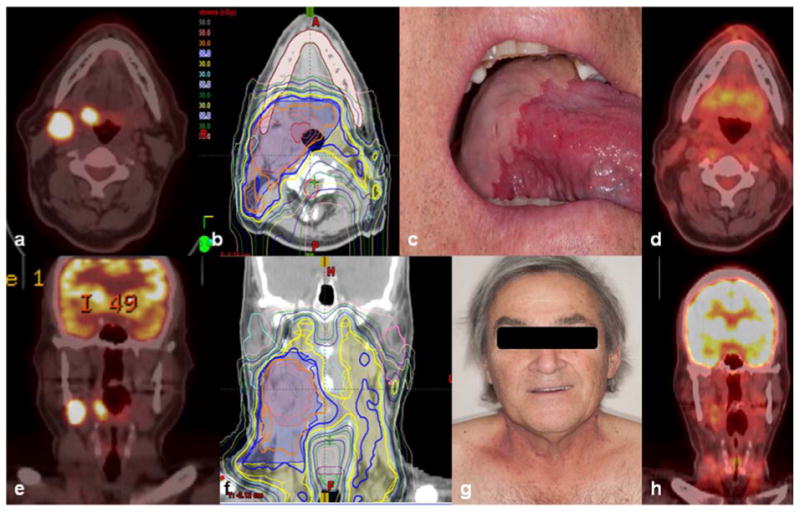
Results: Ten patients presented with SCC and 5 with adenoid cystic carcinoma. All 15 patients were able to complete treatment with MFO-IMPT, with no need for treatment breaks and no hospitalizations. There were no treatment-related deaths, and with a median follow-up time of 28 months (range, 20-35 months), the overall clinical complete response rate was 93.3% (95% confidence interval, 68.1%-99.8%). Xerostomia occurred in all 15 patients as follows: grade 1 in 10 patients, grade 2 in 4 patients, and grade 3 in 1 patient. Mucositis within the planning target volumes was seen during the treatment of all patients: grade 1 in 1 patient, grade 2 in 8 patients, and grade 3 in 6 patients. No patient experienced grade 2 or higher anterior oral mucositis.
Conclusions: To our knowledge, this is the first clinical report of MFO-IMPT for head and neck tumors. Early clinical outcomes are encouraging and warrant further investigation of proton therapy in prospective clinical trials.
Copyright © 2014 Elsevier Inc. All rights reserved.
Conflict of interest statement
Figures
References
-
- Anonymous. NCCN Clinical Practice Guidelines in Oncology. [Accessed January 22, 2012]; Available at: http://www.nccn.org/professionals/physician_gls/f_guidelines.asp.
-
- Chao KS, Deasy JO, Markman J, et al. A prospective study of salivary function sparing in patients with head-and-neck cancers receiving intensity-modulated or three-dimensional radiation therapy: initial results. Int J Radiat Oncol Biol Phys. 2001;49:907–916. - PubMed
-
- Dirix P, Vanstraelen B, Jorissen M, Vander Poorten V, Nuyts S. Intensity-modulated radiotherapy for sinonasal cancer: improved outcome compared to conventional radiotherapy. Int J Radiat Oncol Biol Phys. 2010;78:998–1004. - PubMed
Publication types
MeSH terms
Grants and funding
LinkOut - more resources
Full Text Sources
Other Literature Sources
Medical
Research Materials
