


Development of comorbidity-adapted exercise protocols for patients with knee osteoarthritis
- PMID: 24868151
- PMCID: PMC4027930
- DOI: 10.2147/CIA.S55705
Development of comorbidity-adapted exercise protocols for patients with knee osteoarthritis
Abstract
Background: Exercise therapy is generally recommended for patients with osteoarthritis (OA) of the knee. Comorbidity, which is highly prevalent in OA, may interfere with exercise therapy. To date, there is no evidence-based protocol for the treatment of patients with knee OA and comorbidity. Special protocols adapted to the comorbidity may facilitate the application of exercise therapy in patients with knee OA and one or more comorbidities.
Purpose: The purpose of this study was to develop comorbidity-adapted exercise protocols for patients with knee OA and comorbidity.
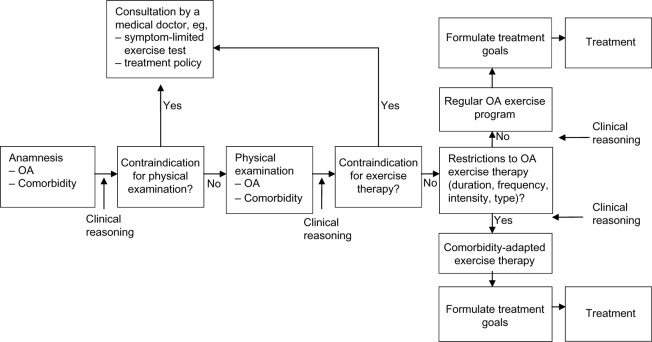
Method: Several steps were undertaken to develop comorbidity-adapted protocols: selection of highly prevalent comorbidities in OA, a literature search to identify restrictions and contraindications for exercise therapy for the various comorbid diseases, consultation of experts on each comorbid disease, and field testing of the protocol in eleven patients with knee OA and comorbidity.
Results: Based on literature and expert opinion, comorbidity-adapted protocols were developed for highly prevalent comorbidities in OA. Field testing showed that the protocols provided guidance in clinical decision making in both the diagnostic and the treatment phase. Because of overlap, the number of exercise protocols could be reduced to three: one for physiological adaptations (coronary disease, heart failure, hypertension, diabetes type 2, chronic obstructive pulmonary diseases, obesity), one for behavioral adaptations (chronic a-specific pain, nonspecific low back pain, depression), and one for environmental adaptations (visual or hearing impairments). Evaluation of patient outcome after treatment showed significant (P<0.05) and clinically relevant improvements in activity limitations and pain.
Conclusion: Comorbidity-adapted exercise protocols for patients with knee OA were developed, providing guidance in clinical reasoning with regard to diagnostics and treatment. To evaluate the effectiveness of treatment in line with our protocols, a randomized clinical trial should be performed.
Keywords: arthritis; coexisting disease; comorbidity; exercise therapy; knee osteoarthritis; rehabilitation.
Figures
References
-
- Caporali R, Cimmino MA, Sarzi-Puttini P, et al. Comorbid conditions in the AMICA study patients: effects on the quality of life and drug prescriptions by general practitioners and specialists. Semin Arthritis Rheum. 2005;35(1 Suppl 1):31–37. - PubMed
-
- Feinstein AR. The pre-therapeutic classification of comorbidity in chronic disease. J Chronic Dis. 1970;23(7):455–468. - PubMed
Publication types
MeSH terms
LinkOut - more resources
Full Text Sources
Other Literature Sources
