


Accelerated postero-lateral spinal fusion by collagen scaffolds modified with engineered collagen-binding human bone morphogenetic protein-2 in rats
- PMID: 24869484
- PMCID: PMC4037187
- DOI: 10.1371/journal.pone.0098480
Accelerated postero-lateral spinal fusion by collagen scaffolds modified with engineered collagen-binding human bone morphogenetic protein-2 in rats
Abstract
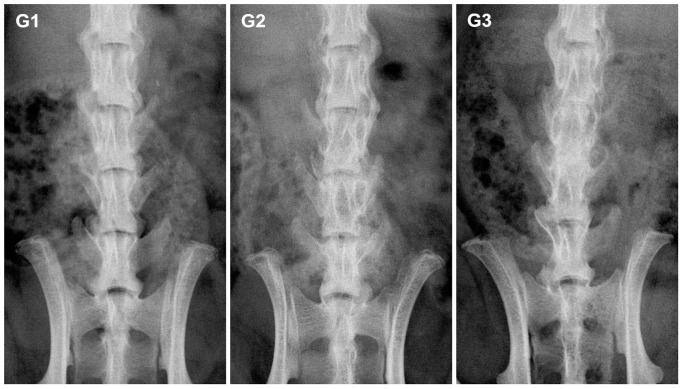
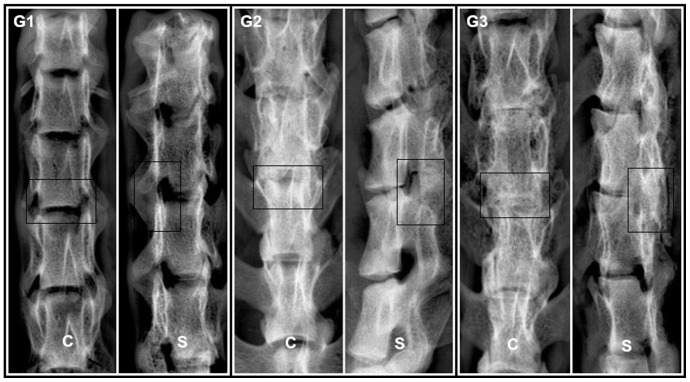
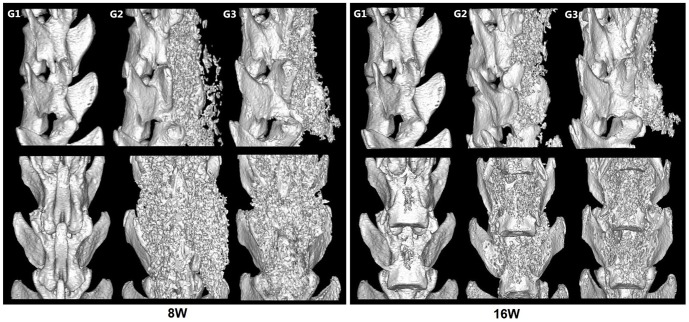
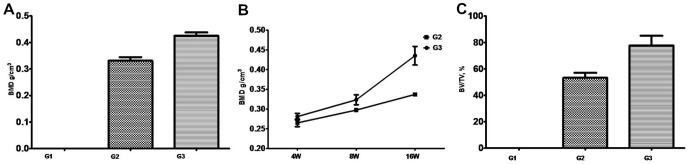
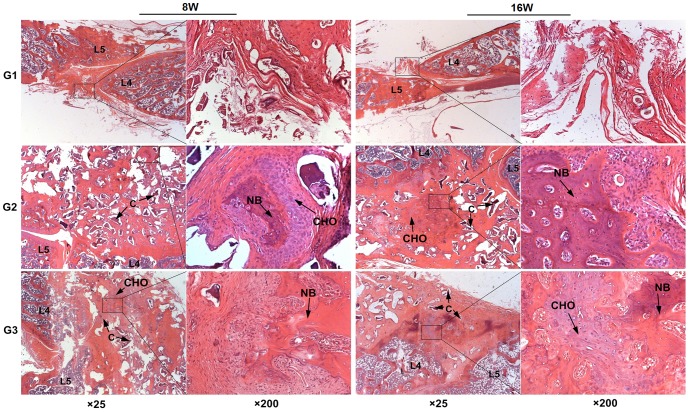
Bone morphogenetic protein-2 (BMP-2) is a potent osteoinductive cytokine that plays a critical role in bone regeneration and repair. However, its distribution and side effects are major barriers to its success as therapeutic treatment. The improvement of therapy using collagen delivery matrices has been reported. To investigate a delivery system on postero-lateral spinal fusion, both engineered human BMP-2 with a collagen binding domain (CBD-BMP-2) and collagen scaffolds were developed and their combination was implanted into Sprague-Dawley (SD) rats to study Lumbar 4-5 (L4-L5) posterolateral spine fusion. We divided SD rats into three groups, the sham group (G1, n = 20), the collagen scaffold-treated group (G2, n = 20) and the BMP-2-loaded collagen scaffolds group (G3, n = 20). 16 weeks after surgery, the spines of the rats were evaluated by X-radiographs, high-resolution micro-computed tomography (micro-CT), manual palpation and hematoxylin and eosin (H&E) staining. The results showed that spine L4-L5 fusions occurred in G2(40%) and G3(100%) group, while results from the sham group were inconsistent. Moreover, G3 had better results than G2, including higher fusion efficiency (X score, G2 = 2.4±0.163, G3 = 3.0±0, p<0.05), higher bone mineral density (BMD, G2: 0.3337±0.0025g/cm3, G3: 0.4353±0.0234g/cm3. p<0.05) and more bone trabecular formation. The results demonstrated that with site-specific collagen binding domain, a dose of BMP-2 as low as 0.02mg CBD-BMP-2/cm3 collagen scaffold could enhance the posterolateral intertransverse process fusion in rats. It suggested that combination delivery could be an alternative in spine fusion with dramatically decreased side effects caused by high dose of BMP-2.
Conflict of interest statement
Figures
References
-
- Reid JJ, Johnson JS, Wang JC (2011) Challenges to bone formation in spinal fusion. J Biomech 44: 213–220. - PubMed
-
- Alsaleh KA, Tougas CA, Roffey DM, Wai EK (2012) Osteoconductive bone graft extenders in posterolateral thoracolumbar spinal fusion. Spine(Phila Pa 1976) 37: 993–1000. - PubMed
-
- Geiger M, Li RH, Friess W (2003) Collagen sponges for bone regeneration with rhBMP-2. Adv Drug Deliv Rev 55: 1613–1629. - PubMed
Publication types
MeSH terms
Substances
LinkOut - more resources
Full Text Sources
Other Literature Sources
