. 2014 May 28;9(5):e98329.
doi: 10.1371/journal.pone.0098329. eCollection 2014.

Ethanolic extract of Astragali radix and Salviae radix prohibits oxidative brain injury by psycho-emotional stress in whisker removal rat model

Affiliations

Ethanolic extract of Astragali radix and Salviae radix prohibits oxidative brain injury by psycho-emotional stress in whisker removal rat model

Hyeong-Geug Kim et al. PLoS One. .

Abstract

Myelophil, an ethanolic extract of Astragali Radix and Salviae Radix, has been clinically used to treat chronic fatigue and stress related disorders in South Korea. In this study, we investigated the protective effects of Myelophil on a whisker removal-induced psycho-emotional stress model. SD rats were subjected to whisker removal after oral administration of Myelophil or ascorbic acid for consecutive 4 days. Whisker removal considerably increased total reactive oxygen species in serum levels as well as cerebral cortex and hippocampal regions in brain tissues. Lipidperoxidation levels were also increased in the cerebral cortex, hippocampus regions, and brain tissue injuries as shown in histopathology and immunohistochemistry. However, Myelophil significantly ameliorated these alterations, and depletion of glutathione contents in both cerebral cortex and hippocampus regions respectively. Serum levels of corticosterone and adrenaline were notably altered after whisker removal stress, whereas these abnormalities were significantly normalized by pre-treatment with Myelophil. The NF-κB was notably activated in both cerebral cortex and hippocampus after whisker removal stress, while it was efficiently blocked by pre-treatment with Myelophil. Myelophil also significantly normalizes alterations of tumor necrosis factor-α, interleukin (IL)-1β, IL-6 and interferon-γ in both gene expressions and protein levels. These results suggest that Myelophil has protective effects on brain damages in psycho-emotional stress, and the underlying mechanisms involve regulation of inflammatory proteins, especially NF-κB modulation.


Conflict of interest statement

Competing Interests: The authors have declared that no competing interests exist.

Figures

Figure 1
Figure 1. Fingerprinting analysis of Myelophil.
Myelophil and three reference standards were subjected to ultra-high-performance liquid chromatography (UHPLC) analysis (A), Salvianolic acid B (m/z 719.1604, [M+H]+) (B) and (C) astragaloside IV (m/z 785.4684, [M+H]+), are the two major compounds in the qualitative histogram. Standards are shown in both the mass chromatogram and high-resolution mass spectra, and quantitative analysis of Myelophil (D).
Figure 2
Figure 2. Experimental design and way to remove whisker of animals.
Experimental schedule (A), and for induction psychological stress, the whiskers around the nose and mouth were completely cut off with scissors without the use of anesthesia (B). A total sprague sawley rats (n = 60) were treated with distilled water, Myelophil (50, 100 or 200 mg/kg, p.o) or (ascorbic acid 100 mg/kg, p.o) were orally administrated for consecutive 4 days. The last administrations of drugs were additionally administrated 2 hours before whisker removal stress without normal group. Twelve hours after, animals with whisker removal stress all animals were sacrificed under the ether anesthesia. After sacrificed the whole blood and brain tissues were isolated from animals for further assays.
Figure 3
Figure 3. Histopathological and immunohistochemistry findings.
Hematoxylin and eosin (H&E) staining in prefrontal cortex (A) and hippocampal CA1 regions (B). The immunohistochemistry for 4-hydroxynonenal (4-HNE) were performed in prefrontal cortex (C) and hippocampal CA1 regions (D). The slides were observed by light microscopy (200× magnification, n = 3). The reference bar indicated 50 µm.
Figure 4
Figure 4. Serum levels of stress-associated hormones.
Serum levels of corticosterone (A) and adrenaline (B) were determined by enzyme-linked immunosorbent assay. Data are means ± standard deviations (n = 10). # p<0.05 compared with the normal group; * p<0.05 and ** p<0.01 compared with the control group.
Figure 5
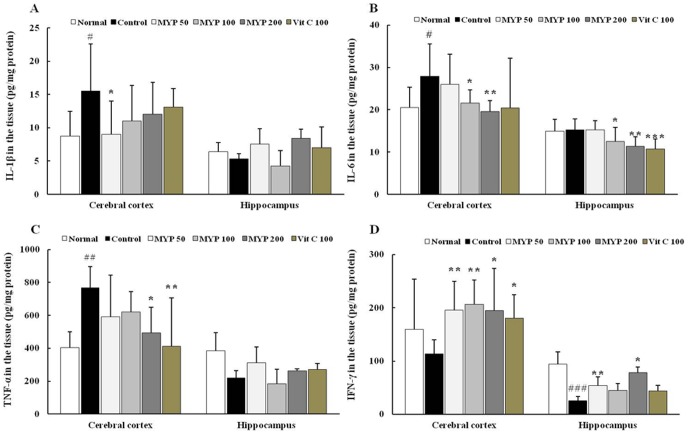
Figure 5. Inflammatory and immune-related cytokine levels in brain tissues.
Protein levels of interleukin (IL)-1β (A), tumor necrosis factor-α (TNF-α) (B), IL-6 (C) and interferone-γ (IFN-γ) (D) were determined by enzyme-linked immunosorbent assay in cerebral cortex and hippocampus, respectively. Data are means ± standard deviations (n = 7). # p<0.05 and ## p<0.01compared with the normal group; * p<0.05 and ** p<0.01compared with the control group.
Figure 6
Figure 6. Gene expression levels of inflammatory and immune-related cytokines in brain tissues.
Gene expression levels of interleukin (IL)-1β, tumor necrosis factor-α (TNF-α), IL-6, inducible nitric oxide synthase (iNOS), IL-10 and interferone-γ (IFN-γ) (D) were determined using real-time PCR. Data are means ± standard deviations (n = 4). # p<0.05, ## p<0.01, and ### p<0.001 compared with the normal group; * p<0.05 and *** p<0.001 compared with the control group.
Figure 7
Figure 7. Western blot analysis of NF-κB activation in brain tissues.
IκBα (cytosolic extract) (A) and NF-κB (nuclear extract) (B) were detected by their specific antibodies (n = 3).

References

    1. Koolhaas JM, Bartolomucci A, Buwalda B, de Boer SF, Flugge G, et al. (2011) Stress revisited: a critical evaluation of the stress concept. Neurosci Biobehav Rev 35: 1291–1301 10.1016/j.neubiorev.2011.02.003 - DOI - PubMed
    1. Dimitrijevic M, Stanojevic S, Kustrimovic N, Leposavic G (2012) End-point effector stress mediators in neuroimmune interactions: their role in immune system homeostasis and autoimmune pathology. Immunol Res 52: 64–80 10.1007/s12026-012-8275-9 - DOI - PubMed
    1. Videbech P, Petersen TH (2001) [Depression, stress and brain function]. Ugeskr Laeger 163: 6568–6572. - PubMed
    1. Jaremka LM, Lindgren ME, Kiecolt-Glaser JK (2013) Synergistic relationships among stress, depression, and troubled relationships: insights from psychoneuroimmunology. Depress Anxiety 30: 288–296 10.1002/da.22078 - DOI - PMC - PubMed
    1. Oka T, Kanemitsu Y, Sudo N, Hayashi H, Oka K (2013) Psychological stress contributed to the development of low-grade fever in a patient with chronic fatigue syndrome: a case report. Biopsychosoc Med 7: 7. - PMC - PubMed

Publication types