. 2015 Jan;16(1):83-91.
doi: 10.1111/mpp.12161. Epub 2014 Jul 9.

Development of a bipartite ecdysone-responsive gene switch for the oomycete Phytophthora infestans and its use to manipulate transcription during axenic culture and plant infection

Affiliations

Development of a bipartite ecdysone-responsive gene switch for the oomycete Phytophthora infestans and its use to manipulate transcription during axenic culture and plant infection

Heber Gamboa-Meléndez et al. Mol Plant Pathol. 2015 Jan.

Abstract

Conditional expression systems have been proven to be useful tools for the elucidation of gene function in many taxa. Here, we report the development of the first useful inducible promoter system for an oomycete, based on an ecdysone receptor (EcR) and the ecdysone analogue methoxyfenozide. In Phytophthora infestans, the potato late blight pathogen, a monopartite transactivator containing the VP16 activation domain from herpes simplex virus, the GAL4 DNA-binding domain from yeast and the EcR receptor domain from the spruce budworm enabled high levels of expression of a β-glucuronidase (GUS) reporter gene, but unacceptable basal activity in the absence of the methoxyfenozide inducer. Greatly improved performance was obtained using a bipartite system in which transcription is activated by a heterodimer between a chimera of VP16 and the migratory locust retinoid X receptor, and a separate EcR-DNA-binding domain chimera. Transformants were obtained that exhibited >100-fold activation of the reporter by methoxyfenozide, with low basal levels of expression and induced activity approaching that of the strong ham34 promoter. Performance varied between transformants, probably as a result of position effects. The addition of methoxyfenozide enabled strong induction during hyphal growth, zoosporogenesis and colonization of tomato. No significant effects of the inducer or transactivators on growth, development or pathogenicity were observed. The technology should therefore be a useful addition to the arsenal of methods for the study of oomycete plant pathogens.

Keywords: biotechnology; functional genomics; inducible promoter; late blight; transformation.


Figures

Figure 1
Figure 1
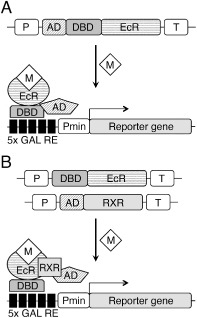
Methoxyfenozide‐inducible expression systems. (A) Monopartite system. This employs a transcription factor comprising a herpes simplex virus‐derived VP16 activation domain (AD), the DNA‐binding domain from Saccharomyces cerevisiaeGAL4 (DBD) and an ecdysone receptor domain from Christoneura fumiferana (EcR), which are expressed from a promoter (P) and terminator (T). After binding methoxyfenozide (M), the chimeric transcription factor translocates into the nucleus, where it binds GAL4 response elements (5x GAL4 RE) upstream of a minimal promoter (Pmin) to activate a reporter gene. (B) Bipartite or two‐hybrid system. An active transcription factor results when methoxyfenozide binds to a DBDEcR chimera, which binds a chimera of AD and the retinoid X‐receptor from Locusta migratoria (RXR).
Figure 2
Figure 2
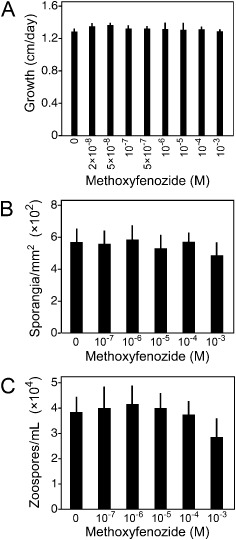
Effects of methoxyfenozide on Phytophthora infestans. (A) Growth on rye–sucrose agar containing 0–1 mm methoxyfenozide. (B) Sporulation on rye–sucrose agar containing 0–1 mm methoxyfenozide, measured in cultures 8 days after inoculation. (C) Zoospore release from sporangia incubated in 0–1 mm methoxyfenozide. In each panel, values represent averages and standard deviations from three biological replicates.
Figure 3
Figure 3
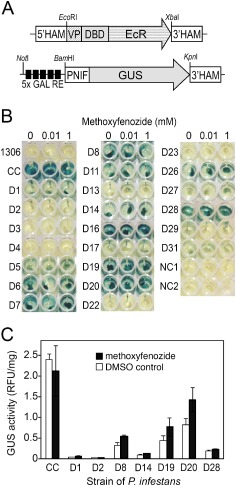
Performance of monopartite gene switch in Phytophthora infestans. (A) Linearized maps of plasmids expressing the VP16DBDEcR chimera (top) and β‐glucuronidase (GUS) reporter (bottom). Each also bears a neomycin phosphotransferase II (nptII) gene for selection of transformants (not shown). Transcription units employ the constitutive Ham34 promoter from Bremia lactucae (5'HAM), the minimal NifS promoter from P. infestans (PNIF) and the Ham34 transcriptional terminator (3'HAM). (B) Histochemical staining for GUS in hyphal plugs incubated for 24 h in rye–sucrose broth containing 0, 0.01 or 1 mm methoxyfenozide. Strains D1D31 were obtained by co‐transformation of the two plasmids shown in (A); NC1 and NC2 are negative control transformants obtained using the GUS plasmid alone; CC is a positive control that expresses GUS from the Ham34 promoter. (C) Specific activity of GUS in transformants grown for 24 h in rye–sucrose broth containing 10 μm methoxyfenozide or the dimethylsulphoxide (DMSO) solvent alone, expressed as relative fluorescence units (RFU) per microgram. Values are from two biological replicates.
Figure 4
Figure 4
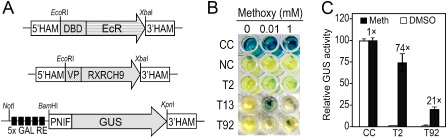
Initial tests of two‐hybrid switch in Phytophthora infestans. (A) Shown from top to bottom are the linearized maps of plasmids expressing the GAL4 DBDEcR chimera, VP16RXR fusion and β‐glucuronidase (GUS) reporter. Not shown are the neomycin phosphotransferase II (nptII) cassettes. (B) Histochemical staining of GUS in transformants (T2, T13, T92) obtained using the three plasmids, a negative control transformant containing the GUS reporter alone (NC) and a strain expressing GUS from the Ham34 promoter (CC). Cultures were grown as described in Fig. 3 with 0, 0.01 or 1 mm inducer. (C) Specific activity of GUS in transformants grown for 24 h in rye–sucrose broth containing 10 μm methoxyfenozide or the dimethylsulphoxide (DMSO) solvent alone. Numbers above the bars represent the fold induction by methoxyfenozide.
Figure 5
Figure 5
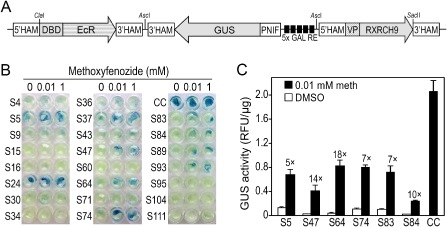
Tests of two‐hybrid switch expressed from a single plasmid. (A) Linearized map of plasmid encoding the GAL4 DBDEcR chimera, VP16RXR fusion and β‐glucuronidase (GUS) reporter. Not shown is neomycin phosphotransferase II (nptII). (B) Histochemical staining of GUS in transformants (S4S111) containing the two‐hybrid plasmid and a strain expressing GUS from the Ham34 promoter (CC). Cultures were grown as in Fig. 3 with 0, 0.01 or 1 mm inducer. (C) Specific activity of GUS in transformants grown in broth containing 10 μm methoxyfenozide or the dimethylsulphoxide (DMSO) solvent alone, expressed as relative fluorescence units (RFU) per microgram of protein. Numbers above the bars represent the fold induction by methoxyfenozide.
Figure 6
Figure 6
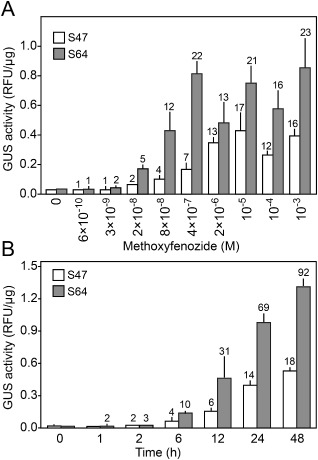
Effect of methoxyfenozide concentration and incubation time on induction of the two‐hybrid system. (A) Specific activity of β‐glucuronidase (GUS) in transformants S47 and S64 (from Fig. 5) grown in broth and treated for 24 h with the indicated amounts of inducer. (B) Activities after treatment with 10 μm methoxyfenozide for 0–48 h. Numbers above the bars represent the fold induction by methoxyfenozide. RFU, relative fluorescence units.
Figure 7
Figure 7
Induction of two‐hybrid reporter in two‐hybrid transformants S64 and S47 in hyphae and germinating sporangia. (A) β‐Glucuronidase (GUS) specific activity after treatment with 10 and 30 μm of inducer, or the dimethylsulphoxide (DMSO) solvent control. Left: the inducer was added to hyphae submerged in rye–sucrose broth, and tissue was analysed after 24 h. Centre: surface‐grown hyphae from agar cultures were transferred to medium containing inducer and assayed after 24 h. Right: sporangia were placed in 0.25 mm CaCl2 containing inducer, incubated for 90 min at 12 °C and assayed. Specific activity is expressed as picomoles of substrate cleaved per second per milligram of protein. (B) Histochemical staining of hyphae induced on agar medium, or chilled sporangia.
Figure 8
Figure 8
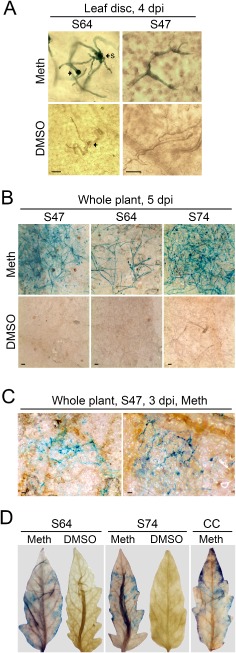
Performance of two‐hybrid system in tomato tissue infected with zoospores of Phytophthora infestans transformants, using the histochemical staining assay. (A) Leaf discs floated on water containing 10 μm methoxyfenozide (Meth) or the dimethylsulphoxide (DMSO) solvent control at 4 days post‐infection (dpi). In the S64 panel, P. infestans hyphae are starting to emerge from stomata (S) onto the leaf surface. In the S47 panel, P. infestans is shown at a slightly earlier stage of the disease cycle, in the apoplastic space. (B) Leaflets at 5 dpi from infected whole tomato plants sprayed with 10 μm methoxyfenozide or the control. (C) Same as (B) but at 3 dpi, showing two representative leaflets. (D) Leaflets from whole plants induced by adding methoxyfenozide to the soil. Strains were all‐in‐one transformants (S64, S74) and the constitutive β‐glucuronidase (GUS) strain (CC). Size bars in (A–C) are 40 μm.

References

    1. Ah Fong, A. , Xiang, Q. and Judelson, H.S. (2007) Architecture of the sporulation‐specific Cdc14 promoter from the oomycete Phytophthora infestans . Eukaryot. Cell, 6, 2222–2230. - PMC - PubMed
    1. Ah‐Fong, A.M. and Judelson, H.S. (2011) Vectors for fluorescent protein tagging in Phytophthora: tools for functional genomics and cell biology. Fungal Biol. 115, 882–890. - PubMed
    1. Auslander, S. and Fussenegger, M. (2013) From gene switches to mammalian designer cells: present and future prospects. Trends Biotechnol. 31, 155–168. - PubMed
    1. Baneyx, F. (1999) Recombinant protein expression in Escherichia coli . Curr. Opin. Biotechnol. 10, 411–421. - PubMed
    1. Braun, S. , Azoitei, A. and Spindler‐Barth, M. (2009) DNA‐binding properties of Drosophila ecdysone receptor isoforms and their modification by the heterodimerisation partner ultraspiracle. Arch. Insect Biochem. Physiol. 72, 172–191. - PubMed

Publication types

MeSH terms

Associated data

LinkOut - more resources