


School-based obesity prevention intervention in Chilean children: effective in controlling, but not reducing obesity
- PMID: 24872892
- PMCID: PMC4020193
- DOI: 10.1155/2014/618293
School-based obesity prevention intervention in Chilean children: effective in controlling, but not reducing obesity
Abstract
Objective: To evaluate the effectiveness of a 12-month multicomponent obesity prevention intervention. Setting. 9 elementary schools in Santiago, Chile. Subjects. 6-8 y old low-income children (N = 1474).
Design: Randomized controlled study; 5 intervention/4 control schools. We trained teachers to deliver nutrition contents and improve the quality of PE classes. We determined % healthy snacks brought from home, children's nutrition knowledge, nutritional status, duration of PE classes, and % time in moderate/vigorous activity (MVA). Effectiveness was determined by comparing Δ BMI Z between intervention and control children using PROCMIXED.
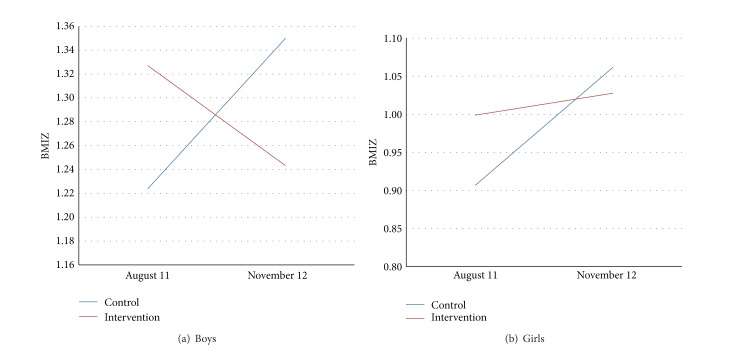
Results: % obesity increased in boys from both types of schools and in girls from control schools, while decreasing in girls from intervention schools (all nonsignificant). % class time in MVA declined (24.5-16.2) while remaining unchanged (24.8-23.7%) in classes conducted by untrained and trained teachers, respectively. In boys, BMI Z declined (1.33-1.24) and increased (1.22-1.35) in intervention and control schools, respectively. In girls, BMI Z remained unchanged in intervention schools, while increasing significantly in control schools (0.91-1.06, P = 0.024). Interaction group ∗ time was significant for boys (P < 0.0001) and girls (P = 0.004).
Conclusions: This intervention was effective in controlling obesity, but not preventing it. Even though impact was small, results showed that when no intervention is implemented, obesity increases.
Comment in
-
Comment on "School-Based Obesity Prevention Intervention in Chilean Children: Effective in Controlling, but not Reducing Obesity".J Obes. 2015;2015:183528. doi: 10.1155/2015/183528. Epub 2015 Jun 11. J Obes. 2015. PMID: 26171245 Free PMC article. No abstract available.
References
-
- Vio F, Albala C, Kain J. Nutrition transition in Chile revisited: mid-term evaluation of obesity goals for the period 2000–2010. Public Health Nutrition. 2008;11(4):405–412. - PubMed
-
- Bustos N, Benavides C. Qué Rico es Comer Sano!! Santiago, Chile: INTA; 2010.
-
- Concha F. Moviéndonos Por la Educación Física. Santiago, Chile: INTA; 2007.
Publication types
MeSH terms
LinkOut - more resources
Full Text Sources
Other Literature Sources
Medical
