. 2014 Jun 24;53(24):4015-24.
doi: 10.1021/bi500162z. Epub 2014 Jun 12.

Regulation of nonmuscle myosin II by tropomyosin

Affiliations

Regulation of nonmuscle myosin II by tropomyosin

Bipasha Barua et al. Biochemistry. .

Abstract

The actin cytoskeleton carries out cellular functions, including division, migration, adhesion, and intracellular transport, that require a variety of actin binding proteins, including myosins. Our focus here is on class II nonmuscle myosin isoforms, NMIIA, NMIIB, and NMIIC, and their regulation by the actin binding protein, tropomyosin. NMII myosins are localized to different populations of stress fibers and the contractile ring, structures involved in force generation required for cell migration, adhesion, and cytokinesis. The stress fibers and contractile ring that contain NMII myosins also contain tropomyosin. Four mammalian genes encode more than 40 tropomyosins. Tropomyosins inhibit or activate actomyosin MgATPase and motility depending on the myosin and tropomyosin isoform. In vivo, tropomyosins play a role in cell migration, adhesion, cytokinesis, and NMII isoform localization in an isoform-specific manner. We postulate that the isoform-specific tropomyosin localization and effect on NMII isoform localization reflect modulation of NMII actomyosin kinetics and motile function. In this study, we compare the ability of different tropomyosin isoforms to support actin filament motility with NMIIA, NMIIB, and NMIIC as well as skeletal muscle myosin. Tropomyosins activated, inhibited, or had no effect on motility depending on the myosin, indicating that the myosin isoform is the primary determinant of the isoform-specific effect of tropomyosin on actomyosin regulation. Activation of motility of nonmuscle tropomyosin-actin filaments by NMII myosin correlates with an increased Vmax of the myosin MgATPase, implying a direct effect on the myosin MgATPase, in contrast to the skeletal tropomyosin-actin filament that has no effect on the Vmax or maximal filament velocity.


Figures
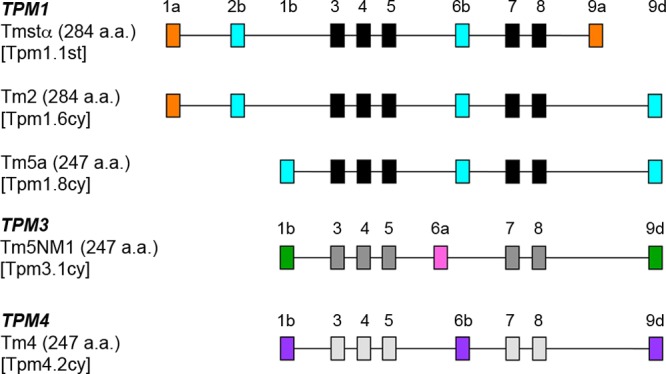
Figure 1
Figure 1
Tropomyosin gene structure in vertebrates. The arrangement of exons expressed in the Tm isoforms used in this study from TPM1, TPM3, and TPM4 genes is shown. The names of the Tms in parentheses correspond to the systematic nomenclature proposed for mammalian tropomyosins by Geeves, Hitchcock-DeGregori, and Gunning (manuscript submitted for publication). The full forms of the names in the parentheses are as follows: Tpm1.1st, Tpm1.1st(a.b.b.a); Tpm1.6cy, Tpm1.6cy(a.b.b.d); Tpm1.8cy, Tpm1.8cy(b.-.b.d.); Tpm3.1cy, Tpm3.1cy(b.-.a.d); Tpm4.2cy, Tpm4.2cy(b.-.b.d).
Figure 2
Figure 2
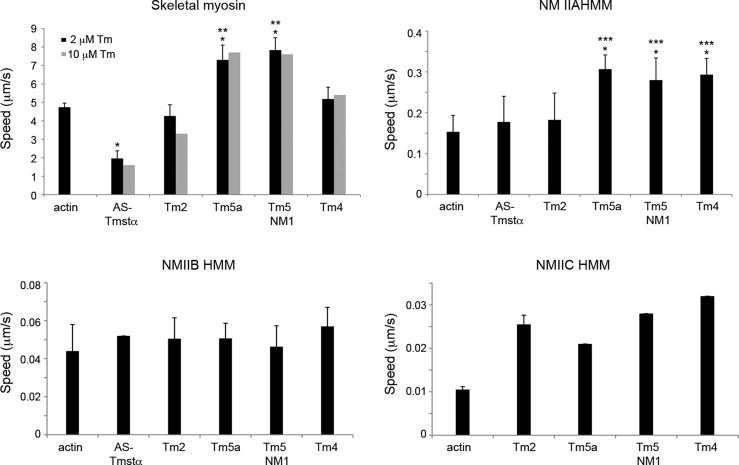
Filament speeds of actin–tropomyosin in in vitro motility assays. Filament speeds were determined for actin and actin–Tm on skeletal myosin and phosphorylated NMIIA, NMIIB, and NMIIC HMMs. The assays with actin–Tm were conducted with 2 μM Tm (black bars). Assays were also conducted with 10 μM Tm for skeletal myosin (gray bars). The filament speeds are means ± SD from two to six experiments (Table 1). The data with no error bars are from a single experiment. *P < 0.01 compared with actin. **P < 0.01 compared with AS-Tmstα, Tm2, and Tm4. ***P < 0.05 compared with AS-Tmstα and Tm2 (unpaired Student’s t test). Assay conditions: 25 mM imidazole (pH 7.6), 25 mM KCl, 4 mM MgCl2, 7.6 mM MgATP, 50 mM DTT, 0.5% methyl cellulose, and an oxygen scavenger system (0.1 mg/mL glucose oxidase, 0.02 mg/mL catalase, and 2.5 mg/mL glucose). The temperature was 27 °C for skeletal myosin and 32 °C for HMMs IIA, IIB, and IIC.
Figure 3
Figure 3
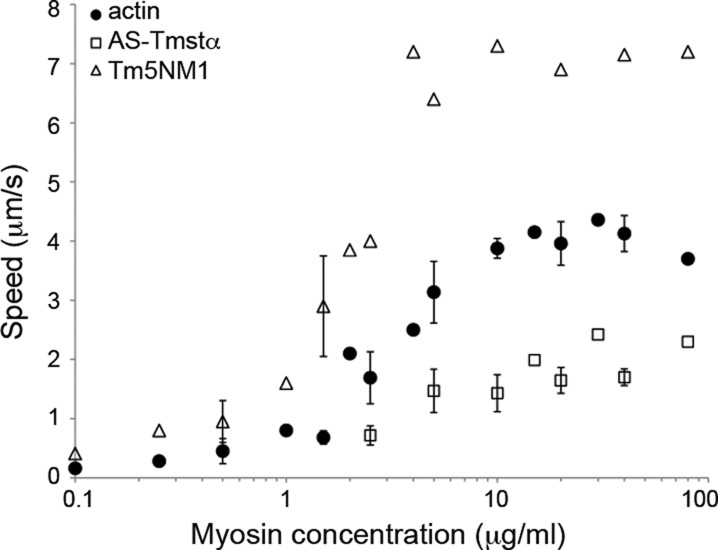
Filament speeds as a function of surface myosin density. Filament speeds were determined for actin, actin–AS-Tmstα, and actin–Tm5NM1 as a function of skeletal myosin loading concentration. The data with error bars show the standard deviation from two or three experiments, and the data with no error bars are from a single experiment. Assay conditions are the same as in Figure 2. The temperature was 27 °C.
Figure 4
Figure 4
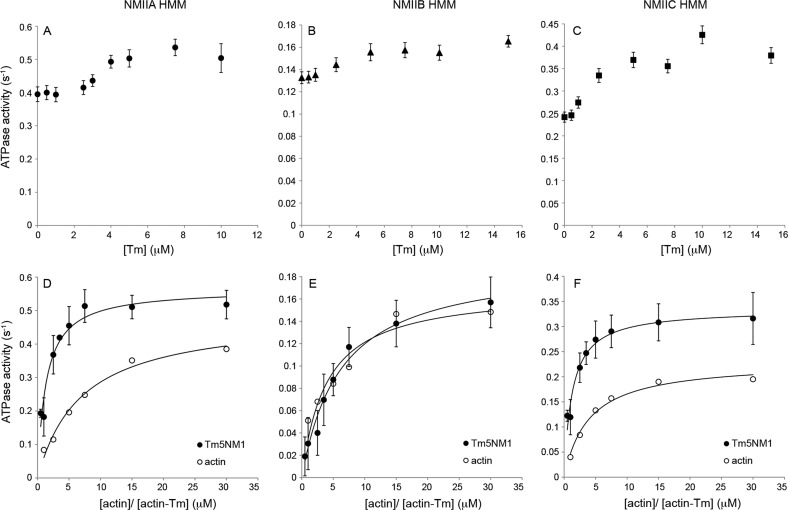
Actin-activated MgATPase activity of myosins. The steady-state ATPase activity of phosphorylated NMIIA (A and D), NMIIB (B and E), and NMIIC (C and F) HMMs was measured in the presence of (A–C) 15 μM actin and varying concentrations of Tm5NM1 (0–15 μM) or (D–F) varying concentrations of actin and actin–Tm5NM1 (0.5–30 μM) combined at a 1:1 molar ratio. The data in panels D–F were fit to a hyperbolic equation (—) to obtain the values for Vmax and KATPase. Each HMM II protein was at a concentration of 0.1 μM. Each data point is shown with the standard deviation from three or four experiments, and the data without error bars are from a single experiment. The Vmax and KATPase values are listed in Table 2. Assay conditions: 10 mM MOPS (pH 7.0), 2 mM MgCl2, 1 mM ATP, 50 mM KCl, 0.15 mM EGTA, 40 units/mL l-lactic dehydrogenase, 200 units/mL pyruvate kinase, 200 μM NADH, and 1 mM phospho(enol)pyruvate. The temperature was 25 °C.
Figure 5
Figure 5
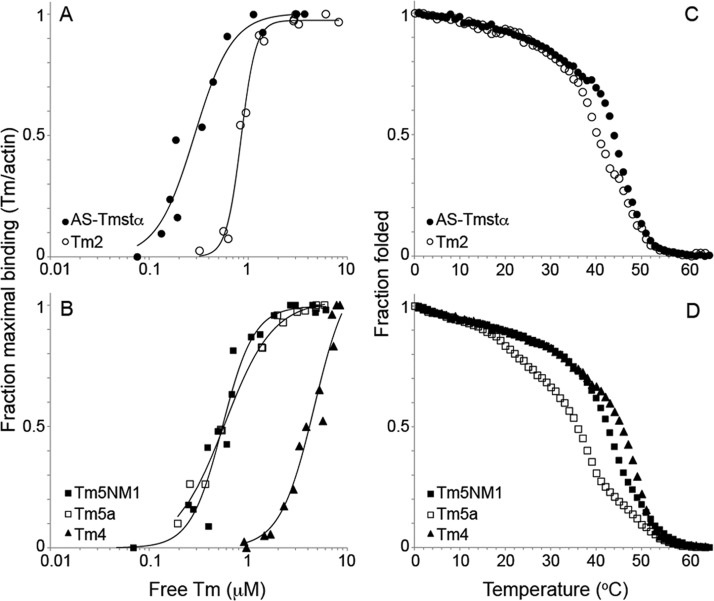
Actin affinity and thermal stability of tropomyosins. (A and B) Binding of Tm measured by cosedimentation with F-actin. Tropomyosin (0.1–8 μM) was combined with 5 μM F-actin and sedimented at 20 °C in 200 mM NaCl, 10 mM Tris-HCl (pH 7.5), 2 mM MgCl2, and 0.5 mM DTT. Stoichiometric binding of one Tm per seven actins is represented by a maximal fraction of binding of 1. The data for each isoform were obtained from two to four independent experiments. The Kapp and Hill coefficient (αH) values are listed in Table 3. (C and D) Fraction folded as measured by the relative ellipticity at 222 nm as a function of temperature (0–65 °C). The Tm concentration was 1.5 μM in 0.5 M NaCl, 10 mM sodium phosphate (pH 7.5), 1 mM EDTA, and 1 mM DTT. The fraction folded is relative to the mean residue ellipticity at 0 °C, where the proteins were fully folded. The TM values are listed in Table 3.

References

    1. Engelhardt W. A.; Ljubimowa M. N. (1939) Myosine and adenosinetriphosphatase. Nature 144, 668–669.
    1. Gordon A. M.; Homsher E.; Regnier M. (2000) Regulation of contraction in striated muscle. Physiol. Rev. 80, 853–924. - PubMed
    1. Bremel R. D.; Weber A. (1972) Cooperation within actin filament in vertebrate skeletal muscle. Nat. New Biol. 238, 97–101. - PubMed
    1. Wang C. L.; Coluccio L. M. (2010) New insights into the regulation of the actin cytoskeleton by tropomyosin. Int. Rev. Cell Mol. Biol. 281, 91–128. - PMC - PubMed
    1. Pruyne D. (2008) Tropomyosin function in yeast. Adv. Exp. Med. Biol. 644, 168–186. - PubMed

Publication types

LinkOut - more resources