Review
. 2014 Aug 10:187:133-44.
doi: 10.1016/j.jconrel.2014.05.036. Epub 2014 May 27.

State-of-the-art in design rules for drug delivery platforms: lessons learned from FDA-approved nanomedicines

Affiliations
Review

State-of-the-art in design rules for drug delivery platforms: lessons learned from FDA-approved nanomedicines

Charlene M Dawidczyk et al. J Control Release. .

Abstract

The ability to efficiently deliver a drug to a tumor site is dependent on a wide range of physiologically imposed design constraints. Nanotechnology provides the possibility of creating delivery vehicles where these design constraints can be decoupled, allowing new approaches for reducing the unwanted side effects of systemic delivery, increasing targeting efficiency and efficacy. Here we review the design strategies of the two FDA-approved antibody-drug conjugates (Brentuximab vedotin and Trastuzumab emtansine) and the four FDA-approved nanoparticle-based drug delivery platforms (Doxil, DaunoXome, Marqibo, and Abraxane) in the context of the challenges associated with systemic targeted delivery of a drug to a solid tumor. The lessons learned from these nanomedicines provide an important insight into the key challenges associated with the development of new platforms for systemic delivery of anti-cancer drugs.

Keywords: Active targeting; Circulation; Enhanced permeability and retention (EPR) effect; Liposomes; Nanoparticles; Tumor targeting.


Figures

Figure 1
Figure 1
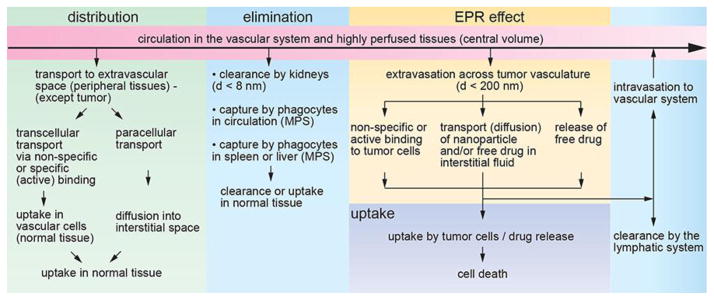
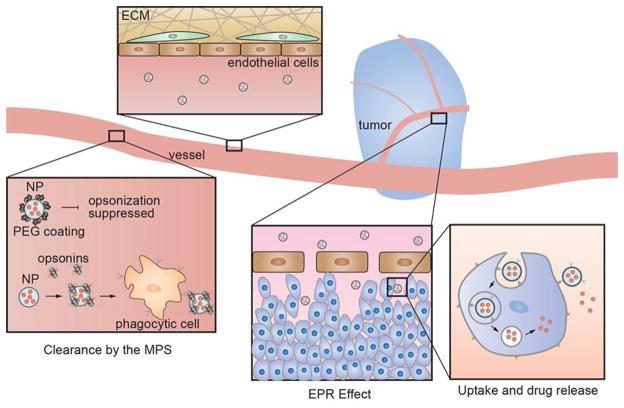
Schematic illustration of physiologically imposed design constraints for nanoparticle-based targeted drug delivery. After systemic delivery of a nanoparticle-based platform, distribution in peripheral tissues (except the tumor) can lead to uptake in normal tissues and the potential for adverse side effects. Nanoparticles can be targeted by the Mononuclear Phagocyte System (MPS) in circulation or in the liver and spleen. Small nanoparticles or nanoparticle fragments can be cleared by the kidneys. The enhanced permeability and retention (EPR) effect is usually the key to accumulation of a nanoparticle-platform in a solid tumor. A nanoparticle may be taken up by active targeting of cell surface biomarkers on the tumor cells or by passive non-specific binding. Drug release after uptake may be by passive diffusion (e.g. from a polymer nanoparticle) or by exploiting a cleavable linker. Transport of the nanoparticle platform or free drug to the tumor core usually relies on passive diffusion in the interstitial space.
Figure 2
Figure 2
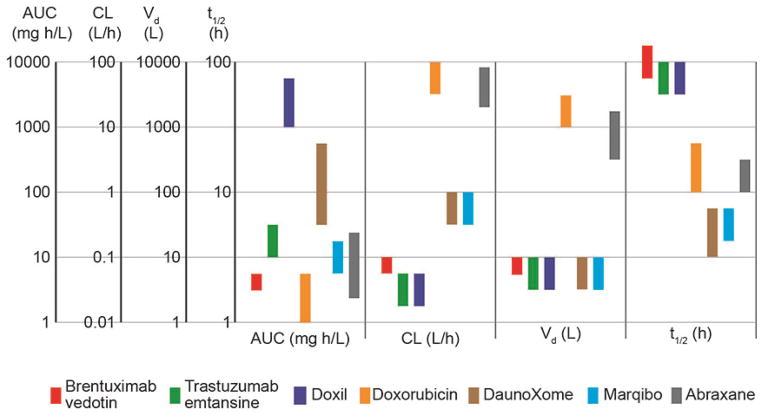
Summary of pharmacokinetic parameters for FDA-approved antibody drug conjugates (ADCs) and nanomedicines: Area Under the Curve (AUC), clearance (CL), distribution volume (Vd), and elimination half-time (t1/2). Each bar represents the range of mean values obtained from clinical trials in humans. Brentuxumab vedotin, Trastuzumab emtansine, Doxil, Doxorubicin, DaunoXome, Marqibo, Abraxane. Doxil has high AUC, low clearance rate, small distribution volume, and a long elimination half-time. These features are largely due to the polyethylene glycol coating that provides extended evasion of the MPS and minimizes distribution into peripheral tissues. DaunoXome and Marqibo also have a small distribution volume but are designed to have faster MPS uptake and shorter elimination half-times by having no polyethylene glycol coating. The ADCs have low clearance rates, small distribution volumes, and long elimination half-time, but relative low AUCs. Abraxane has a relatively fast clearance rate, large distribution volume, and moderate elimination half-time.
Figure 3
Figure 3
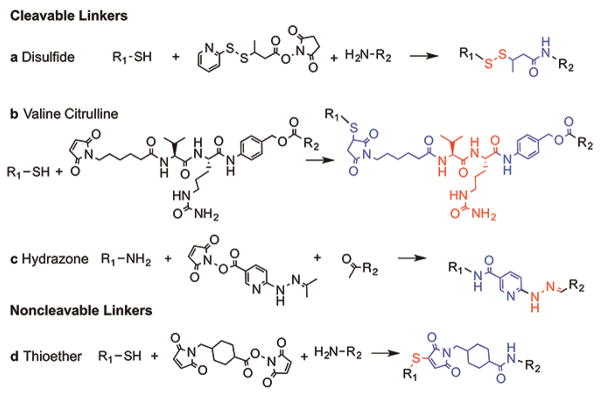
Common cleavable linkers for ADCs. (a) Disulfide bonds are formed using a cross-linking agent such as N-succinimidyl 3-(2-pyridyldithio)butyrate (SPDP) to link a thiol group to an amine. Disulfide bonds are cleavable under reducing agents. (b) The valine-citrulline bond is a common peptide linkage that can be attached to antibodies via accessible thiols. The peptide sequence cleaved by proteases, such as cathepsin, in acidic endosomes or lysosomes. (c) Hydrazone bonds can be formed using succinimidyl 4-hydrazinonicotinate acetone hydrazone (SANH) to link an amine to an aldehyde containing. Hydrazone bonds are stable at neutral pH but can be cleaved in acidic lysosomes. (d) The thiother bond is the most common non-cleavable linker, formed between a maleimide group (often on the drug) and a sulfhydryl group on the antibody using a crosslinking agent such as succinimidyl 4-(N-maleimidomethyl) cyclohexane-1-carboxylate (SMCC). In general, drug release is achieved by proteolytic degradation of the targeting antibody. The linker is shown in blue with the bond group in red.
Figure 4
Figure 4
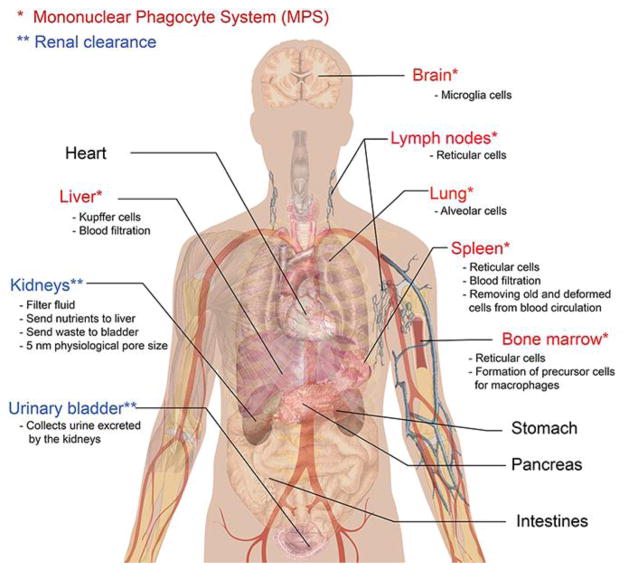
The mononuclear phagocyte system (MPS). Phagocytes, monocytes, and dendritic cells in the MPS participate in the response to inflammation and infection. Phagocytes are responsible for removing pathogens and foreign bodies such as nanoparticles from circulation. Opsonins that bind to nanoparticles initiate uptake and removal from circulation by phagocytes.
Figure 5
Figure 5
The Enhanced Permeation and Retention (EPR) effect. The accumulation of a drug delivery platform by the EPR effect requires high sustained plasma concentrations. Minimizing accumulation in peripheral tissue by transendothelial or paracellular transport is important in maintaining high plasma concentrations. Avoiding clearance by the MPS is important in increasing the elimination half-time. Activation of endothelial cells in the tumor vasculature leads to increased permeability compared to normal vasculature. The leakiness of the vasculature is dependent on the tumor type, size, and microenvironment. It is generally assumed that particles less than 200 nm in diameter are able to extravasate to the tumor site. After extravasation to the tumor site, the delivery platform must diffuse to tumor cells and induce cell death. Drug release can occur by various mechanisms and is one of the major challenges in the development of delivery platforms.

References

    1. Schrama D, Reisfeld RA, Becker JC. Antibody targeted drugs as cancer therapeutics. Nature Reviews Drug Discovery. 2006;5:147–159. - PubMed
    1. Adams GP, Weiner LM. Monoclonal antibody therapy of cancer. Nat Biotechnol. 2005;23:1147–1157. - PubMed
    1. Scott AM, Allison JP, Wolchok JD. Monoclonal antibodies in cancer therapy. Cancer Immun. 2012;12:14. - PMC - PubMed
    1. Galluzzi L, Vacchelli E, Fridman WH, Galon J, Sautes-Fridman C, Tartour E, Zucman-Rossi J, Zitvogel L, Kroemer G. Trial Watch: Monoclonal antibodies in cancer therapy. Oncoimmunology. 2012;1:28–37. - PMC - PubMed
    1. Firer MA, Gellerman G. Targeted drug delivery for cancer therapy: the other side of antibodies. J Hematol Oncol. 2012;5:70. - PMC - PubMed

Publication types