


Eruption stage of permanent molars and occlusal caries activity/arrest
- PMID: 24874701
- PMCID: PMC4293724
- DOI: 10.1177/0022034514537646
Eruption stage of permanent molars and occlusal caries activity/arrest
Abstract
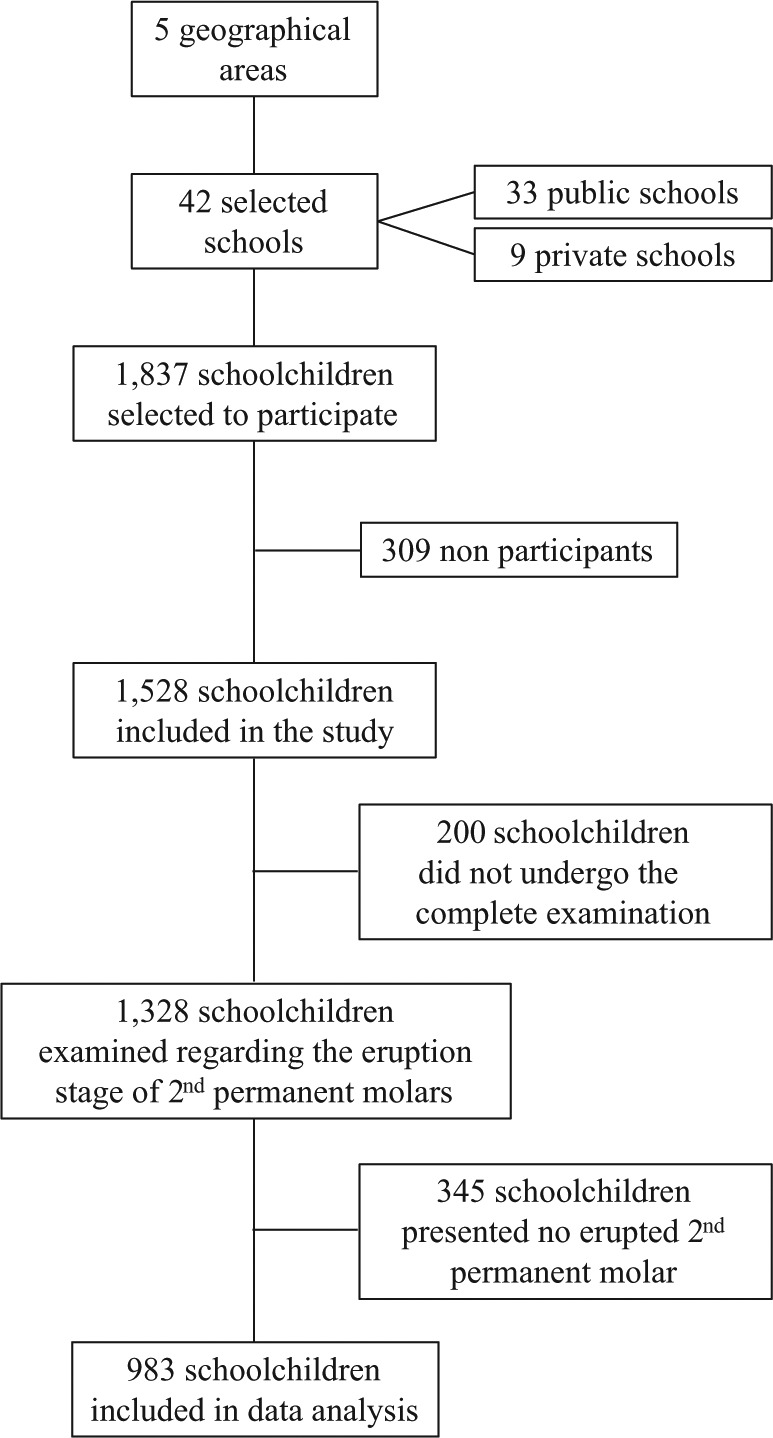
This study assessed the association between the eruption stage of permanent second molars and occlusal caries activity among 12-year-old schoolchildren from South Brazil. A cross-sectional study was performed in Porto Alegre using a multistage probability sampling strategy to select a representative sample. Clinical examination was conducted to assess the eruption stage of permanent molars, Gingival Bleeding Index, and, after tooth cleaning and drying, caries experience (noncavitated and cavitated lesions, including caries activity assessment). Data were collected on sex, socioeconomic status, mother's education, brushing frequency, and consumption of soft drinks. Generalized estimating equations were used to estimate odds ratios (ORs) and 95% confidence intervals (CIs). Overall, 983 schoolchildren with 3,071 second molars were available for analysis. Whereas active caries was observed in 6.6% of fully erupted permanent second molars, caries affected 26.2%, 29.6%, and 18.2% of erupting molars classified as stages 1, 2, and 3, respectively: stage 1, partially erupted occlusal surface; stage 2, fully erupted occlusal surface, <1/2 crown exposed; and stage 3, fully erupted occlusal surface, >1/2 crown exposed. After adjusting for socioeconomic and behavioral variables, partially erupted molars were significantly more likely to present active caries lesions than molars in full occlusion: stage 1, OR = 4.99 (95% CI = 3.38, 7.38); stage 2, OR = 5.18 (95% CI = 3.14, 8.53); stage 3, OR = 3.20 (95% CI = 2.21, 4.64). Similar results were found when clinical variables were included in the adjusted model. In conclusion, most occlusal caries lesions tend to arrest/revert when teeth reach the occlusal plan; however, an important proportion of these lesions remains active and in need of proper management. Children at risk should be targeted with preventive and minimally invasive strategies.
Keywords: cross-sectional study; dental caries; dental occlusion; diagnosis; epidemiology; risk assesment.
© International & American Associations for Dental Research.
Conflict of interest statement
The authors declare no potential conflicts of interest with respect to the authorship and/or publication of this article.
References
-
- ABEP (2009). Brazilian association of population studies: standard Brazilian economic classifications. URL accessed on 5/8/2014 at: http://www.abep.org/new/.
-
- Ainamo J, Bay I. (1975). Problems and proposals for recording gingivitis and plaque. Int Dent J 25:229-235. - PubMed
-
- Alves LS, Susin C, Damé-Teixeira N, Maltz M. (2013). Overweight and obesity are not associated with dental caries among 12-year-old South Brazilian schoolchildren. Community Dent Oral Epidemiol 41:224-231. - PubMed
-
- Brailsford SR, Sheehy EC, Gilbert SC, Clark DT, Kidd EA, Zoitopoulos L, et al. (2005). The microflora of the erupting first permanent molar. Caries Res 39:78-84. - PubMed
Publication types
MeSH terms
LinkOut - more resources
Full Text Sources
Other Literature Sources
