Patient complaints in healthcare systems: a systematic review and coding taxonomy
- PMID: 24876289
- PMCID: PMC4112446
- DOI: 10.1136/bmjqs-2013-002437
Patient complaints in healthcare systems: a systematic review and coding taxonomy
Abstract
Background: Patient complaints have been identified as a valuable resource for monitoring and improving patient safety. This article critically reviews the literature on patient complaints, and synthesises the research findings to develop a coding taxonomy for analysing patient complaints.
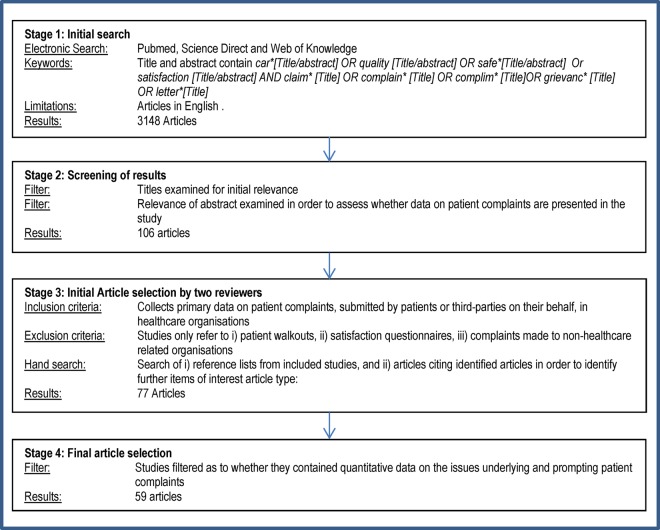
Methods: The PubMed, Science Direct and Medline databases were systematically investigated to identify patient complaint research studies. Publications were included if they reported primary quantitative data on the content of patient-initiated complaints. Data were extracted and synthesised on (1) basic study characteristics; (2) methodological details; and (3) the issues patients complained about.
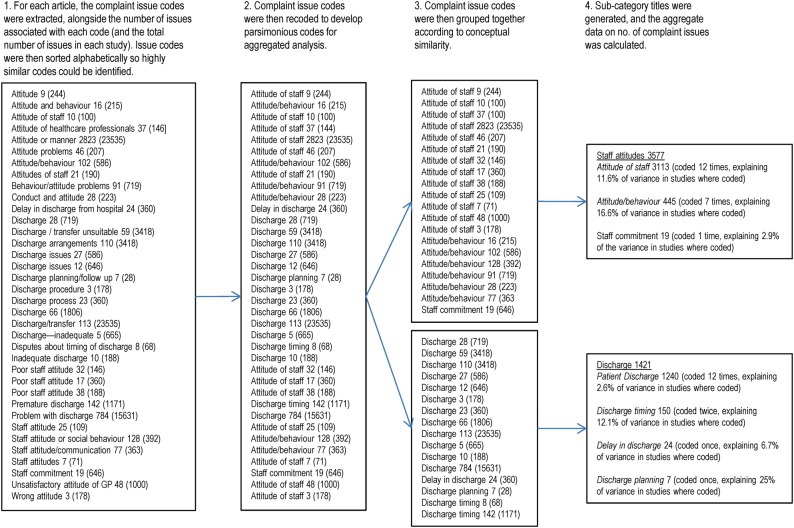
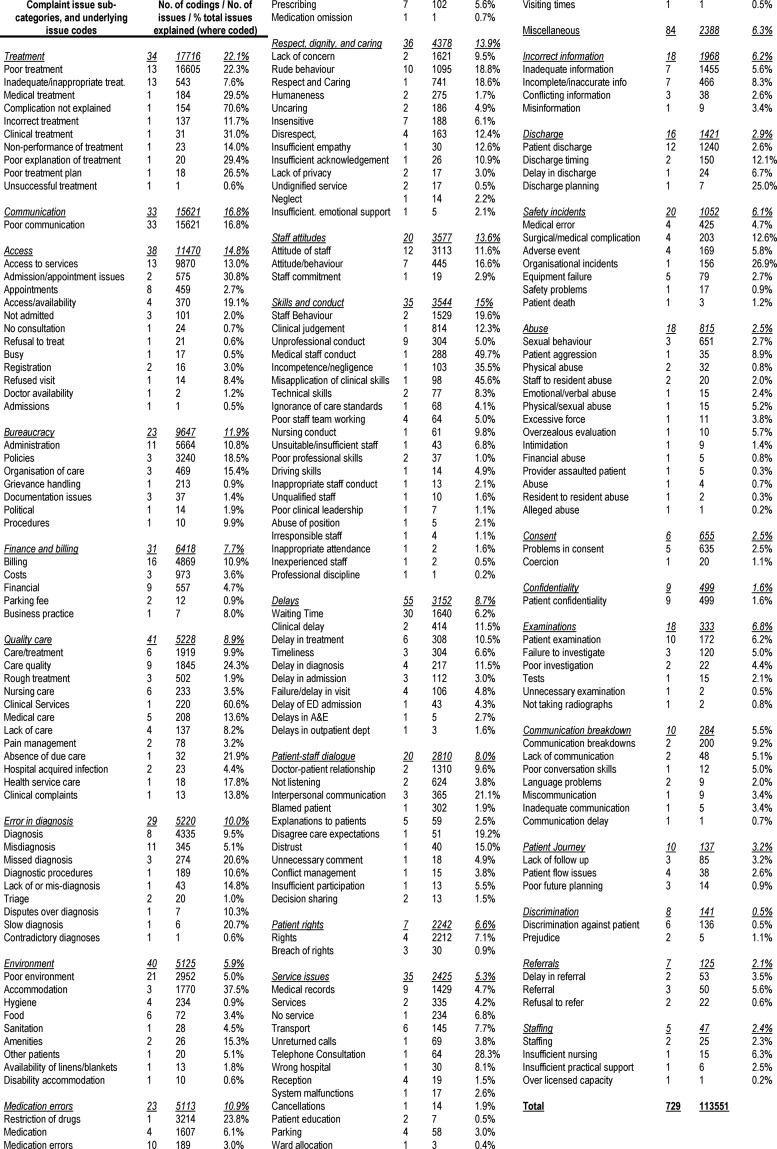
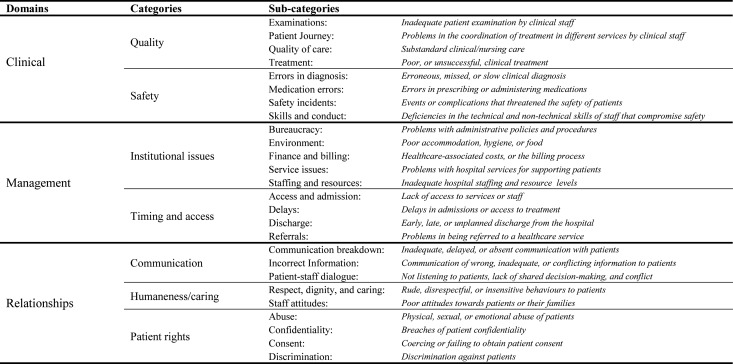
Results: 59 studies, reporting 88,069 patient complaints, were included. Patient complaint coding methodologies varied considerably (eg, in attributing single or multiple causes to complaints). In total, 113,551 issues were found to underlie the patient complaints. These were analysed using 205 different analytical codes which when combined represented 29 subcategories of complaint issue. The most common issues complained about were 'treatment' (15.6%) and 'communication' (13.7%). To develop a patient complaint coding taxonomy, the subcategories were thematically grouped into seven categories, and then three conceptually distinct domains. The first domain related to complaints on the safety and quality of clinical care (representing 33.7% of complaint issues), the second to the management of healthcare organisations (35.1%) and the third to problems in healthcare staff-patient relationships (29.1%).
Conclusions: Rigorous analyses of patient complaints will help to identify problems in patient safety. To achieve this, it is necessary to standardise how patient complaints are analysed and interpreted. Through synthesising data from 59 patient complaint studies, we propose a coding taxonomy for supporting future research and practice in the analysis of patient complaint data.
Keywords: Healthcare quality improvement; Human factors; Patient satisfaction; Patient-centred care; Quality improvement.
Published by the BMJ Publishing Group Limited. For permission to use (where not already granted under a licence) please go to http://group.bmj.com/group/rights-licensing/permissions.
Figures
References
-
- Donaldson L. An organisation with a memory: Learning from adverse events in the NHS. London: Department of Health, 2000
-
- Weingart SN, Pagovich O, Sands DZ, et al. Patient-reported service quality on a medicine unit. Int J Qual Health Care 2006;18:95–101 - PubMed
-
- Levtzion-Korach O, Frankel A, Alcalai H, et al. Integrating incident data from five reporting systems to assess patient safety: making sense of the elephant. Jt Comm J Qual Patient Saf 2010;36:402–10 - PubMed
-
- Francis R. Report of the mid-Staffordshire NHS Foundation Trust Public Inquiry. London: The Stationary Office, 2013
Publication types
MeSH terms
LinkOut - more resources
Full Text Sources
Other Literature Sources
Medical