


Does Device Make Any Difference? A Real-world Retrospective Study of Insulin Treatment Among Elderly Patients With Type 2 Diabetes
- PMID: 24876551
- PMCID: PMC4454098
- DOI: 10.1177/1932296813516956
Does Device Make Any Difference? A Real-world Retrospective Study of Insulin Treatment Among Elderly Patients With Type 2 Diabetes
Abstract
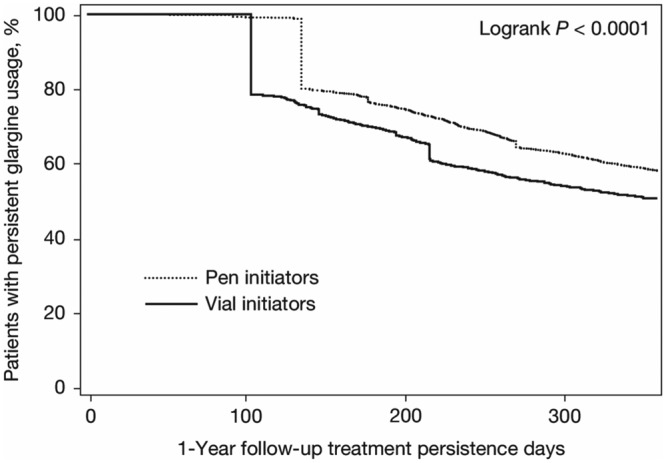
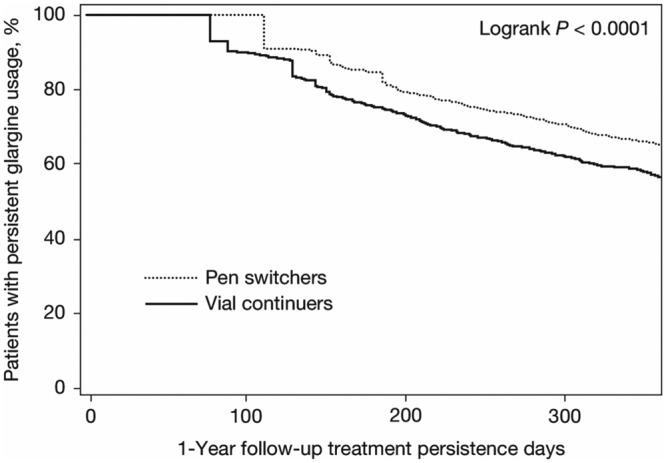
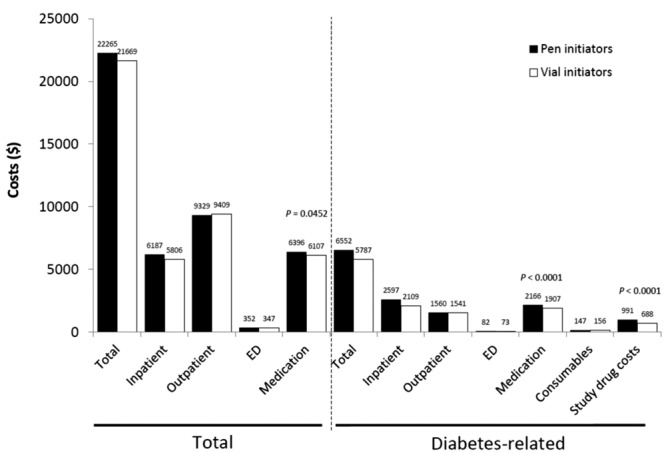
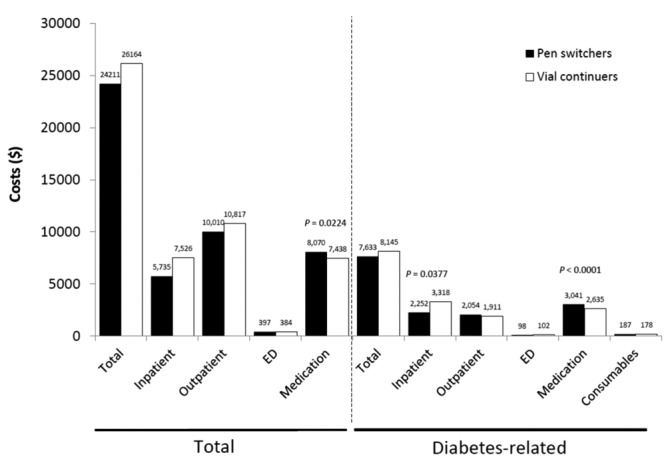
We compared real-world clinical and economic outcomes for insulin glargine treatment administered by disposable pen and traditional vial-and-syringe injections among elderly patients with type 2 diabetes mellitus (T2DM). Using a large database of US retirees, this retrospective longitudinal study examined 1-year follow-up outcomes in patients with T2DM aged 65 years or older who were either insulin naïve and initiated insulin glargine via disposable pen (pen initiators [PI]) or vial (vial initiators [VI]) or were already insulin glargine users but either continued with a vial (vial continuers [VC]) or switched to a disposable pen (pen switchers [PS]). There were 7856 propensity-score-matched patients, including 2930 each in the PI and VI cohorts, and 998 each in the VC and PS cohorts. Compared with vial-and-syringe users, the disposable pen users had significantly greater treatment persistence (P < .0001 for both comparisons), duration of persistence (P < .0001 for both), and adherence (P < .01 for both) and lower insulin daily average consumption (P < .05 for both). Compared with the VI cohort, the PI cohort had significantly fewer hypoglycemia-related events (P = .0164). Total health care costs were comparable for the respective matched cohorts. In elderly patients with T2DM receiving insulin glargine therapy, initiating or switching to a disposable pen was associated with better treatment persistence and adherence than initiating or continuing with vial-and-syringe, without increased total health care costs. Among insulin-naïve patients, initiating insulin glargine by disposable pen was also associated with significantly reduced risk of hypoglycemia compared with vial-and-syringe patients.
Keywords: elderly; insulin glargine; pen; type 2 diabetes.
© 2014 Diabetes Technology Society.
Conflict of interest statement
Figures
References
-
- International Diabetes Foundation. Risk factors, 2011. www.idf.org/about-diabetes/risk-factors. Accessed January 6, 2012.
-
- Centers for Disease Control and Prevention. National diabetes fact sheet: national estimates and general information on diabetes and prediabetes in the United States, 2011. www.cdc.gov/diabetes/pubs/pdf/ndfs_2011.pdf. Accessed January 6, 2012.
-
- Resnick HE, Heineman J, Stone R, Shorr RI. Diabetes in U.S. nursing homes, 2004. Diabetes Care. 2008;31(2):287-288. - PubMed
-
- Russell LB, Valiyeva E, Roman SH, Pogach LM, Suh DC, Safford MM. Hospitalizations, nursing home admissions, and deaths attributable to diabetes. Diabetes Care. 2005;28(7):1611-1617. - PubMed
LinkOut - more resources
Full Text Sources
Other Literature Sources
Research Materials
Miscellaneous
