


Review
doi: 10.1182/blood-2014-05-516252.
Epub 2014 May 29.
Molecular liaisons between erythropoiesis and iron metabolism
Affiliations
- PMID: 24876565
- PMCID: PMC4110655
- DOI: 10.1182/blood-2014-05-516252
Item in Clipboard
Review
Molecular liaisons between erythropoiesis and iron metabolism
Blood.
.
Abstract
Although most circulating iron in blood plasma is destined for erythropoiesis, the mechanisms by which erythropoietic demand modulates the iron supply ("erythroid regulators") remain largely unknown. Iron absorption, plasma iron concentrations, and tissue iron distribution are tightly controlled by the liver-produced hormone hepcidin. During the last decade, much progress has been made in elucidating hepcidin regulation by iron and inflammation. This review discusses the less understood mechanisms and mediators of hepcidin suppression in physiologically and pathologically stimulated erythropoiesis.
© 2014 by The American Society of Hematology.
Figures
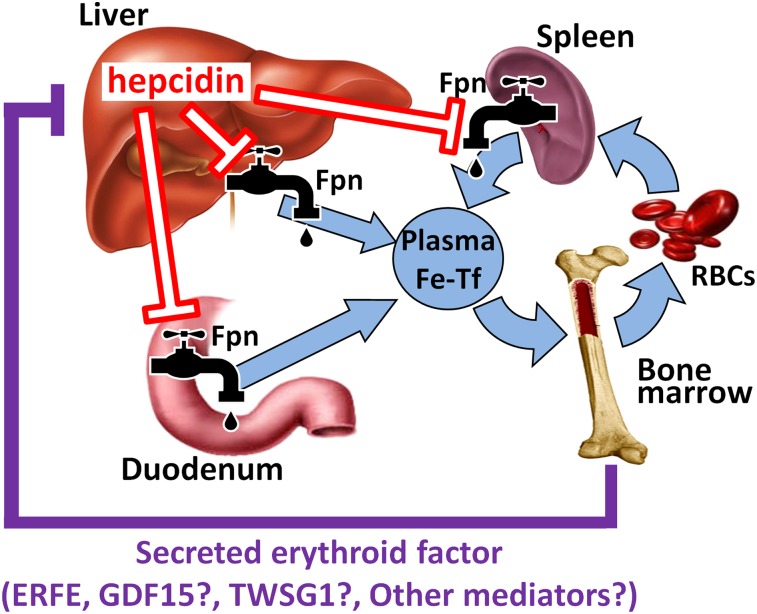
Hepcidin coordinates iron supply for erythropoiesis. Hepcidin controls major iron flows into plasma by causing degradation of its receptor ferroportin. After erythropoietic stimulation, erythroid precursors secrete 1 or more mediators (erythroid factors) that suppress hepcidin production in the liver, resulting in increased iron supply to the bone marrow. ERFE has been proposed to mediate hepcidin suppression in both physiological (eg, after hemorrhage) and pathological conditions (eg, ineffective erythropoiesis), whereas GDF15 and TWSG1 may only play a role in iron-loading anemias. Other erythroid regulators may exist but have yet to be identified.
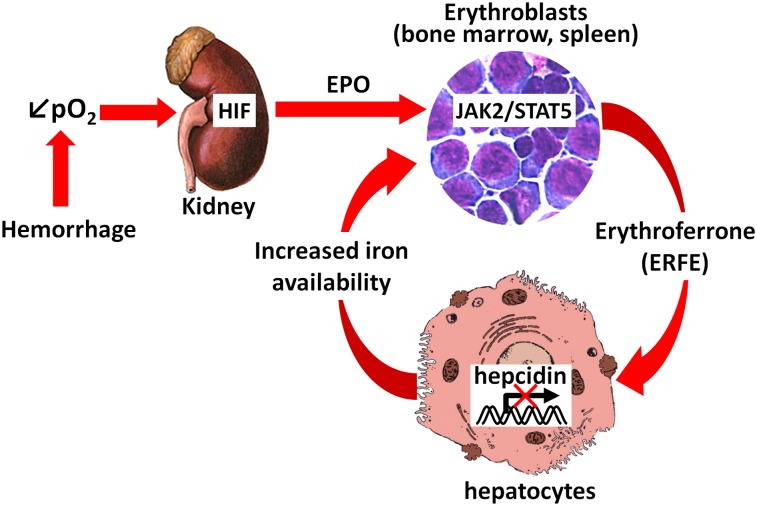
Proposed mechanism of action of the erythroid regulator ERFE. After blood loss, decreased oxygen delivery is sensed in the kidneys, stabilizing HIF and inducing EPO production. Binding of EPO to its receptors on erythroid progenitors in the bone marrow and the spleen leads to the rapid production of ERFE via the JAK2/STAT5 signaling pathway. ERFE is then secreted into the circulation and acts directly on hepatocytes to signal for hepcidin suppression in order to increase the iron flow into plasma for new red blood cell synthesis.
References
-
- Ponka P, Sheftel AD. Erythroid iron metabolism. In: Anderson GJ, McLaren GD, editors. Iron Physiology and Pathophysiology in Humans. New York, NY: Humana Press; 2012. pp. 191–209.
-
- Finch C. Regulators of iron balance in humans. Blood. 1994;84(6):1697–1702. - PubMed
-
- Ganz T, Nemeth E. Hepcidin and disorders of iron metabolism. Annu Rev Med. 2011;62:347–360. - PubMed
-
- Origa R, Galanello R, Ganz T, et al. Liver iron concentrations and urinary hepcidin in beta-thalassemia. Haematologica. 2007;92(5):583–588. - PubMed
Publication types
MeSH terms
Substances
Grants and funding
LinkOut - more resources
Full Text Sources
Other Literature Sources
Medical
