. 2014 Jul;28(7):1186-93.
doi: 10.1210/me.2014-1134. Epub 2014 May 30.

Convergence of IPMK and LKB1-AMPK signaling pathways on metformin action

Affiliations

Convergence of IPMK and LKB1-AMPK signaling pathways on metformin action

Sookhee Bang et al. Mol Endocrinol. 2014 Jul.

Abstract

Metformin is a biguanide drug that is widely prescribed for type 2 diabetes. Metformin suppresses hepatic gluconeogenesis and increases fatty acid oxidation. Although studies have suggested that metformin acts, at least in part, via activation of the liver kinase B1 (LKB1)/AMP-activated protein kinase (AMPK) pathway, the specific molecular mechanisms underlying metformin's regulation of glucose and lipid metabolism have not been well delineated. Recently, we have shown that inositol polyphosphate multikinase (IPMK) plays an important role in cellular energy metabolism and glucose-mediated AMPK regulation. Here we investigated the role of IPMK in metformin-induced AMPK activation. We observed that metformin-mediated activation of AMPK was impaired in the absence of IPMK. Overexpression of wild-type IPMK was sufficient to restore LKB1-AMPK activation by either metformin or AICAR in IPMK(-/-) murine embryonic fibroblast cells, suggesting that IPMK may act as an upstream regulator of LKB1-AMPK signaling in response to metformin. Moreover, this regulation was mediated by protein-protein interaction between IPMK and LKB1 as a dominant-negative peptide, which abrogates this interaction, attenuated metformin's ability to activate AMPK. Our data demonstrate that IPMK plays an important role in LKB1/AMPK signaling and may be targeted for treatment of metabolic diseases.


Figures
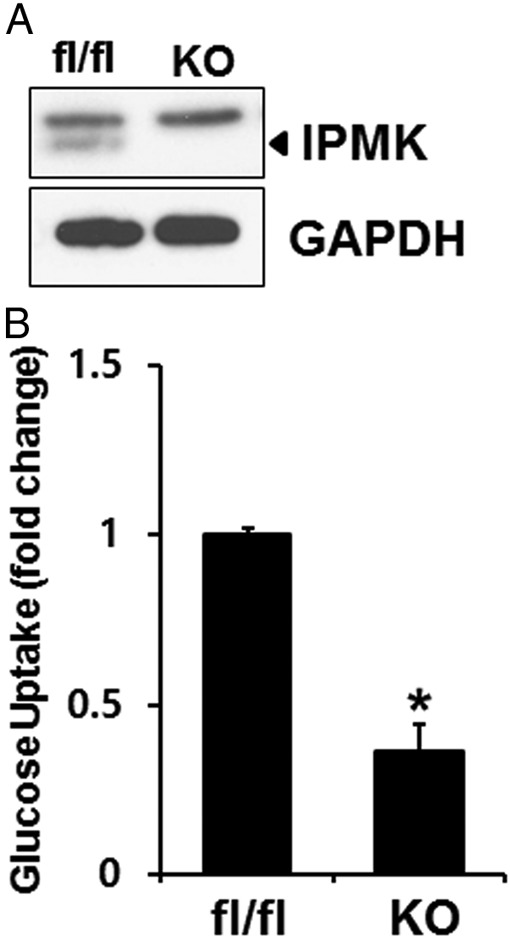
Figure 1.
Figure 1.
IPMK deletion reduces glucose uptake. A, IPMK in MEFs isolated from Ipmkloxp/loxp mice is deleted with retrovirus containing Cre recombinase. Blots are representative of at least 3 separate experiments. B, Glucose uptake was measured in WT (fl/fl) and Ipmk−/− (KO) mice as described in Materials and Methods. The graph represent the mean ± SE of 3 independent uptake analysis performed in at least triplicate. *, P < .005, Student's t test.
Figure 2.
Figure 2.
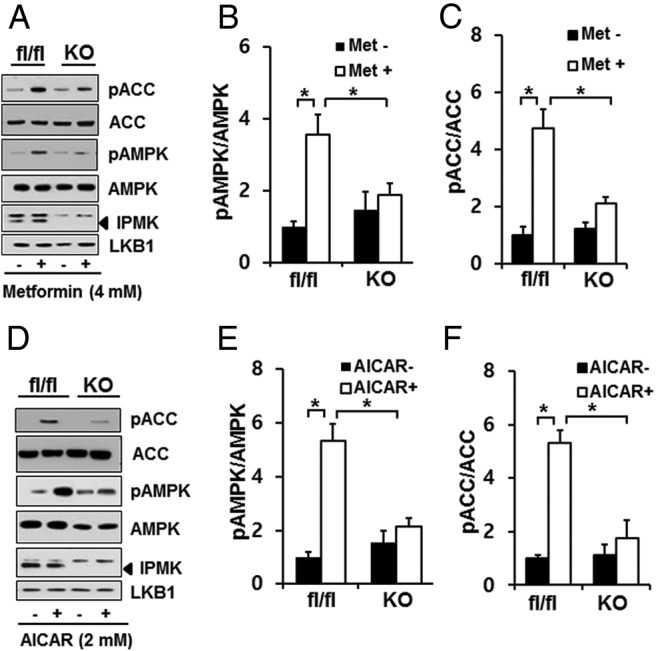
IPMK depletion attenuates LKB1-AMPK signaling in response to AMPK agonists. Cells were treated with 4mM metformin (A–C) or 2mM AICAR (D–F) for 2 hours. Cell lysates were subjected to SDS-PAGE and immunoblotting for phospho-AMPK (pAMPK) and its substrates phospho-ACC (pACC) and phospho-Raptor. Blots are representative of at least 3 separate experiments. Relative quantifications of pAMPKα2 or pACC levels are shown. Values are normalized by total levels of AMPKα2 or ACC, respectively. Values are expressed as means ± SE of 3 determinations. *, P < .005, Student's t test.
Figure 3.
Figure 3.
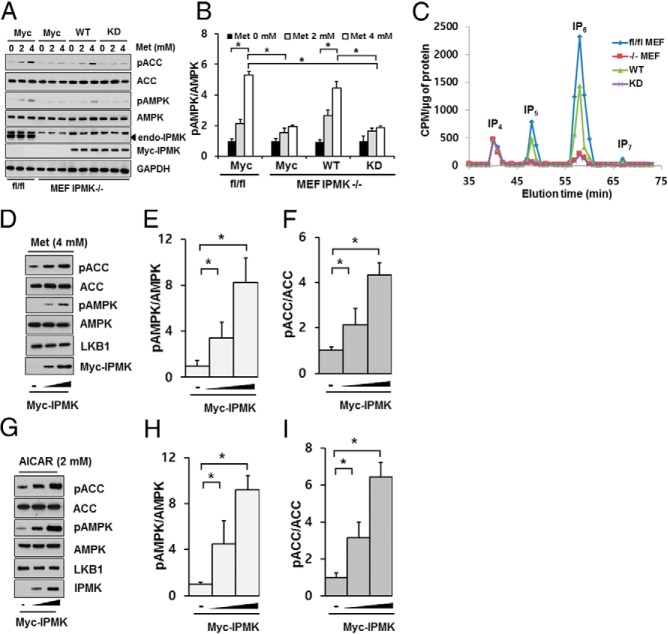
Overexpression of catalytically active IPMK restores LKB1-AMPK signaling in IPMK-depleted (KO) MEFs cells. A and B, Cells (1 × 10⁶) were transfected (electroporation) with 30 μg Myc-tagged WT IPMK or KD IPMK. Thirty hours after electroporation, cells were treated with 4mM metformin for 2 hours. Cell lysates were analyzed for phospho-AMPK (pAMPK) and phospho-ACC (pACC). Blots are representative of at least 3 separate experiments. C, Soluble InsPs (labeled IP4, IP5, IP6, and IP7) were separated by HPLC. D–I, Cells (1 × 10⁶) were transfected (electroporation) with 15 or 30 μg of Myc-tagged WT IPMK for 30 hours. Cells were then treated with 4mM metformin (D–F) or 2mM AICAR (G–I) for 2 hours. Blots are representative of at least 3 separate experiments. Relative quantifications of pAMPKα2 or pACC levels are shown. Values are normalized by total levels of AMPKα2 or ACC, respectively, and are expressed as means ± SE of 3 determinations. *, P < .005, Student's t test.
Figure 4.
Figure 4.
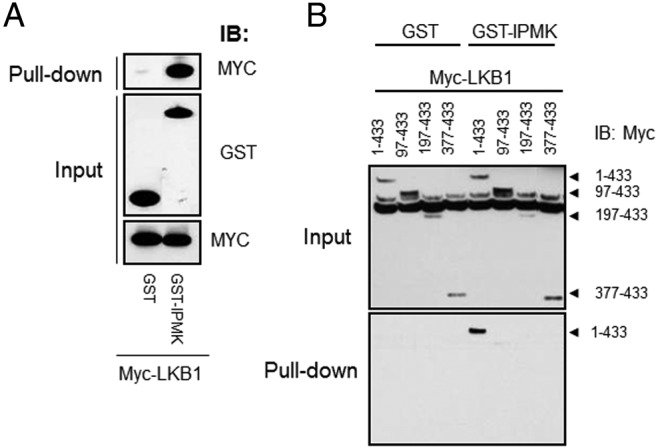
An interaction between LKB1 and IPMK is necessary for metformin-mediated AMPK activation. A, 293T cells were cotransfected with GST or GST-IPMK and Myc-LKB1 for 30 hours, followed by GST pull-down and immunoblotting for Myc-LKB1. B, Cells were cotransfected with plasmids encoding various N-terminal truncated fragments (1–433, 97–433, 197–433, or 377–433 amino acids) and either GST or a GST-IPMK in HEK293T cells for 48 hours, followed by pull-down and immunoblotting for Myc-LKB1 fragments.
Figure 5.
Figure 5.
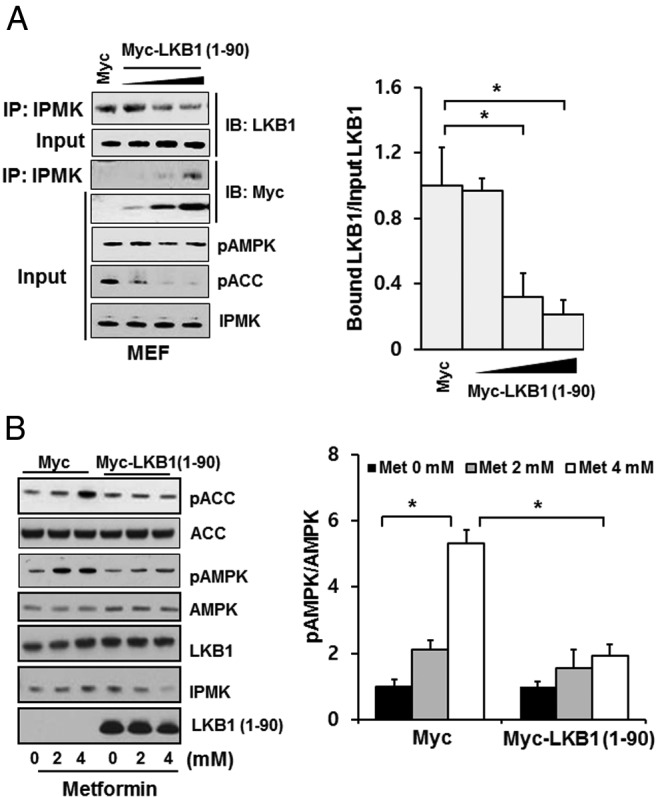
An interaction between LKB1 and IPMK is necessary for metformin-mediated AMPK activation. A, Cells were transfected with Myc or 1 to 4 μg Myc-LKB1 (1–90) for 30 hours, immunoprecipitation was performed with endogenous IPMK antibody, and bound LKB1 was detected. AMPK phosphorylation and its substrates ACC and Raptor protein expression were analyzed by Western blotting. Blots are representative of at least 3 separate experiments. Relative quantifications of bound LKB1 to IPMK are shown. Values are normalized by total levels of input LKB1 and expressed as means ± SE of 3 determinations. *, P < .005, Student's t test. B, Overexpression of LKB1 (1–90) interferes with AMPK activation in response to AICAR. MEF cells were transfected with Myc or 4 μg Myc-LKB1 (1–90) for 30 hours, followed by treatment with various concentrations of metformin for 2 hours. Cell lysates were prepared and analyzed for phospho-AMPK (pAMPK) and phospho-ACC (pACC). Blots are representative of at least 3 separate experiments. Values are normalized by total levels of AMPK and are expressed as means ± SE of 3 determinations. *, P < .005, Student's t test.

References

    1. Carling D. The AMP-activated protein kinase cascade–a unifying system for energy control. Trends Biochem Sci. 2004;29:18–24. - PubMed
    1. Hardie DG, Carling D. The AMP-activated protein kinase–fuel gauge of the mammalian cell? Eur J Biochem. 1997;246:259–273. - PubMed
    1. Hardie DG, Hawley SA, Scott JW. AMP-activated protein kinase–development of the energy sensor concept. J Physiol. 2006;574:7–15. - PMC - PubMed
    1. Alessi DR, Sakamoto K, Bayascas JR. LKB1-dependent signaling pathways. Annu Rev Biochem. 2006;75:137–163. - PubMed
    1. Hardie DG. AMP-activated/SNF1 protein kinases: conserved guardians of cellular energy. Nat Rev Mol Cell Biol. 2007;8:774–785. - PubMed

Publication types

MeSH terms