


Ranolazine inhibition of hERG potassium channels: drug-pore interactions and reduced potency against inactivation mutants
- PMID: 24877995
- PMCID: PMC4121676
- DOI: 10.1016/j.yjmcc.2014.05.013
Ranolazine inhibition of hERG potassium channels: drug-pore interactions and reduced potency against inactivation mutants
Abstract
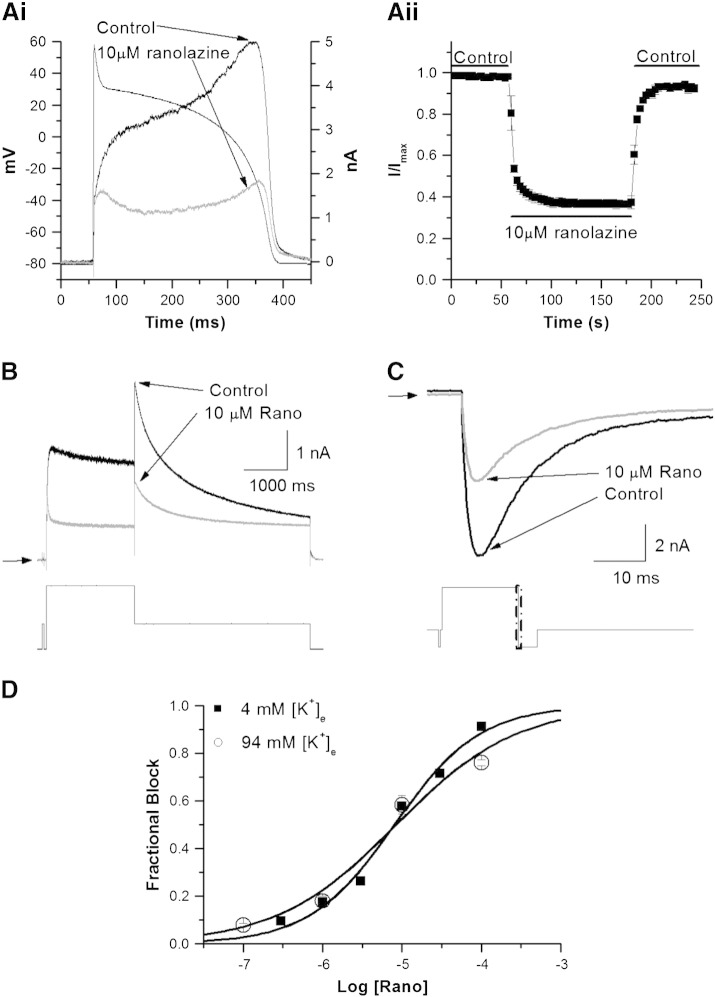
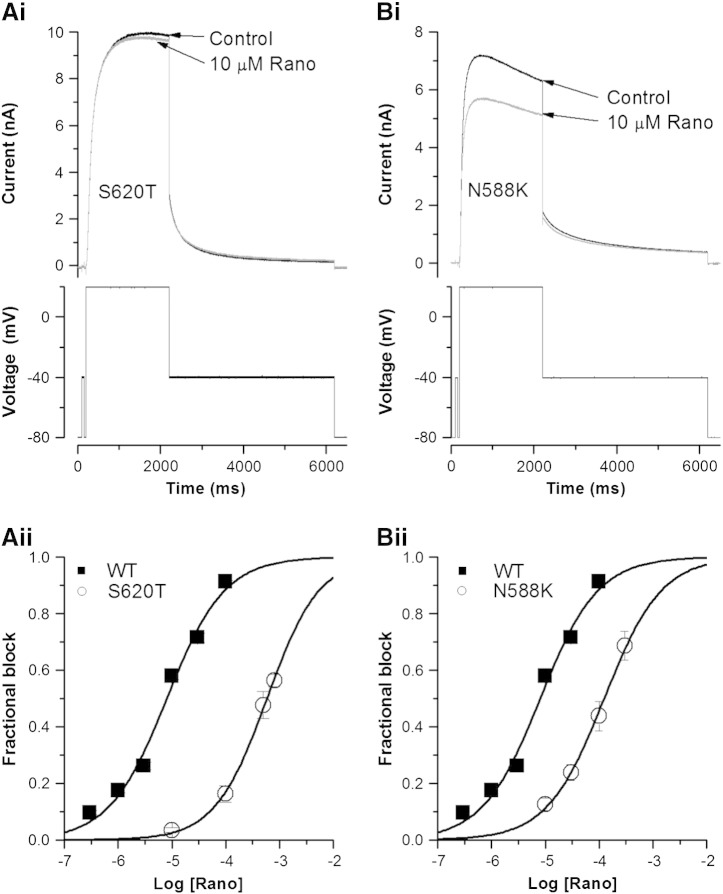
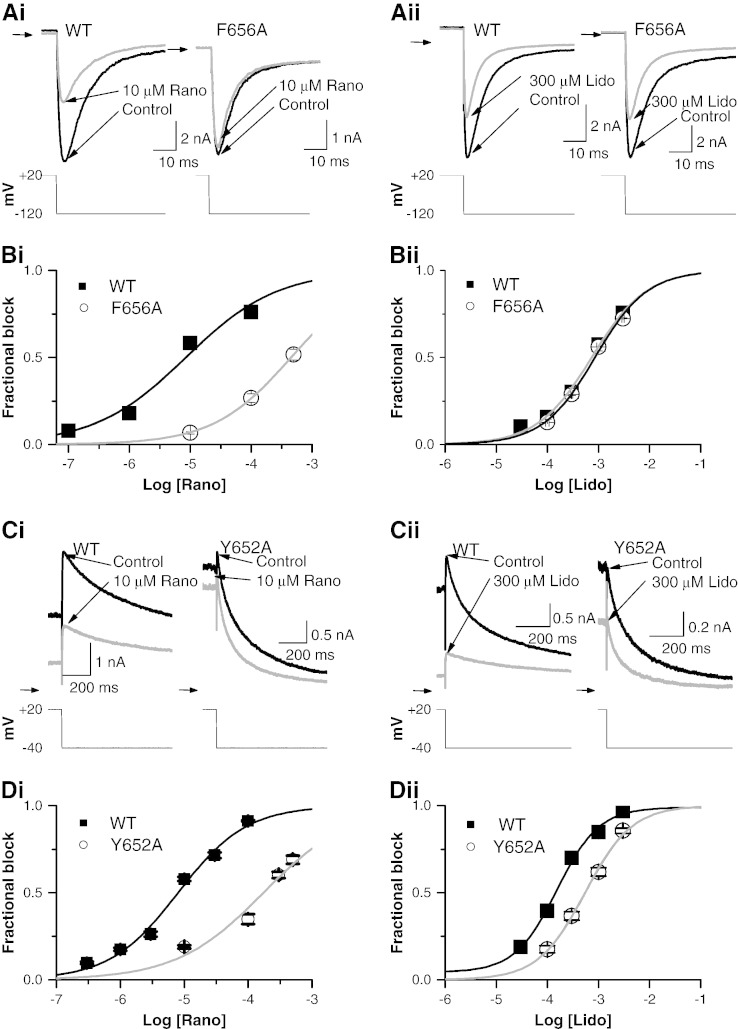
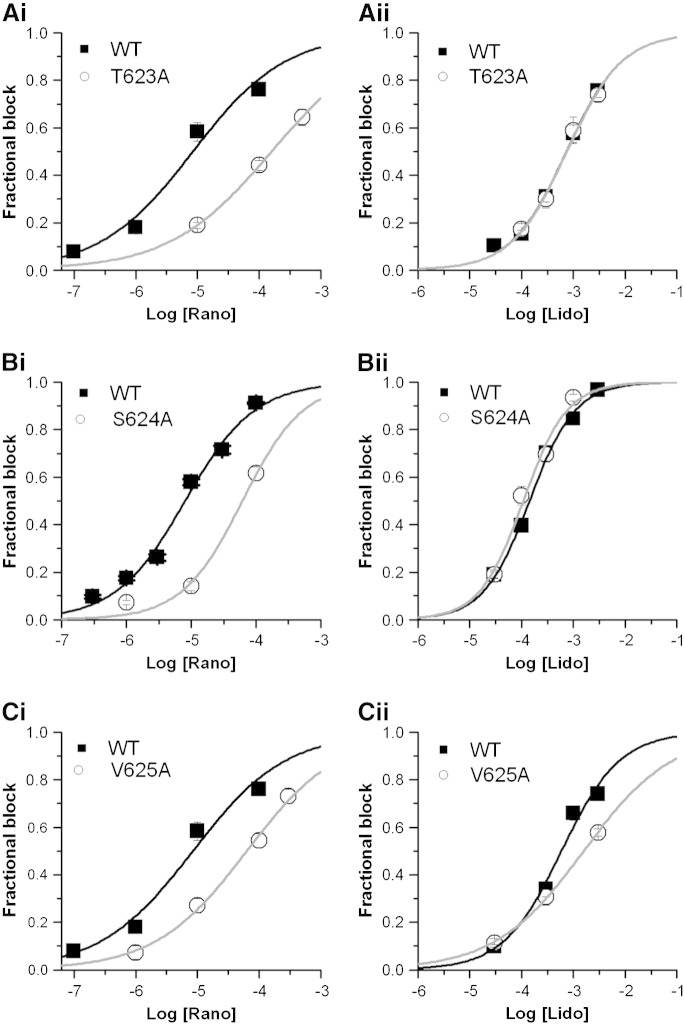
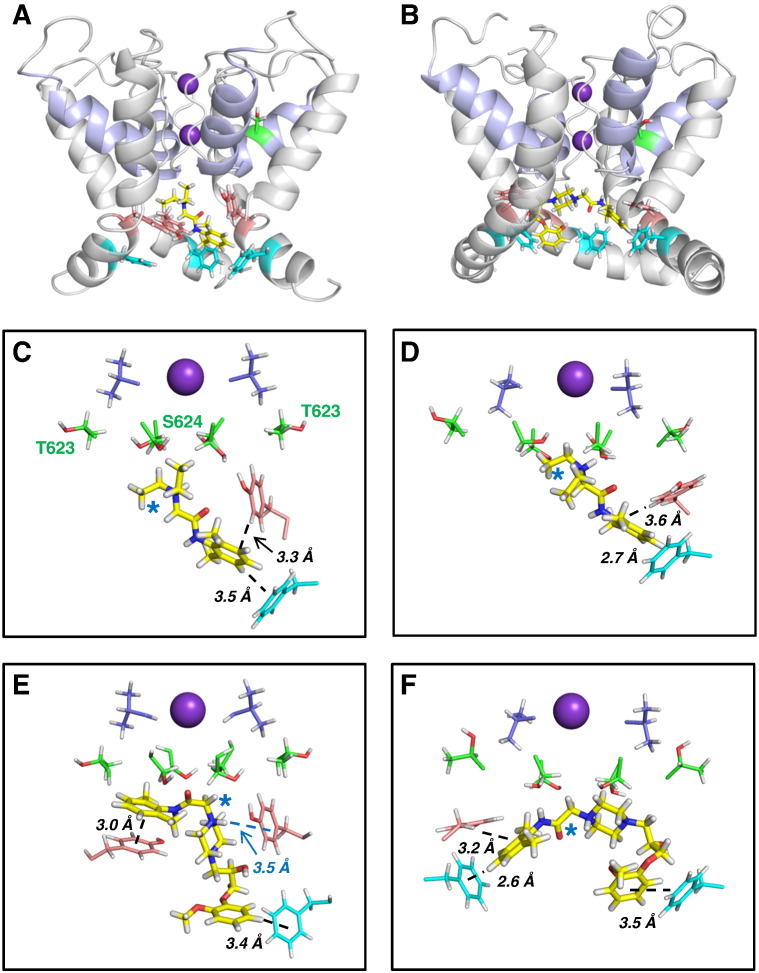
The antianginal drug ranolazine, which combines inhibitory actions on rapid and sustained sodium currents with inhibition of the hERG/IKr potassium channel, shows promise as an antiarrhythmic agent. This study investigated the structural basis of hERG block by ranolazine, with lidocaine used as a low potency, structurally similar comparator. Recordings of hERG current (IhERG) were made from cell lines expressing wild-type (WT) or mutant hERG channels. Docking simulations were performed using homology models built on MthK and KvAP templates. In conventional voltage clamp, ranolazine inhibited IhERG with an IC50 of 8.03μM; peak IhERG during ventricular action potential clamp was inhibited ~62% at 10μM. The IC50 values for ranolazine inhibition of the S620T inactivation deficient and N588K attenuated inactivation mutants were respectively ~73-fold and ~15-fold that for WT IhERG. Mutations near the bottom of the selectivity filter (V625A, S624A, T623A) exhibited IC50s between ~8 and 19-fold that for WT IhERG, whilst the Y652A and F656A S6 mutations had IC50s ~22-fold and 53-fold WT controls. Low potency lidocaine was comparatively insensitive to both pore helix and S6 mutations, but was sensitive to direction of K(+) flux and particularly to loss of inactivation, with an IC50 for S620T-hERG ~49-fold that for WT IhERG. Docking simulations indicated that the larger size of ranolazine gives it potential for a greater range of interactions with hERG pore side chains compared to lidocaine, in particular enabling interaction of its two aromatic groups with side chains of both Y652 and F656. The N588K mutation is responsible for the SQT1 variant of short QT syndrome and our data suggest that ranolazine is unlikely to be effective against IKr/hERG in SQT1 patients.
Keywords: Antiarrhythmic; Docking; Lidocaine; QT interval; Ranolazine; hERG.
Copyright © 2014. Published by Elsevier Ltd.
Figures
References
-
- Nattel S. Class III drugs: amiodarone, bretylium, ibutilide and sotalol. In: Zipes D.P., Jalife J., editors. Cardiac electrophysiology; from cell to bedside. 3rd ed. 1999. pp. 921–932.
-
- Hondeghem L.M., Snyders D.J. Class III antiarrhythmic agents have a lot of potential but a long way to go. Circulation. 1990;81:686–690. - PubMed
-
- Sanguinetti M.C., Tristani-Firouzi M. hERG potassium channels and cardiac arrhythmia. Nature. March 23 2006;440:463–469. - PubMed
-
- Hancox J.C., McPate M.J., El Harchi A., Zhang Y.H. The hERG potassium channel and hERG screening for drug-induced torsades de pointes. Pharmacol Ther. 2008;119:118–132. - PubMed
-
- Lees-Miller J.P., Duan Y., Teng G.Q., Duff H.J. Molecular determinant of high affinity dofetilide binding to HERG1 expressed in Xenopus oocytes: involvement of S6 sites. Mol Pharmacol. 2000;57:367–374. - PubMed
Publication types
MeSH terms
Substances
Grants and funding
LinkOut - more resources
Full Text Sources
Other Literature Sources
Medical
