


The effects of social learning on the acquisition of cocaine self-administration
- PMID: 24878249
- PMCID: PMC4102004
- DOI: 10.1016/j.drugalcdep.2014.04.025
The effects of social learning on the acquisition of cocaine self-administration
Abstract
Background: Social learning models of substance use propose that drug-use behaviors are learned by observing and mimicking the behavior of others. The aim of this study was to examine the acquisition of cocaine self-administration in three groups of experimentally naïve rats: rats that were tested in isolation, rats that were tested in the presence of another rat that had access to cocaine and had previously been trained to self-administer cocaine, and rats that were tested in the presence of another rat that did not have access to cocaine.
Methods: Male rats were reared in isolated or pair-housed conditions and implanted with intravenous catheters. Pair-housed rats were then assigned to drug-experienced or drug-naïve conditions. In the drug-experienced condition, one rat of each pair was trained to self-administer cocaine in isolation before the reintroduction of its partner. In the drug-naïve condition, one rat of each pair did not have access to cocaine for the duration of the study. For each group, the acquisition of cocaine self-administration was measured over 15 days in rats with access to cocaine but no prior operant training.
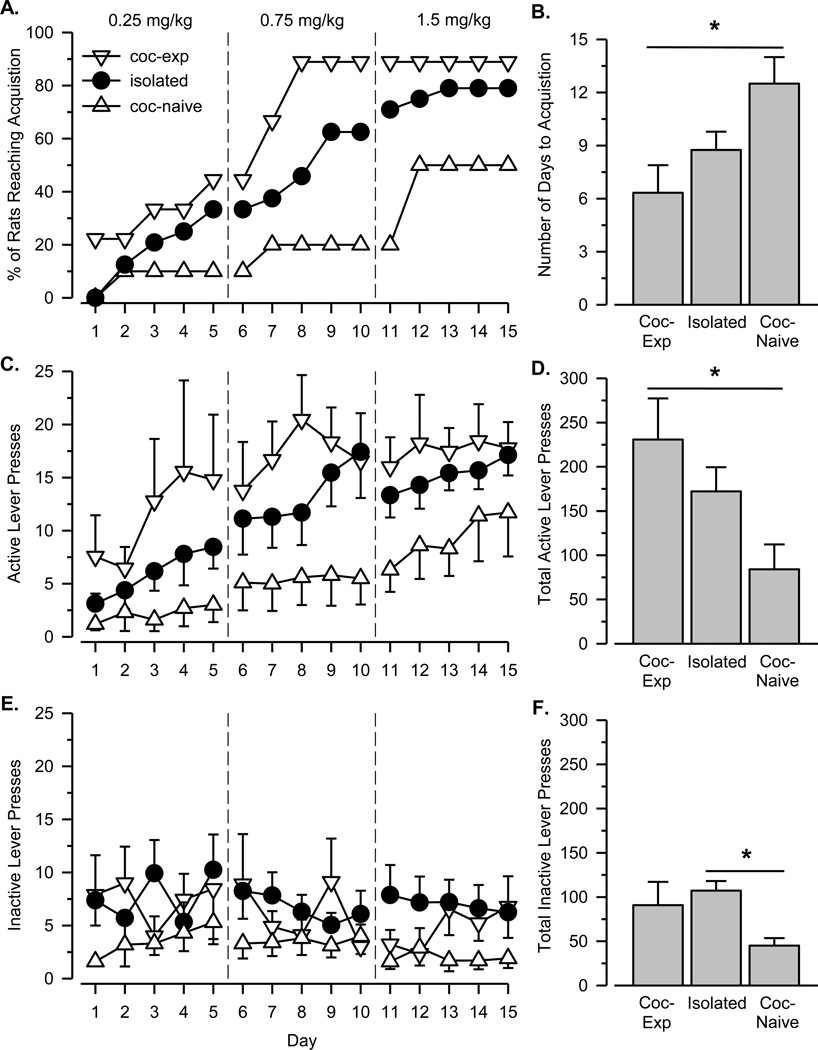
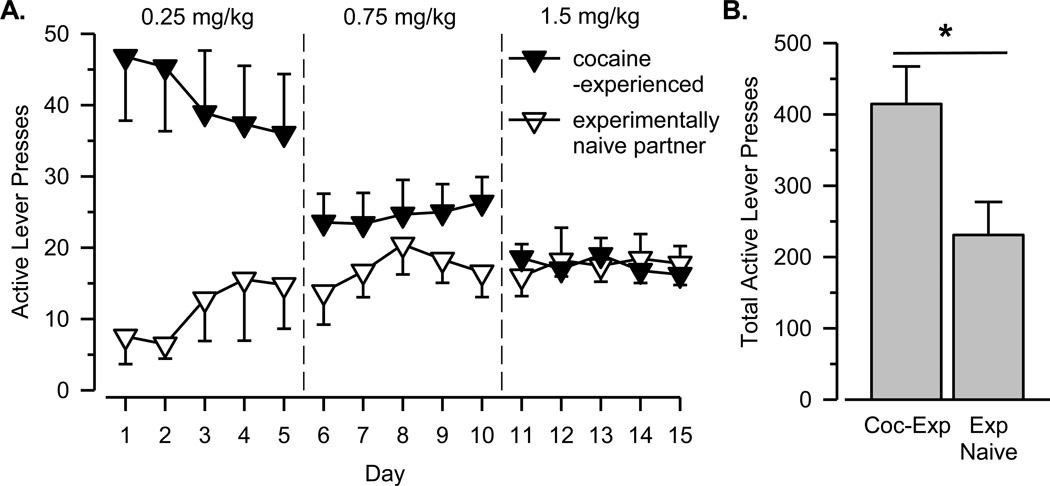
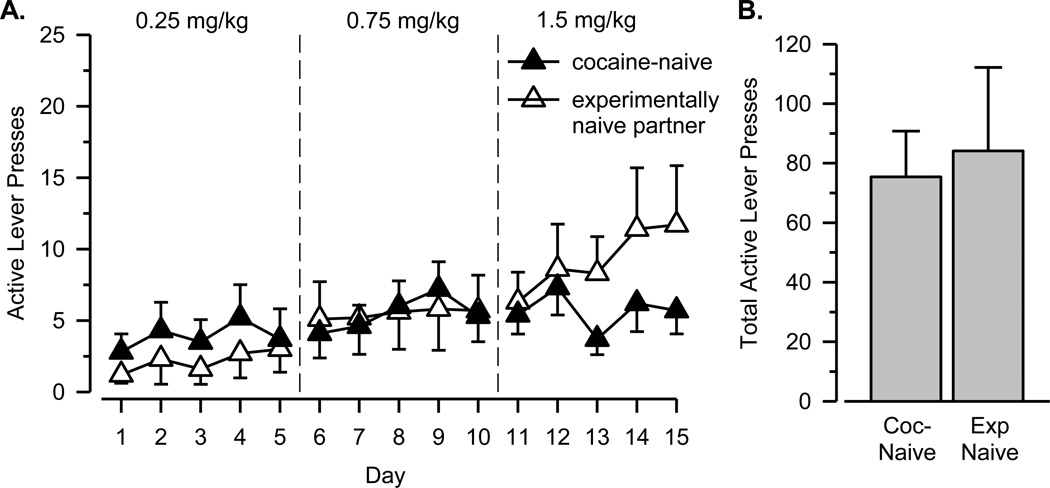
Results: Rats tested with a drug-experienced partner were faster to acquire cocaine self-administration and emitted more active lever presses than rats tested with a cocaine-naïve partner. Data for the isolated control group fell between the other two groups on these measures.
Conclusion: These data indicate that the acquisition of cocaine self-administration can either be facilitated or inhibited by social contact. Collectively, these results support a social learning model of substance use.
Keywords: Cocaine; Rat; Self-administration; Social; Social learning.
Copyright © 2014 Elsevier Ireland Ltd. All rights reserved.
Conflict of interest statement
Conflict of Interest
The authors have no financial conflicts of interest in regard to this research.
Figures
References
-
- Aisner R, Terkel J. Ontogeny of pine cone opening behavior in the black rat, Rattus rattus. Anim. Behav. 1992;44:327–336.
-
- Andrews JA, Hops H. The influence of peers on substance abuse. In: Scheier LM, editor. Handbook of Drug Use Etiology: Theory, Methods, and Empirical Findings. Washington DC: American Psychological Association; 2010. pp. 403–420.
-
- Badiani A. Substance-specific environmental influences on drug use and drug preference in animals and humans. Curr. Opin. Neurobiol. 2013;23:588–596. - PubMed
-
- Bahi A. Increased anxiety, voluntary alcohol consumption and ethanol-induced place preference in mice following chronic psychosocial stress. Stress. 2013;16:441–451. - PubMed
-
- Bahr SJ, Hoffmann JP, Yang X. Parental and peer influences on the risk of adolescent drug use. J. Prim. Prev. 2005;26:529–551. - PubMed
Publication types
MeSH terms
Substances
Grants and funding
LinkOut - more resources
Full Text Sources
Other Literature Sources
Medical
