


Cost-effectiveness of uterine-preserving procedures for the treatment of uterine fibroid symptoms in the USA
- PMID: 24878319
- PMCID: PMC4213230
- DOI: 10.2217/cer.14.32
Cost-effectiveness of uterine-preserving procedures for the treatment of uterine fibroid symptoms in the USA
Abstract
Objective: To evaluate the cost-effectiveness of the following three treatments of uterine fibroids in a population of premenopausal women who wish to preserve their uteri: myomectomy, magnetic resonance-guided focused ultrasound (MRgFUS) and uterine artery embolization (UAE).
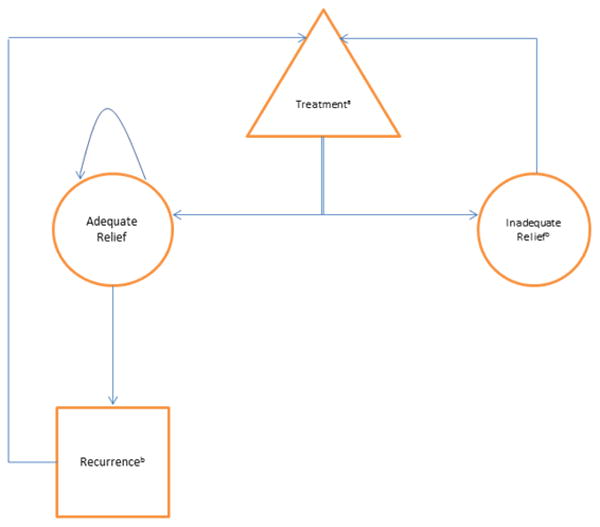
Materials & methods: A decision analytic Markov model was constructed. Cost-effectiveness was calculated in terms of US$ per quality-adjusted life year (QALY) over 5 years. Two types of costs were calculated: direct costs only, and the sum of direct and indirect (productivity) costs. Women in the hypothetical cohort were assessed for treatment type eligibility, were treated based on eligibility, and experienced adequate or inadequate symptom relief. Additional treatment (myomectomy) occurred for inadequate symptom relief or recurrence. Sensitivity analysis was conducted to evaluate uncertainty in the model parameters.
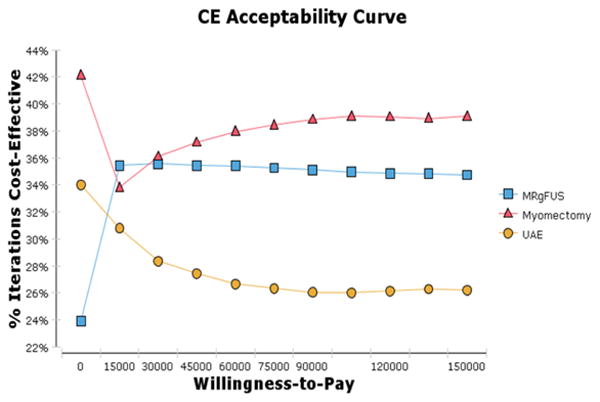
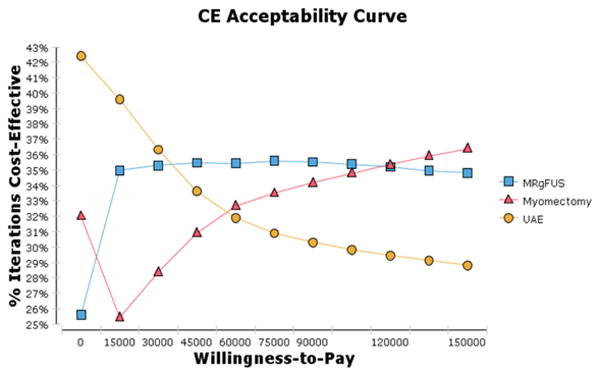
Results: In the base case, myomectomy, MRgFUS and UAE had the following combinations of mean cost and mean QALYs, respectively: US$15,459, 3.957; US$15,274, 3.953; and US$18,653, 3.943. When incorporating productivity costs, MRgFUS incurred a mean cost of US$21,232; myomectomy US$22,599; and UAE US$22,819. Using probabilistic sensitivity analysis (PSA) and excluding productivity costs, myomectomy was cost effective at almost every decision threshold. Using PSA and incorporating productivity costs, myomectomy was cost effective at decision thresholds above US$105,000/QALY; MRgFUS was cost effective between US$30,000 and US$105,000/QALY; and UAE was cost effective below US$30,000/QALY.
Conclusion: Myomectomy, MRgFUS, and UAE were similarly effective in terms of QALYs gained. Depending on assumptions about costs and willingness to pay for additional QALYs, all three treatments can be deemed cost effective in a 5-year time frame.
Keywords: MRgFUS; Markov model; UAE; cost–effectiveness; magnetic resonance-guided focused ultrasound; myomectomy; uterine artery embolization; uterine fibroids; uterine-preserving treatments.
Conflict of interest statement
Other authors do not report any conflict of interests.
Figures
References
-
- Baird DD, Dunson DB, Hill MC, Cousins D, Schectman JM. High cumulative incidence of uterine leiomyoma in black and white women: ultrasound evidence. Am J Obstet Gynecol. 2003;188(1):100–107. - PubMed
-
- Cramer SF, Patel A. The frequency of uterine leiomyomas. Am J Clin Pathol. 1990;94(4):435–438. - PubMed
-
- Lee DW, Ozminkowski RJ, Carls GS, Wang S, Gibson TB, Stewart EA. The direct and indirect cost burden of clinically significant and symptomatic uterine fibroids. Journal of occupational and environmental medicine / American College of Occupational and Environmental Medicine. 2007;49(5):493–506. - PubMed
-
- Levy BS. Modern management of uterine fibroids. Acta Obstet Gynecol Scand. 2008;87(8):812–823. - PubMed
Publication types
MeSH terms
Grants and funding
LinkOut - more resources
Full Text Sources
Other Literature Sources
Medical
Research Materials
Miscellaneous
