


Learning to eat vegetables in early life: the role of timing, age and individual eating traits
- PMID: 24878745
- PMCID: PMC4039444
- DOI: 10.1371/journal.pone.0097609
Learning to eat vegetables in early life: the role of timing, age and individual eating traits
Abstract
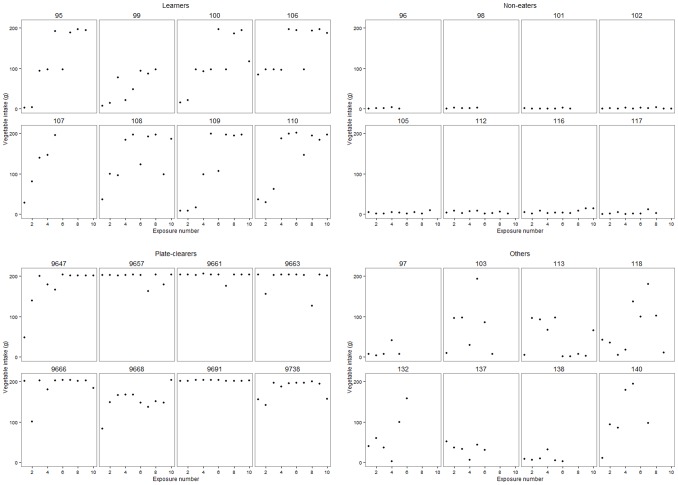
Vegetable intake is generally low among children, who appear to be especially fussy during the pre-school years. Repeated exposure is known to enhance intake of a novel vegetable in early life but individual differences in response to familiarisation have emerged from recent studies. In order to understand the factors which predict different responses to repeated exposure, data from the same experiment conducted in three groups of children from three countries (n = 332) aged 4-38 m (18.9±9.9 m) were combined and modelled. During the intervention period each child was given between 5 and 10 exposures to a novel vegetable (artichoke puree) in one of three versions (basic, sweet or added energy). Intake of basic artichoke puree was measured both before and after the exposure period. Overall, younger children consumed more artichoke than older children. Four distinct patterns of eating behaviour during the exposure period were defined. Most children were "learners" (40%) who increased intake over time. 21% consumed more than 75% of what was offered each time and were labelled "plate-clearers". 16% were considered "non-eaters" eating less than 10 g by the 5th exposure and the remainder were classified as "others" (23%) since their pattern was highly variable. Age was a significant predictor of eating pattern, with older pre-school children more likely to be non-eaters. Plate-clearers had higher enjoyment of food and lower satiety responsiveness than non-eaters who scored highest on food fussiness. Children in the added energy condition showed the smallest change in intake over time, compared to those in the basic or sweetened artichoke condition. Clearly whilst repeated exposure familiarises children with a novel food, alternative strategies that focus on encouraging initial tastes of the target food might be needed for the fussier and older pre-school children.
Conflict of interest statement
Figures
References
-
- Anderson AS, Porteous LE, Foster E, Higgins C, Stead M, et al. (2005) The impact of a school-based nutrition education intervention on dietary intake and cognitive and attitudinal variables relating to fruits and vegetables. Public Health Nutrition 8: 650–656. - PubMed
-
- Cooke L, Wardle J (2005) Age and gender differences in children’s food preferences. British Journal of Nutrition 93: 741–746. - PubMed
-
- Nicklaus S, Boggio V, Chabanet C, Issanchou S (2005) A prospective study of food variety seeking in childhood, adolescence and early adult life. Appetite 44: 289–297. - PubMed
-
- Birch LL (1999) Development of food preferences. Annual Review of Nutrition 19: 41–62. - PubMed
Publication types
MeSH terms
LinkOut - more resources
Full Text Sources
Other Literature Sources
