Review
. 2014 Apr 8;17(2):141-50.
doi: 10.1007/s40477-014-0089-2. eCollection 2014 Jun.

Sonographic evaluation of hindfoot disorders

Affiliations
Review

Sonographic evaluation of hindfoot disorders

Douglas F Hoffman et al. J Ultrasound. .

Abstract

Foot pain is a common orthopedic condition that can have an impact on health-related quality of life. The evaluation of plantar hindfoot pain begins with history and physical examination. Imaging modalities, standard radiographs, sonography, MR, CT are often utilized to clarify the diagnosis. The article is a detailed description of the sonographic evaluation of the plantar fascia and its disorders as well as the common etiologies in the differential diagnosis of plantar fasciopathy.

Il dolore al piede è una condizione ortopedica comune, che può avere un impatto sulla qualità della vita legata alla salute. La valutazione del dolore del retro-piede inizia con l’anamnesi e con l’esame fisico. Le varie modalità di imaging, radiografie standard, ecografia, risonanza magnetica, TC, sono spesso utilizzate per chiarire la diagnosi. L’articolo è una descrizione dettagliata della valutazione ecografica della fascia plantare e dei suoi disturbi, nonché delle patologie che più frequentemente entrano nella diagnosi differenziale con le malattie della fascia plantare.

Keywords: Heel pain; Hindfoot; Lateral cord; Plantar aponeurosis; Plantar fasciopathy; Sonography.


Figures
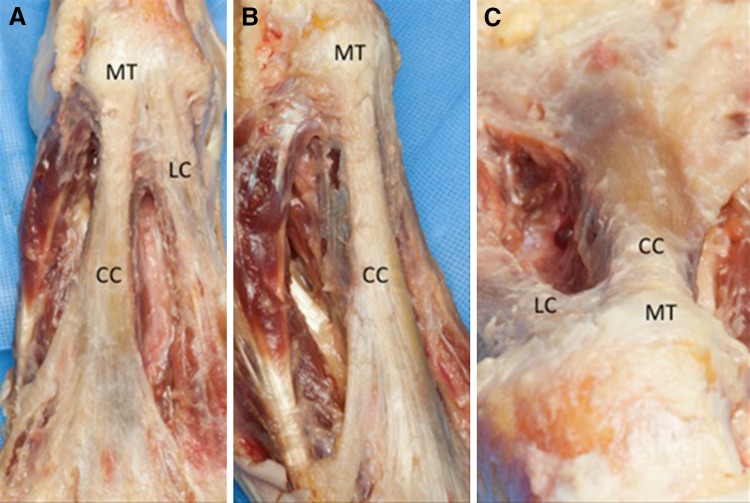
Fig. 1
Fig. 1
Cadaveric dissection of the central cord of the plantar aponeurosis. Plantar view (a), plantar oblique view (b), and plantar axial view (c) of the central cord (CC) showing its origin from the medial tubercle of the calcaneus (MT). Note that the central cord conforms to the bony contour of the medial tubercle. The proximal third of the central cord has a triangular appearance with the apex plantar. More distally, the central cord widens and thins as it divides into five diverging bands. LT lateral cord of the plantar fascia
Fig. 2
Fig. 2
Normal sonogram of the central cord of the plantar fascia. a Extended long axis sonogram of the central cord of the plantar fascia (CC) that arises from the medial calcaneal tuberosity (MT) and travels distally as a homogenous hyperechoic fibrillar band that overlies the flexor digitorum brevis muscle (FDB). b Close-up image of the attachment of the central cord (CC) showing the oblique orientation of the fibers as they insert on to the medial calcaneal tuberosity (MT). c Short axis sonogram of the central cord of the plantar fascia (white arrowheads) at its insertion on to the medial calcaneal tuberosity (MT). Note how the central cord conforms to the underlying calcaneus
Fig. 3
Fig. 3
Sonogram of proximal plantar fasciopathy. Long axis (a) and short axis (b) sonograms showing marked hypoechoic thickening of the proximal central cord of the plantar fascia with several foci of complete loss of fibrillar echotexture. In addition, note the loss of fascial edge sharpness (white arrowheads) and cortical irregularity with large enthesophyte (asterisk) of the underlying medial tubercle of the calcaneus (MT)
Fig. 4
Fig. 4
Sonogram of distal plantar fasciopathy of the central cord of the plantar fascia. Long axis (a) and short axis (b) sonograms of the distal central cord of the plantar fascia shows full thickness fusiform hypoechoic thickening (between calipers) with alteration, although not complete loss of fibrillar echotexture. Note that the thickening is completely contained with in the fascia edges of the aponeurosis which is in contrast to plantar fibromatosis where the fibroma will typically extend beyond the superficial border of the aponeurosis
Fig. 5
Fig. 5
Sonogram of a partial tear of the central cord of the plantar fascia with corresponding MR. Long axis sonogram (a) with corresponding T2-weighted MR (c) shows hypoechoic thickening, loss of normal fibrillar echotexture, and loss of sharp borders characteristic of proximal plantar fasciopathy. In addition, there is a focus of complete loss of echotexture (solid arrowhead) that widened with dynamic dorsiflexion of the ankle and great toe confirming the presence of a partial tear. Short axis sonogram (b) and corresponding T2-weighted MR (d) showing the partial tear. Note the cortical irregularity of the medial calcaneal tubercle (MT) suggestive of an underlying chronic proximal plantar fasciopathy
Fig. 6
Fig. 6
Sonogram of a complete plantar fascia tear. Long axis sonogram of a complete tear of the proximal central cord of the plantar fascia. Note that the central cord has torn and retracted (arrowheads) from the medial calcaneal tubercle (MT)
Fig. 7
Fig. 7
Sonogram of a 46-year woman who is 8 months status post an open complete plantar fascia release with the return of heel pain. Long axis sonogram (a) with color Doppler imaging (b) shows complete transection of the central cord with retraction of the two ends (calipers in A) with vascularity at the proximal stump and adjacent to the medial calcaneal tuberosity (MT) suggestive of inflammatory changes most likely from direct pressure to the area
Fig. 8
Fig. 8
Sonographic evaluation of entrapment of the first branch of the lateral plantar nerve (Baxter’s neuropathy). Long axis sonogram of the abductor digit minimi muscle (ADM) (a) shows general hypoechogenicity suggestive of fatty replacement from chronic compression of the first branch of the lateral plantar nerve. For comparison, the adjacent flexor digitorum brevis muscle (FDB) (b) shows normal muscle echogenicity. c Short axis sonogram shows the first branch of the lateral plantar nerve (white arrowhead). Within the distal medial tarsal tunnel, after the tibial nerve divides into the medial and lateral plantar nerve, the first branch of the lateral plantar nerve divides from the lateral plantar nerve (white arrow) and travels in a vertical orientation towards the interval between the abductor hallucis (not shown) and the quadratus plantae (QP). At this location, an ultrasound-guided nerve block can be performed to confirm the presence of an entrapment of the first branch of the lateral plantar nerve
Fig. 9
Fig. 9
Sonogram of plantar fibromatosis. Long axis (a) and short axis (b) sonogram of the central cord of the plantar fascia shows a hypoechoic fusiform nodular thickening (white arrowheads) that is located in the superficial and medial region of the central cord, the most common location. Note the lack of continuity of the fibrillar echotexture and superficial border of the central cord which helps distinguish a fibroma from distal plantar fasciopathy. FDB flexor digitorum brevis
Fig. 10
Fig. 10
Sonogram of a foreign body within the fat pad of the heel. Long axis sonogram (a) with color Doppler imaging (b) of a 53-year-old woman with plantar heel pain for 2 years and no recollection of a foreign body entering the foot. Methodical scanning revealed a 0.5 cm foreign body with the plantar heel pad of the hindfoot with superficial hyperemia. Note that there is a lack of granulomatous tissue reaction despite the chronicity of the foreign body. Ultrasound was also used to mark the location of the foreign body on the skin. Surgical excision revealed a wood sliver
Fig. 11
Fig. 11
Sonogram of a calcaneal stress fracture. Long axis sonogram with color Doppler imaging of the plantar calcaneus shows hypoechoic thickening adjacent to the calcaneal cortex, corresponding to edema, and increased vascularity of the periosteum, both suggestive of a stress fracture. If radiographs do not show evidence of a calcaneal stress fracture then definitive confirmation can be achieved with MR evaluation
Fig. 12
Fig. 12
Sonogram of a rheumatoid nodule within the plantar fat pad of the hindfoot. Long axis (a) and short axis (b) sonogram shows a well-demarcated predominantly hypoechoic mass within the plantar fat pad. Color Doppler imaging did not reveal vascularity (not shown). Note that the rheumatoid nodule abuts the underlying calcaneus (CALC) but there are no erosive changes or periosteal reaction of the calcaneal cortex
Fig. 13
Fig. 13
Sonogram of plantar vein thrombosis. Short axis sonogram of the plantar foot shows two enlarged thrombosed plantar veins with a small artery in the middle (arrowhead). Note the overlying flexor digitorum brevis muscle (FDB)

References

    1. Hill CL, Gill TK, Menz HB, Taylor AW, et al. Prevalence and correlates of foot pain in a population-based study: the North West Adelaide Health Study. J Foot Ankle Res. 2008;1:1. doi: 10.1186/1757-1146-1-2. - DOI - PMC - PubMed
    1. Hannan MT, McLennan CE, Rivinus MC, et al. Population-based study of foot disorders in men and women from the Framingham Study (abstract) Arthritis Rheum. 2006;54(suppl):S497.
    1. Thomas MJ, Roddy E, Zhang W, et al. The population prevalence of foot and ankle pain in middle and old age: a systematic review. Pain. 2011;152:2870. doi: 10.1016/j.pain.2011.09.019. - DOI - PubMed
    1. Riddle DL, Schappert SM. Volume of ambulatory care visits and patterns of care for patients diagnosed with plantar fasciitis: a national study of medical doctors. Foot Ankle Int. 2004;25:303. doi: 10.1177/107110070402500505. - DOI - PubMed
    1. Hoffman D, Bianchi S. Sonographic evaluation of plantar hindfoot and midfoot pain. J Ultrasound Med. 2013;32:1271. doi: 10.7863/ultra.32.7.1271. - DOI - PubMed

LinkOut - more resources
