


Maximal exercise in obese patients with COPD: the role of fat free mass
- PMID: 24885001
- PMCID: PMC4229957
- DOI: 10.1186/1471-2466-14-96
Maximal exercise in obese patients with COPD: the role of fat free mass
Abstract
Background: Obese patients (OB) with COPD may better tolerate exercise as compared to normal weight (NW) COPD patients, even if the reason for this is not yet fully understood. We investigated the interactions between obesity, lung hyperinflation, fat-free mass (FFM) and exercise capacity in COPD.
Methods: Forty-four patients (16 females; age 65 ± 8 yrs) were assessed by resting lung function and body composition and exercised on a cycle-ergometer to exhaustion.
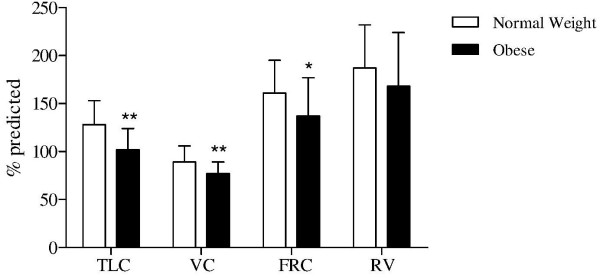
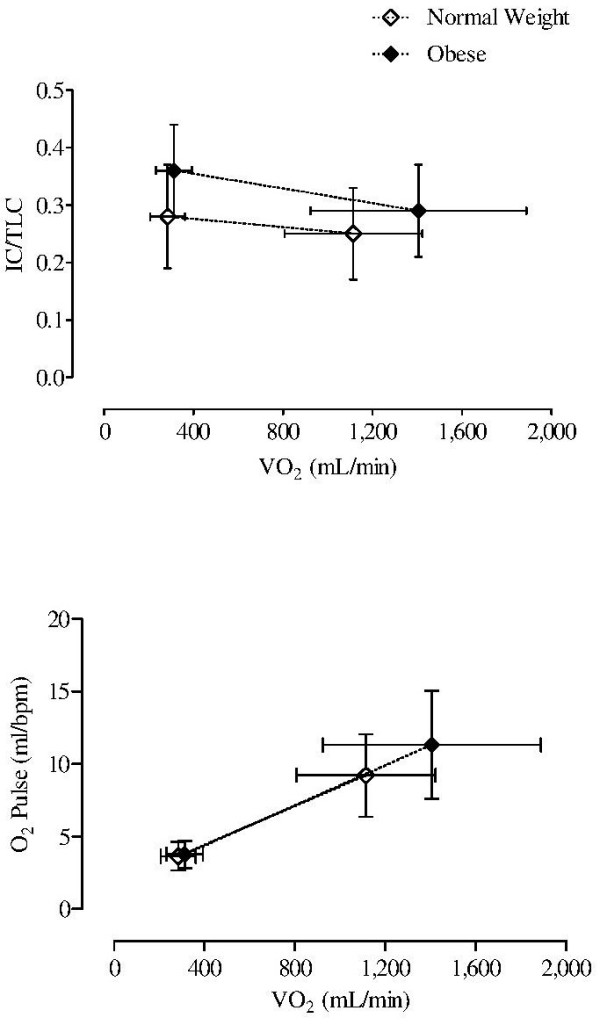
Results: Twenty-two OB and 22 NW patients did not differ in age, gender and airflow obstruction degree, but in FFM (p < 0.05). OB had significantly higher values in inspiratory capacity/total lung capacity ratio (IC/TLC) at rest (p < 0.01), but not at peak of exercise and showed significantly higher values in peak workload (p < 0.05) and in peak oxygen uptake (VO2), when expressed as absolute value (p < 0.05), but not when corrected by FFM. OB compared to NW experienced lower leg fatigue (p < 0.05), but similar dyspnea on exertion. In all patients, the regression equation by stepwise multiple regression analysis for peak workload and VO2, as dependent variables included both FFM and IC/TLC at rest, as independent variables (r(2) = 0.43 and 0.37, respectively).
Conclusions: OB with COPD, as compared to NW patients matched for age, gender and airflow obstruction, had greater FFM and less resting lung hyperinflation and showed greater maximal exercise capacity. Pulmonary and non-pulmonary factors may explain the preservation of exercise tolerance in patients with COPD associated with obesity.
Figures
References
Publication types
MeSH terms
LinkOut - more resources
Full Text Sources
Other Literature Sources
Medical
Miscellaneous
