Case Reports
. 2014 May 23:14:71.
doi: 10.1186/1471-2415-14-71.

The Argus II prosthesis facilitates reaching and grasping tasks: a case series

Affiliations
Case Reports

The Argus II prosthesis facilitates reaching and grasping tasks: a case series

Aachal Kotecha et al. BMC Ophthalmol. .

Abstract

Background: To evaluate the reach-to-grasp performance of patients fitted with an epiretinal artifical retina device.

Methods: This was a hospital-based case series consisting of six patients fitted with the Argus II (Second Sight Medical Products Inc, California, USA) retinal prosthesis. Participants were asked to reach out and pick up a high-contrast cuboid object with the prosthesis in the 'On', 'Off' or 'Scrambled' setting presented in a randomised order. The 'Scrambled' setting consisted of a random, scattered signal presented to the prosthesis. The session was repeated after a 4-6 week period. Hand movements were measured using motion detection cameras. The number of successful object grasps was calculated.

Results: The number of successful grasps was greater with the prosthesis in the 'On' setting (visit 1: median [interquartile range] percentage success: 'Off' = 0 [0 to 50]%, 'On' = 69 [67 to 95]%, 'Scrambled' = 59 [42 to 95]%; Friedman Chi-squared test statistic 6.5, p = 0.04; visit 2 median [IQR] percentage success: 'Off' = 0 [0 to 25]%, 'On' = 69 [53 to 100]%, 'Scrambled' = 28 [13 to 63]%; Friedman Chi-squared test statistic 8.4, p= 0.02).

Conclusions: The use of an electronic retinal prosthesis facilitates reach-and-grasp performance. Further work should explore how performance can be improved with targeted rehabilitation.


Figures
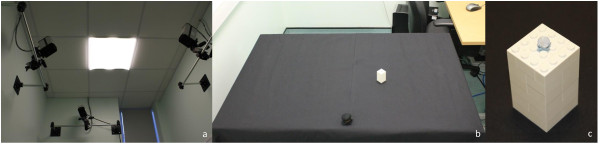
Figure 1
Figure 1
The experimental set-up. (a) Three ProReflex motion capture units triangulated the workspace at a height of approximately 1.5 metres above the table; (b) the experimental set up consisted of a table covered in black felt, illuminated uniformly from above; (c) the participant was instructed to reach and grasp a white Lego® block.
Figure 2
Figure 2
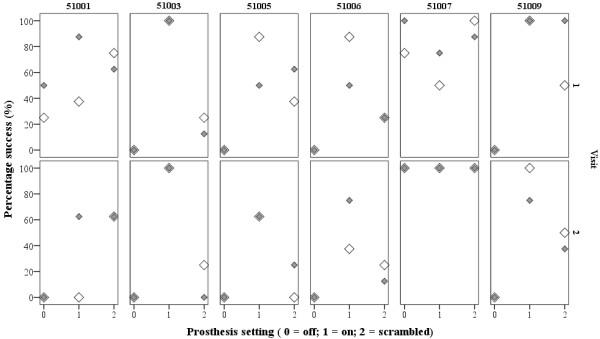
The percentage of successful grasps obtained for each patient within each trial condition.Shaded symbols = eyes patched, clear symbols = eyes unpatched. The data show that, for the majority of participants, more successful grasps were achieved when the prosthesis was activated.
Figure 3
Figure 3
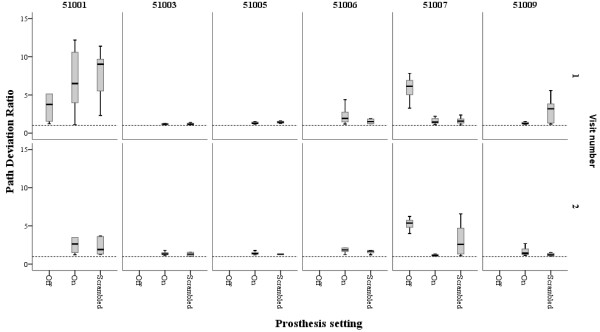
Path deviation ratio for each successful grasp obtained by each patient. The path deviation ratio is the ratio between the path taken by the hand to reach the object and the shortest straight line distance between the hand and object at the start. The path trajectory was measured using the wrist marker. The dotted line represents a ratio of 1.0, which would indicate a straight line trajectory of the reaching hand to the object. Boxes represent median, 25th and 75th percentiles, error bars 5th and 95th percentiles of successful grasps under each prosthesis setting; patched and unpatched data pooled.
Figure 4
Figure 4
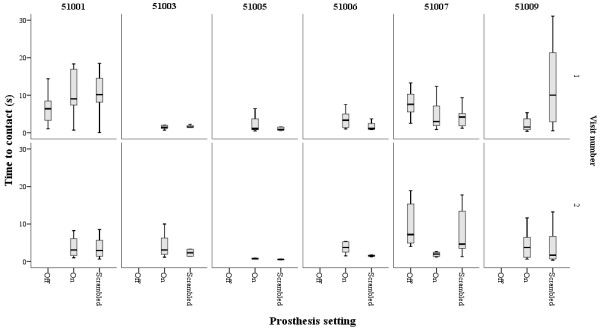
Time to object contact (TTC) for each successful grasp obtained by each patient. TTC represents the time between the onset of hand movement to making contact with the object, defined as the object moving ≥1 mm from its position on the table. The shorter the TTC, the quicker the hand reached the object. Boxes represent median, 25th and 75th percentiles, error bars 5th and 95th percentiles of successful grasps under each prosthesis setting; patched and unpatched data pooled.

References

    1. Boughman JA, Conneally PM, Nance WE. Population genetic studies of retinitis pigmentosa. Am J Hum Genet. 1980;32(2):223–235. - PMC - PubMed
    1. Hartong DT, Berson EL, Dryja TP. Retinitis pigmentosa. Lancet. 2006;368(9549):1795–1809. doi: 10.1016/S0140-6736(06)69740-7. - DOI - PubMed
    1. Bunce C, Wormald R. Leading causes of certification for blindness and partial sight in England & Wales. BMC Public Health. 2006;6:58. doi: 10.1186/1471-2458-6-58. - DOI - PMC - PubMed
    1. Santos A, Humayun MS, De Juan E Jr, Greenburg RJ, Marsh MJ, Klock IB, Milam AH. Preservation of the inner retina in retinitis pigmentosa. A morphometric analysis. Arch Ophthalmol. 1997;115(4):511–515. doi: 10.1001/archopht.1997.01100150513011. - DOI - PubMed
    1. Humayun MS, Prince M, De Juan E Jr, Barron Y, Moskowitz M, Klock IB, Milam AH. Morphometric analysis of the extramacular retina from postmortem eyes with retinitis pigmentosa. Invest Ophthalmol Vis Sci. 1999;40(1):143–148. - PubMed

Publication types

LinkOut - more resources