Effort, anhedonia, and function in schizophrenia: reduced effort allocation predicts amotivation and functional impairment
- PMID: 24886012
- PMCID: PMC4048870
- DOI: 10.1037/a0036299
Effort, anhedonia, and function in schizophrenia: reduced effort allocation predicts amotivation and functional impairment
Abstract
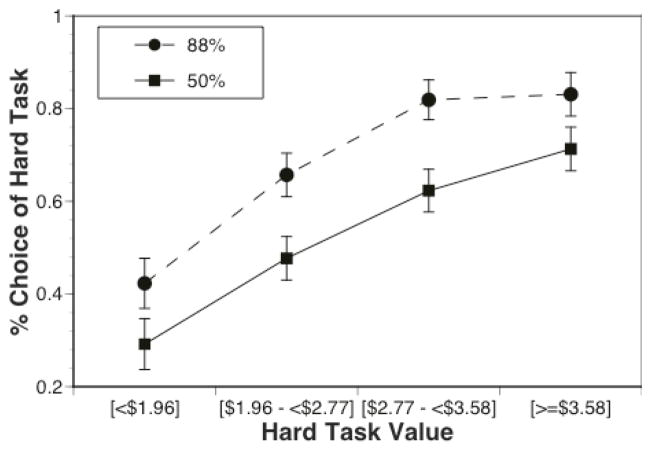
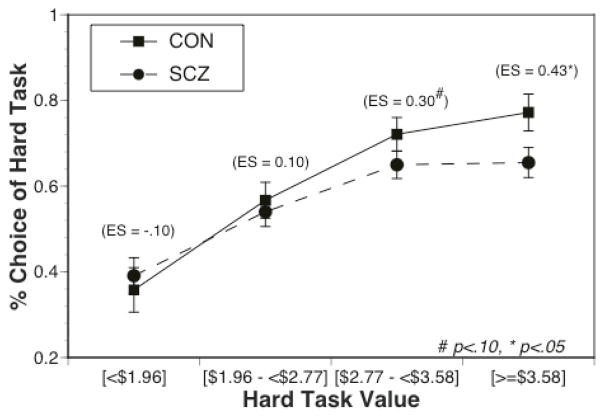
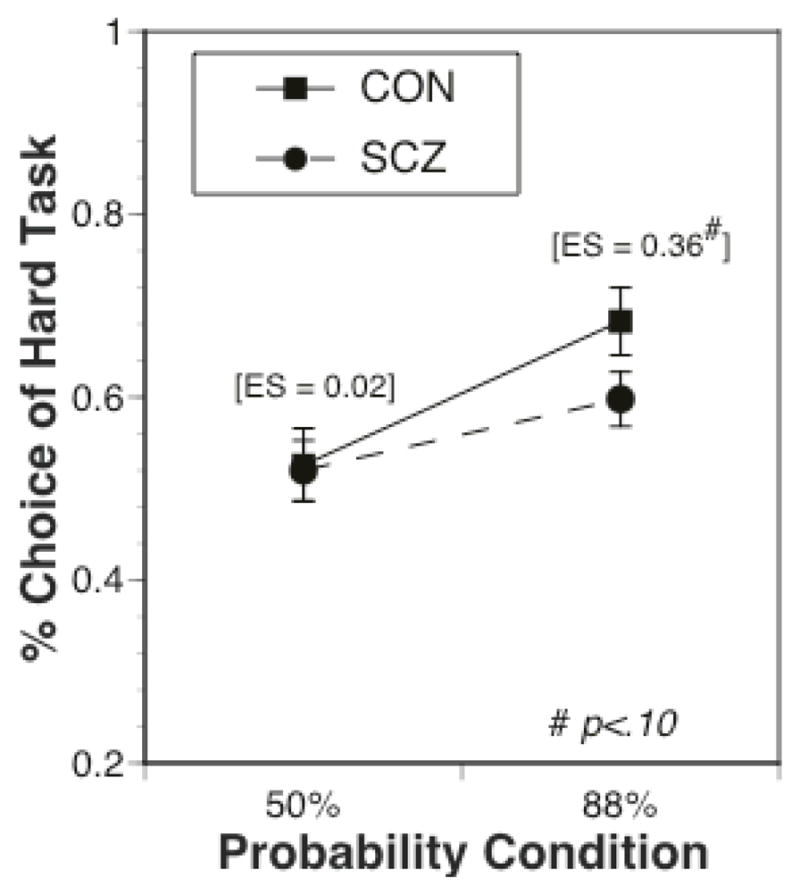
One of the most debilitating aspects of schizophrenia is an apparent interest in or ability to exert effort for rewards. Such "negative symptoms" may prevent individuals from obtaining potentially beneficial outcomes in educational, occupational, or social domains. In animal models, dopamine abnormalities decrease willingness to work for rewards, implicating dopamine (DA) function as a candidate substrate for negative symptoms given that schizophrenia involves dysregulation of the dopamine system. We used the effort-expenditure for rewards task (EEfRT) to assess the degree to which individuals with schizophrenia were wiling to exert increased effort for either larger magnitude rewards or for rewards that were more probable. Fifty-nine individuals with schizophrenia and 39 demographically similar controls performed the EEfRT task, which involves making choices between "easy" and "hard" tasks to earn potential rewards. Individuals with schizophrenia showed less of an increase in effort allocation as either reward magnitude or probability increased. In controls, the frequency of choosing the hard task in high reward magnitude and probability conditions was negatively correlated with depression severity and anhedonia. In schizophrenia, fewer hard task choices were associated with more severe negative symptoms and worse community and work function as assessed by a caretaker. Consistent with patterns of disrupted dopamine functioning observed in animal models of schizophrenia, these results suggest that 1 mechanism contributing to impaired function and motivational drive in schizophrenia may be a reduced allocation of greater effort for higher magnitude or higher probability rewards.
Figures

References
-
- Abi-Dargham A, Kegeles LS, Zea-Ponce Y, Mawlawi O, Martinez D, Mitropoulou V, O’Flynn K, Koenigsberg HW, Van Heertum R, Cooper T, Laruelle M, Siever LJ. Striatal amphetamine-induced dopamine release in patients with schizotypal personality disorder studied with single photon emission computed tomography and [123I]iodobenzamide. Biol Psychiatry. 2004;55(10):1001–1006. - PubMed
-
- Aghevli MA, Blanchard JJ, Horan WP. The expression and experience of emotion in schizophrenia: a study of social interactions. Psychiatry Res. 2003;119(3):261–270. - PubMed
-
- Andreasen NC. The scale for the assessment of negative symptoms (SANS) Iowa City: University of Iowa; 1983a.
Publication types
MeSH terms
Grants and funding
LinkOut - more resources
Full Text Sources
Other Literature Sources
Medical