Meta-Analysis
. 2014 May 1:12:138.
doi: 10.1186/1477-7819-12-138.

Sublobectomy versus lobectomy for stage IA (T1a) non-small-cell lung cancer: a meta-analysis study

Affiliations
Meta-Analysis

Sublobectomy versus lobectomy for stage IA (T1a) non-small-cell lung cancer: a meta-analysis study

Yaxin Liu et al. World J Surg Oncol. .

Abstract

Background: Although lobectomy is considered the standard surgical treatment for the majority of patients with non-small-cell lung cancer (NSCLC), the operation project for patients with stage IA NSCLC (T1a, tumor diameter≤2 cm) remains controversial. Sublobectomy is appropriate only in certain patients as many doctors consider it to be overtreatment. We evaluated the five-year overall survival rate of sublobectomy and lobectomy for stage IA NSCLC (T1a, tumor diameter≤2 cm) through a meta-analysis.

Methods: The five-year overall survival rate (OS) of stage IA (T1a) NSCLC after sublobectomy (including wedge resection and segmentectomy) and lobectomy were compared. We also compared the OS of stage IA (T1a) NSCLC after segmentectomy and lobectomy. The log (hazard ratio, ln (HR)) and its standard error (SE) were used as the outcome measure for data combining.

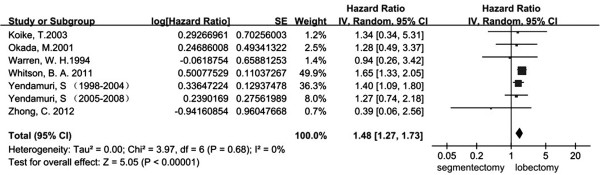
Results: There were 12 eligible studies published between 1994 and 2013 in which the total number of participants was 18,720. When compared to lobectomy, there was a statistically significant difference of sublobectomy on OS of stage IA (T1a) NSCLC patients (HR 1.38; 95% confidence interval (95% CI), 1.19 to 1.61; P<0.0001). For the comparison between segmentectomy and lobectomy, there was also a statistically significant difference of segmentectomy alone on OS of stage IA (T1a) NSCLC patients (HR 1.48; 95% CI: 1.27 to 1.73; P<0.00001) CONCLUSIONS: We have concluded that in stage IA (T1a) patients sublobectomy, including segmentectomy and wedge resection, causes a lower survival rate than lobectomy.


Figures
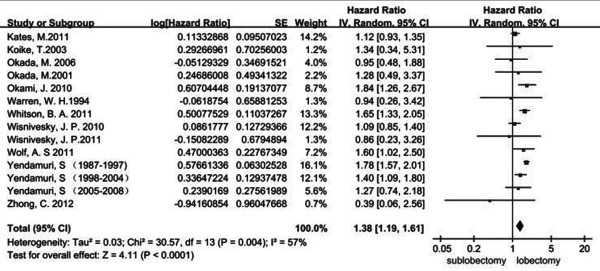
Figure 1
Figure 1
Forest plot of HR for OS impact of operative approach (sublobectomy versus lobectomy) of stage IA NSCLC patients. The combined HR displayed in this figure when compared with sublobectomy suggested that there was a significant benefit of lobectomy on OS of stage IA patients with tumors no larger than 2 cm, (HR 1.38; 95% CI, 1.19 to 1.61; P <0.0001) [5,9,12,16-24]. CI, confidence interval; df, degree of freedom; HR, hazard ratio, OS, overall survivalNSCLC,non-small cell lung cancer; SE, standard error
Figure 2
Figure 2
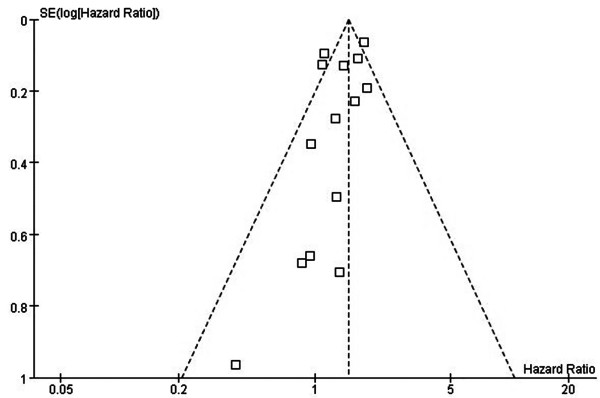
Funnel plot of this analysis. The crossed two lines in the figure represent the 95% CI. This figure presents the impact of operative approach (sublobectomy versus lobectomy) on OS of stage IA NSCLC patients with a tumor size of 2 cm or less.
Figure 3
Figure 3
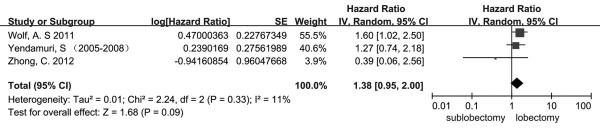
Forest plot of HR for OS impact of operative approach (sublobectomy versus lobectomy) of stage IA NSCLC patients with data after 2000. The combined HR displayed in this figure suggested there was no statistical significance between sublobectomy and lobectomy on OS (HR 1.38; 95% CI, 0.95 to 2.00; P = 0.09). CI, confidence interval; df, degree of freedom; HR, hazard ratio; OS, overall survival [16-18].
Figure 4
Figure 4
Forest plot of HR for OS impact of operative approach (segmentectomy versus lobectomy) of stage IA NSCLC patients. The combined HR displayed in this figure, compared with segmentectomy, suggest that there was a significant benefit of lobectomy on OS of stage IA patients with tumors no larger than 2 cm (HR 1.48; 95% CI, 1.27 to 1.73; P <0.00001)]. CI, confidence interval; df, degree of freedom; HR, hazard ratio; OS, overall survival [5,9,12,16,17,21].

References

    1. Okada M, Nishio W, Sakamoto T, Uchino K, Yuki T, Nakagawa A, Tsubota N. Effect of tumor size on prognosis in patients with non–small cell lung cancer: the role of segmentectomy as a type of lesser resection. J Thorac Cardiovasc Surg. 2005;129:87–93. doi: 10.1016/j.jtcvs.2004.04.030. - DOI - PubMed
    1. Bando T, Yamagihara K, Ohtake Y, Miyahara R, Tanaka F, Hasegawa S, Inui K, Wada H. A new method of segmental resection for primary lung cancer: intermediate results. Eur J Cardiothorac Surg. 2002;21:894–899. doi: 10.1016/S1010-7940(02)00122-7. - DOI - PubMed
    1. Lewis RJ. The role of video-assisted thoracic surgery for carcinoma of the lung: wedge resection to lobectomy by simultaneous individual stapling. Ann Thorac Surg. 1993;56:762–768. doi: 10.1016/0003-4975(93)90975-N. - DOI - PubMed
    1. El-Sherif A, Gooding WE, Santos R, Pettiford B, Ferson PF, Fernando HC, Urda SJ, Luketich JD, Landreneau RJ. Outcomes of sublobar resection versus lobectomy for stage I non–small cell lung cancer: a 13-year analysis. Ann Thorac Surg. 2006;82:408–416. doi: 10.1016/j.athoracsur.2006.02.029. - DOI - PubMed
    1. Koike T, Yamato Y, Yoshiya K, Shimoyama T, Suzuki R. Intentional limited pulmonary resection for peripheral T1 N0 M0 small-sized lung cancer. J Thorac Cardiovasc Surg. 2003;125:924–928. doi: 10.1067/mtc.2003.156. - DOI - PubMed

Publication types