


Trends of Staphylococcus aureus bloodstream infections in a neonatal intensive care unit from 2000-2009
- PMID: 24886471
- PMCID: PMC4024190
- DOI: 10.1186/1471-2431-14-121
Trends of Staphylococcus aureus bloodstream infections in a neonatal intensive care unit from 2000-2009
Abstract
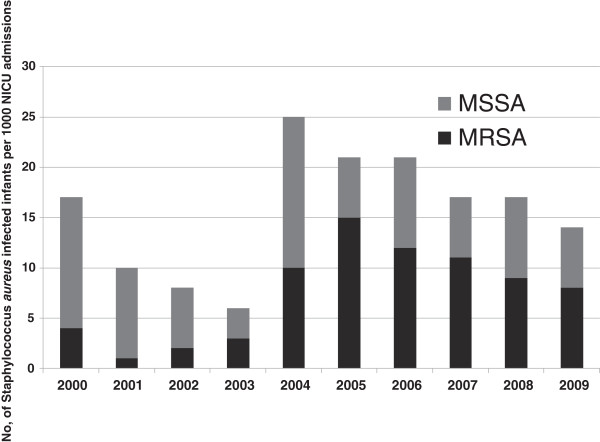
Background: Invasive methicillin-resistant Staphylococcus aureus (MRSA) and methicillin-sensitive Staphylococcus aureus (MSSA) infections are major causes of numerous neonatal intensive care unit (NICU) outbreaks. There have been increasing reports of MRSA outbreaks in various neonatal intensive care units (NICUs) over the last decade. Our objective was to review the experience of Staphylococcus aureus sepsis in our NICU in the last decade and describe the trends in the incidence of Staphylococcus aureus blood stream infections from 2000 to 2009.
Methods: A retrospective perinatal database review of all neonates admitted to our NICU with blood cultures positive for Staphylococcus aureus from (Jan 1st 2000 to December 31st 2009) was conducted. Infants were identified from the database and data were collected regarding their clinical characteristics and co-morbidities, including shock with sepsis and mortality. Period A represents patients admitted in 2000-2003. Period B represents patients seen in 2004-2009.
Results: During the study period, 156/11111 infants were identified with Staphylococcus aureus blood stream infection: 41/4486 (0.91%) infants in Period A and 115/6625 (1.73%) in Period B (p < 0.0004). Mean gestation at birth was 26 weeks for infants in both periods. There were more MRSA infections in Period B (24% vs. 55% p < 0.05) and they were associated with more severe outcomes. In comparing the cases of MRSA infections observed in the two periods, infants in period B notably had significantly more pneumonia cases (2.4% vs. 27%, p = 0.0005) and a significantly higher mortality rate (0% vs. 15.7%, p = 0.0038). The incidences of skin and soft tissue infections and of necrotizing enterocolitis were not significantly changed in the two periods.
Conclusion: There was an increase in the incidence of Staphylococcus aureus infection among neonates after 2004. Although MSSA continues to be a problem in the NICU, MRSA infections were more prevalent in the past 6 years in our NICU. Increased severity of staphylococcal infections and associated rising mortality are possibly related to the increasing MRSA infections with a more virulent community-associated strain.
Figures
References
-
- Centers for Disease Control and Prevention. Outbreaks of community-associated methicillin-resistant Staphylococcus aureus skin infections--Los Angeles County, California, 2002-2003. MMWR Morb Mortal Wkly Rep. 2003;52(5):88. - PubMed
-
- Centers for Disease Control and Prevention. Community-associated methicillin-resistant Staphylococcus aureus infection among healthy newborns--Chicago and Los Angeles County, 2004. MMWR Morb Mortal Wkly Rep. 2006;55(12):329–332. - PubMed
MeSH terms
Substances
LinkOut - more resources
Full Text Sources
Other Literature Sources
Medical
Miscellaneous
