. 2014 May 3:14:37.
doi: 10.1186/1472-6750-14-37.

Tobacco BY-2 cell-free lysate: an alternative and highly-productive plant-based in vitro translation system

Affiliations

Tobacco BY-2 cell-free lysate: an alternative and highly-productive plant-based in vitro translation system

Matthias Buntru et al. BMC Biotechnol. .

Abstract

Background: Cell-free protein synthesis is a rapid and efficient method for the production of recombinant proteins. Usage of prokaryotic cell-free extracts often leads to non-functional proteins. Eukaryotic counterparts such as wheat germ extract (WGE) and rabbit reticulocyte lysate (RLL) may improve solubility and promote the correct folding of eukaryotic multi-domain proteins that are difficult to express in bacteria. However, the preparation of WGEs is complex and time-consuming, whereas RLLs suffer from low yields. Here we report the development of a novel cell-free system based on tobacco Bright Yellow 2 (BY-2) cells harvested in the exponential growth phase.

Results: The highly-productive BY-2 lysate (BYL) can be prepared quickly within 4-5 h, compared to 4-5 d for WGE. The efficiency of the BYL was tested using three model proteins: enhanced yellow fluorescent protein (eYFP) and two versions of luciferase. The added mRNA was optimized by testing different 5' and 3' untranslated regions (UTRs). The protein yield in batch and dialysis reactions using BYL was much higher than that of a commercial Promega WGE preparation, achieving a maximum yield of 80 μg/mL of eYFP and 100 μg/mL of luciferase, compared to only 45 μg/mL of eYFP and 35 μg/mL of luciferase in WGEs. In dialysis reactions, the BYL yielded about 400 μg/mL eYFP, representing up to 50% more of the target protein than the Promega WGE, and equivalent to the amount using 5Prime WGE system.

Conclusions: Due to the high yield and the short preparation time the BYL represents a remarkable improvement over current eukaryotic cell-free systems.


Figures
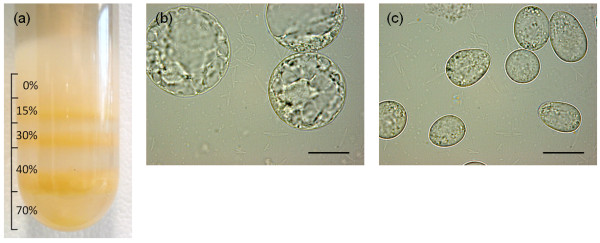
Figure 1
Figure 1
Preparation of evacuolated tobacco BY-2 protoplasts by Percoll gradient centrifugation. (a) Evacuolated protoplasts are concentrated at the interface between 40% and 70% Percoll. (b) Representative image of protoplasts before evacuolation (Scale bar = 20 μm). (c) Representative image of evacuolated protoplasts (Scale bar = 20 μm).
Figure 2
Figure 2
Flowchart showing the preparation of WGE (top panel) and BYL (bottom panel). WGE (top panel). The endosperm is removed from wheat seeds and embryo particles are washed extensively to remove translation inhibitors from the endosperm. To obtain the extract, the washed embryo particles are ground with a mortar under liquid nitrogen or in a Waring blender. BYL (bottom panel). BY-2 cells are cultivated in a 5-L fermenter, harvested in the exponential growth phase (at least 5 days post-inoculation) and converted into protoplasts. The vacuoles are separated from the protoplasts by centrifugation over a stepwise Percoll gradient. The resulting evacuolated protoplasts are lysed using the nitrogen decompression method.
Figure 3
Figure 3
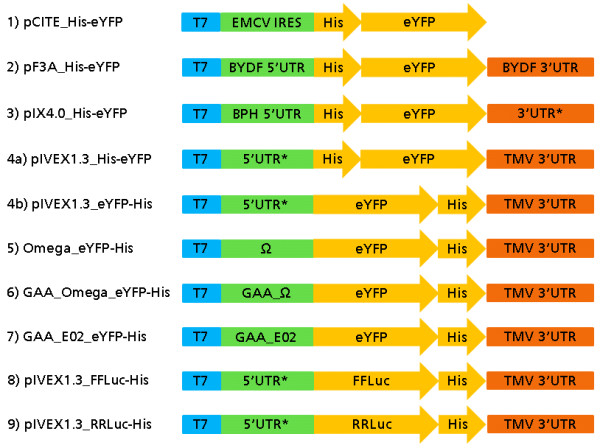
Schematic representation of different eYFP and luciferase expression constructs with various 5’ and 3’ UTRs. EMCV IRES, Encephalomyocarditis virus internal ribosomal entry site; BYDV 5’ UTR, Barley yellow dwarf virus 5’ untranslated region; BPH 5’ UTR, Baculovirus polyhedrin gene 5’ untranslated region; Ω, Tobacco mosaic virus 5’ leader sequence (omega); GAA_Ω, Tobacco mosaic virus 5’ leader sequence (omega) with GAA as first nucleotide triplet; GAA_E02, synthetic 5’ leader sequence; TMV, Tobacco mosaic virus; 5’ UTR*, repetition of a sequence complementary to the 18S ribosomal RNA; 3’ UTR*, trailer sequence with synthetic poly(A) signal; FFLuc, firefly luciferase; RRLuc, Renilla reniformis luciferase.
Figure 4
Figure 4
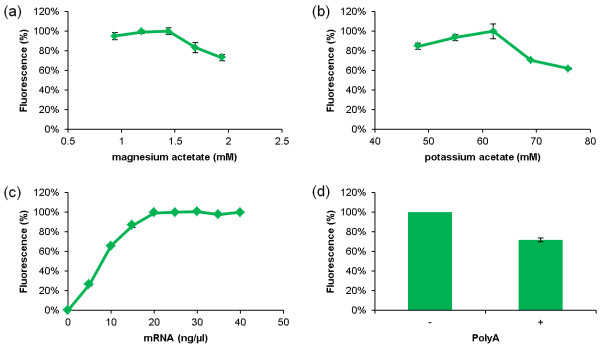
Optimization of reaction conditions in batch mode. Effects on eYFP yield caused by (a) magnesium acetate concentration, (b) potassium acetate concentration, (c) mRNA concentration, (d) presence (+) or absence (-) of poly(A) sequence. Translation reactions were carried out using capped GAA_Omega_eYFP-His mRNA as the template at 25°C and 500 rpm for 18 h. The relative fluorescence intensities are shown. Mean values were calculated from three independent translation experiments.
Figure 5
Figure 5
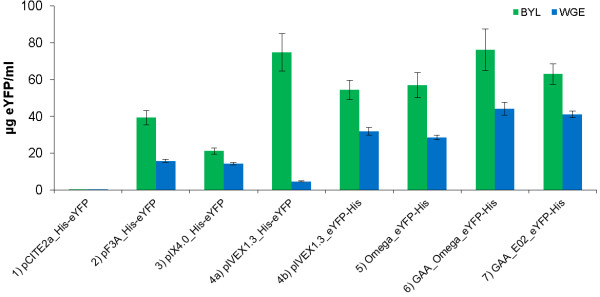
Translation of eYFP mRNAs with various 5’ and 3’ UTRs in BYL and WGE systems in batch mode. Reactions were carried out with 2 μg capped mRNA as the template at 25°C and 500 rpm for 18 h. The amount of fluorescent protein was calculated by comparing with an eYFP standard curve generated by measuring different eYFP concentrations in BYL translation reactions without the mRNA template. Data represent the averages and standard deviations of six independent translation experiments.
Figure 6
Figure 6
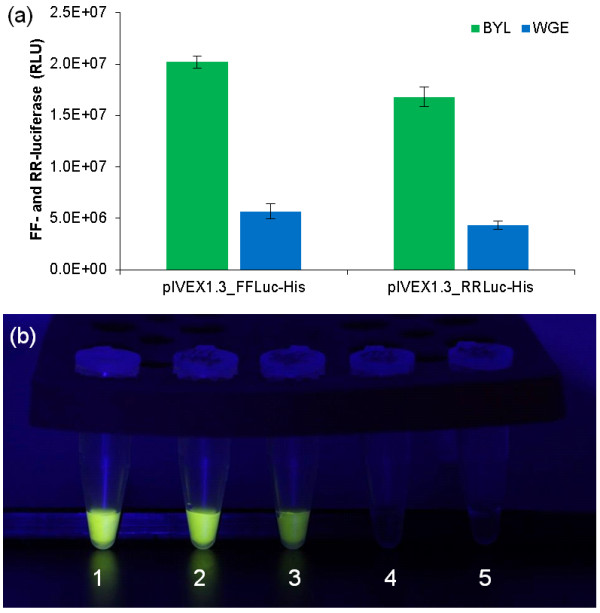
Translation of firefly and Renilla reniformis mRNAs in the BYL and WGE systems. Reactions were carried out with 2 μg capped mRNA as the template at 25°C and 500 rpm for 18 h. (a) Bar graphs show luciferase activity expressed as relative luciferase units (RLU). Data represent the averages and standard deviations of six independent translation experiments. (b) Typical result of FFLuc translation in the BYL and WGE systems, in which 1 μl of reaction mixture was combined with 50 μl luciferase assay buffer: FFLuc standard with 0.1 μg/μl (1), pIVEX1.3_FFLuc-His in BYL (2), pIVEX1.3_FFLuc-His in WGE (3), no template control in BYL (4), no template control in WGE (5).
Figure 7
Figure 7
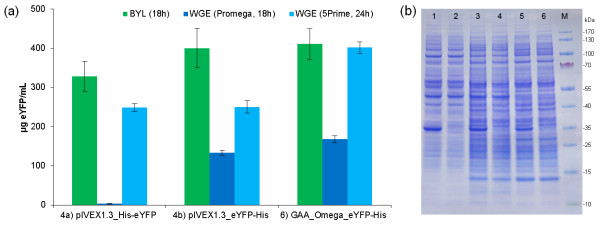
Translation of eYFP mRNAs in BYL and WGE systems in dialysis mode. Reactions were carried out with 3 μg capped mRNA as the template at 25°C and 900 rpm for 18 h and 24 h, respectively. The amount of fluorescent protein (a) was determined by comparison with an eYFP standard curve generated by measuring different eYFP concentrations in BYL translation reactions without a mRNA template. Data represent the averages and standard deviations of six independent translation experiments. (b) SDS-PAGE of the BYL and WGE translation reactions. In each case 10 μl of the translation reactions were loaded on a 4-12% gradient gel. Lane 1: GAA_Omega_eYFP-His in BYL; lane 2: no template control in BYL; lane 3 GAA_Omega_eYFP-His in 5Prime WGE; lane 4: no template control in 5Prime WGE; lane 5: GAA_Omega_eYFP-His in Promega WGE; lane 6: no template control in Promega WGE; M: molecular weight marker.

References

    1. Swartz JR. Transforming biochemical engineering with cell-free biology. AIChE Journal. 2012;58:5–13. doi: 10.1002/aic.13701. - DOI
    1. White ER, Reed TM, Ma Z, Hartman MCT. Replacing amino acids in translation: Expanding chemical diversity with non-natural variants. Methods. 2013;60:70–74. doi: 10.1016/j.ymeth.2012.03.015. - DOI - PubMed
    1. Nilsson BL, Soellner MB, Raines RT. Chemical synthesis of proteins. Annu Rev Biophys Biomol Struct. 2005;34:91–118. doi: 10.1146/annurev.biophys.34.040204.144700. - DOI - PMC - PubMed
    1. Kim HC, Kim TW, Kim DM. Prolonged production of proteins in a cell-free protein synthesis system using polymeric carbohydrates as an energy source. Process Biochem. 2011;46(6):1366–1369. doi: 10.1016/j.procbio.2011.03.008. - DOI
    1. Zawada JF, Yin G, Steiner AR, Yang J, Naresh A, Roy SM, Gold DS, Heinsohn HG, Murray CJ. Microscale to manufacturing scale-up of cell-free cytokine production–a new approach for shortening protein production development timelines. Biotechnol Bioeng. 2011;108(7):1570–1578. doi: 10.1002/bit.23103. - DOI - PMC - PubMed

Publication types

MeSH terms