


Physical, emotional, and social health differences between posttreatment young adults with cancer and matched healthy controls
- PMID: 24888335
- PMCID: PMC4121054
- DOI: 10.1002/cncr.28739
Physical, emotional, and social health differences between posttreatment young adults with cancer and matched healthy controls
Abstract
Background: Young adults (YAs; ages 18-39 years) with cancer face interrupted developmental milestones and increased stressors that can adversely influence psychosocial adjustment. Transitioning from active treatment to posttreatment survivorship can be particularly challenging. The purpose of this study is to describe the health-related quality of life (HRQL) and psychological adaptation of YAs after treatment, relative to young adults without cancer.
Methods: Three cohorts of YAs of mixed cancer diagnoses (N = 120, 0-12 months after treatment; N = 102, 13-24 months after treatment; and N = 113, 25-60 months after treatment; combined M = 31.8 years old, combined sex = 68% women) and an age-, education-, sex-, and partner status-matched group of healthy control participants (HCs; N = 335) were recruited via an online research panel. All participants completed measures assessing demographic and clinical characteristics, HRQL (physical, emotional, social, and spiritual), and psychological adaptation (anxiety, depression, positive affect, posttraumatic growth). Measure content was slightly modified for applicability to HCs without a cancer history.
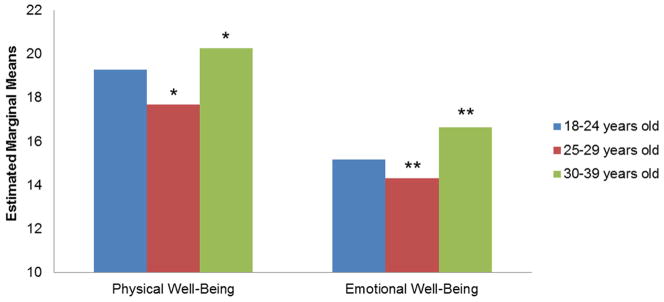
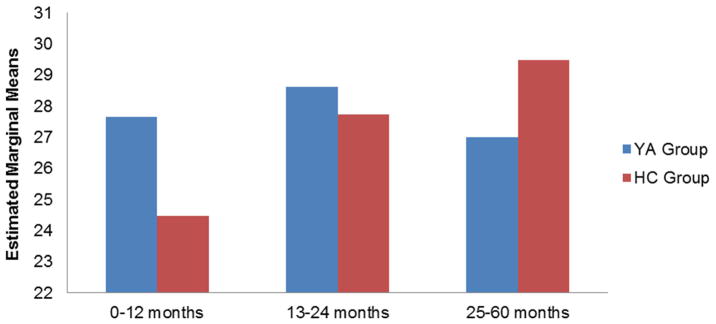
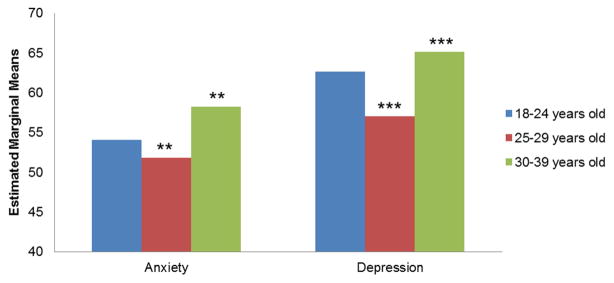
Results: Multivariate analysis of covariance found a significant main effect for group (YAs versus HCs) and a significant group-by-cohort interaction. YAs reported poorer physical (P = .005, d = .22) and emotional well-being (P = .011, d = .20) but better social well-being (P < .001, d = .49). YAs reported comparatively stable scores (P = .74) for posttraumatic growth compared to HCs, who reported greater posttraumatic growth across cohorts (P = .01, d = 16).
Conclusions: Findings underscore the negative and positive sequelae for YAs and highlight the need for comprehensive assessment among YA survivors of cancer. A matched, HC group allows the HRQL and psychological adaptation of YAs to be placed in context, enabling a more precise determination of the impact of cancer on YAs.
Keywords: controlled comparison study; posttraumatic growth; quality of life; survivorship; young adults.
© 2014 American Cancer Society.
Conflict of interest statement
The authors have no financial disclosures or conflicts of interest to report.
Figures
Comment in
-
Patient-centered research to inform patient-centered care for adolescents and young adults (AYAs) with cancer.Cancer. 2014 Aug 1;120(15):2227-9. doi: 10.1002/cncr.28734. Epub 2014 May 28. Cancer. 2014. PMID: 24890786 No abstract available.
References
-
- Bleyer A. Latest Estimates of Survival Rates of the 24 Most Common Cancers in Adolescent and Young Adult Americans. Journal of Adolescent and Young Adult Oncology. 2011;1:37–42. - PubMed
-
- Avis NE, Deimling GT. Cancer survivorship and aging. Cancer. 2008;113:3519–3529. - PubMed
-
- Oeffinger KC, Mertens AC, Sklar CA, et al. Chronic health conditions in adult survivors of childhood cancer. New England journal of medicine. 2006;355:1572–1582. - PubMed
Publication types
MeSH terms
Grants and funding
LinkOut - more resources
Full Text Sources
Other Literature Sources
Medical
