


Does bilingualism influence cognitive aging?
- PMID: 24890334
- PMCID: PMC4320748
- DOI: 10.1002/ana.24158
Does bilingualism influence cognitive aging?
Abstract
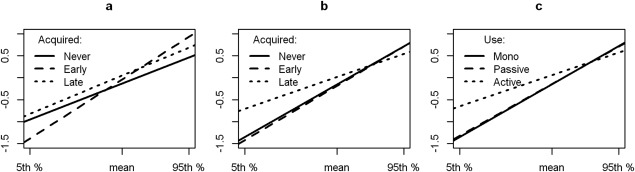
Recent evidence suggests a positive impact of bilingualism on cognition, including later onset of dementia. However, monolinguals and bilinguals might have different baseline cognitive ability. We present the first study examining the effect of bilingualism on later-life cognition controlling for childhood intelligence. We studied 853 participants, first tested in 1947 (age = 11 years), and retested in 2008-2010. Bilinguals performed significantly better than predicted from their baseline cognitive abilities, with strongest effects on general intelligence and reading. Our results suggest a positive effect of bilingualism on later-life cognition, including in those who acquired their second language in adulthood.
© 2014 The Authors Annals of Neurology published by Wiley Periodicals, Inc. on behalf of American Neurological Association. This is an open access article under the terms of the Creative Commons Attribution License, which permits use, distribution and reproduction in any medium, provided the original work is properly cited.
Figures
Similar articles
-
Language and cognitive control networks in bilinguals and monolinguals.Neuropsychologia. 2018 Aug;117:352-363. doi: 10.1016/j.neuropsychologia.2018.06.023. Epub 2018 Jun 28. Neuropsychologia. 2018. PMID: 29959966 Free PMC article.
-
Bilingualism in older Mexican-American immigrants is associated with higher scores on cognitive screening.BMC Geriatr. 2016 Nov 24;16(1):189. doi: 10.1186/s12877-016-0368-1. BMC Geriatr. 2016. PMID: 27881073 Free PMC article.
-
Protective effect of bilingualism on aging, MCI, and dementia: A community-based study.Alzheimers Dement. 2024 Apr;20(4):2620-2631. doi: 10.1002/alz.13702. Epub 2024 Feb 20. Alzheimers Dement. 2024. PMID: 38376105 Free PMC article.
-
Bilingualism Is Associated with a Delayed Onset of Dementia but Not with a Lower Risk of Developing it: a Systematic Review with Meta-Analyses.Neuropsychol Rev. 2020 Mar;30(1):1-24. doi: 10.1007/s11065-020-09426-8. Epub 2020 Feb 8. Neuropsychol Rev. 2020. PMID: 32036490 Free PMC article.
-
Neuropsychological, cognitive, and theoretical considerations for evaluation of bilingual individuals.Neuropsychol Rev. 2008 Sep;18(3):255-68. doi: 10.1007/s11065-008-9069-7. Epub 2008 Oct 8. Neuropsychol Rev. 2008. PMID: 18841477 Free PMC article. Review.
Cited by
-
Bilingual children show an advantage in controlling verbal interference during spoken language comprehension.Biling (Camb Engl). 2015 Jul;18(3):490-501. doi: 10.1017/S1366728914000686. Biling (Camb Engl). 2015. PMID: 26146479 Free PMC article.
-
The influence of bilingualism on gray matter volume in the course of aging: a longitudinal study.Front Aging Neurosci. 2023 Jul 20;15:1193283. doi: 10.3389/fnagi.2023.1193283. eCollection 2023. Front Aging Neurosci. 2023. PMID: 37547741 Free PMC article.
-
Uncovering the Mechanisms Responsible for Why Language Learning May Promote Healthy Cognitive Aging.Front Psychol. 2017 Dec 15;8:2217. doi: 10.3389/fpsyg.2017.02217. eCollection 2017. Front Psychol. 2017. PMID: 29326636 Free PMC article. Review.
-
Are There Any Cognitive Benefits of Computer-Based Foreign Language Training for Healthy Elderly People? - A Mini-Review.Front Psychol. 2021 Jan 12;11:573287. doi: 10.3389/fpsyg.2020.573287. eCollection 2020. Front Psychol. 2021. PMID: 33584410 Free PMC article. Review.
-
Dual-Language Use and Cognitive Function Among Mexican Americans Aged 65 and Older.J Alzheimers Dis. 2024;99(3):1105-1115. doi: 10.3233/JAD-231187. J Alzheimers Dis. 2024. PMID: 38759004 Free PMC article.
References
-
- Kavé G, Eyal N, Shorek A, Cohen-Mansfield J. Multilingualism and cognitive state in the oldest old. Psychol Aging. 2008;23:70–78. - PubMed
-
- Bialystok E, Craik FI, Freedman M. Bilingualism as a protection against the onset of symptoms of dementia. Neuropsychologia. 2007;45:459–464. - PubMed
-
- Chertkow H, Whitehead V, Phillips N. Multilingualism (but not always bilingualism) delays the onset of Alzheimer disease: evidence from a bilingual community. Alzheimer Dis Assoc Disord. 2010;24:118–125. - PubMed
-
- Alladi S, Bak TH, Duggirala V. Bilingualism delays age at onset of dementia, independent of education and immigration status. Neurology. 2013;81:1938–1944. - PubMed
MeSH terms
Grants and funding
LinkOut - more resources
Full Text Sources
Other Literature Sources
Medical
