Does bilingualism influence cognitive aging?
- PMID: 24890334
- PMCID: PMC4320748
- DOI: 10.1002/ana.24158
Does bilingualism influence cognitive aging?
Abstract
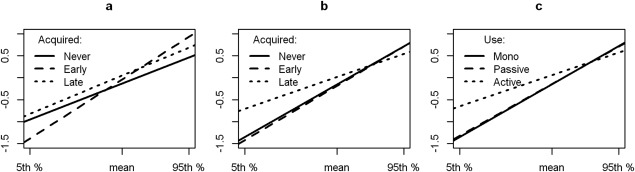
Recent evidence suggests a positive impact of bilingualism on cognition, including later onset of dementia. However, monolinguals and bilinguals might have different baseline cognitive ability. We present the first study examining the effect of bilingualism on later-life cognition controlling for childhood intelligence. We studied 853 participants, first tested in 1947 (age = 11 years), and retested in 2008-2010. Bilinguals performed significantly better than predicted from their baseline cognitive abilities, with strongest effects on general intelligence and reading. Our results suggest a positive effect of bilingualism on later-life cognition, including in those who acquired their second language in adulthood.
© 2014 The Authors Annals of Neurology published by Wiley Periodicals, Inc. on behalf of American Neurological Association. This is an open access article under the terms of the Creative Commons Attribution License, which permits use, distribution and reproduction in any medium, provided the original work is properly cited.
Figures
References
-
- Kavé G, Eyal N, Shorek A, Cohen-Mansfield J. Multilingualism and cognitive state in the oldest old. Psychol Aging. 2008;23:70–78. - PubMed
-
- Bialystok E, Craik FI, Freedman M. Bilingualism as a protection against the onset of symptoms of dementia. Neuropsychologia. 2007;45:459–464. - PubMed
-
- Chertkow H, Whitehead V, Phillips N. Multilingualism (but not always bilingualism) delays the onset of Alzheimer disease: evidence from a bilingual community. Alzheimer Dis Assoc Disord. 2010;24:118–125. - PubMed
-
- Alladi S, Bak TH, Duggirala V. Bilingualism delays age at onset of dementia, independent of education and immigration status. Neurology. 2013;81:1938–1944. - PubMed
MeSH terms
Grants and funding
LinkOut - more resources
Full Text Sources
Other Literature Sources
Medical