


Association between prehospital electrocardiogram use and patient home distance from the percutaneous coronary intervention center on total reperfusion time in ST-segment-elevation myocardial infarction patients: a retrospective analysis from the national cardiovascular data registry
- PMID: 24890543
- PMCID: PMC4115060
- DOI: 10.1016/j.ahj.2014.03.014
Association between prehospital electrocardiogram use and patient home distance from the percutaneous coronary intervention center on total reperfusion time in ST-segment-elevation myocardial infarction patients: a retrospective analysis from the national cardiovascular data registry
Abstract
Background: Current guidelines recommend ≤90 minutes from first medical contact to percutaneous coronary intervention (FMC2B) for ST-segment-elevation myocardial infarction (STEMI) patients. We evaluated the relationship between patient home distance from a percutaneous coronary intervention (PCI) center, prehospital electrocardiogram (ECG) use, and FMC2B time among patients with STEMI.
Methods: We performed a retrospective cohort study including all STEMI patients in the ACTION-Get With The Guidelines registry from July 1, 2008, to September 30, 2012, who were transported by ambulance to a PCI center. Patient home distance was defined as the driving distance from the patient's home zip code to the PCI center address. Distance was classified into tertiles, and linear regression was used to characterize the interaction between prehospital ECG use and patient home distance with respect to FMC2B time.
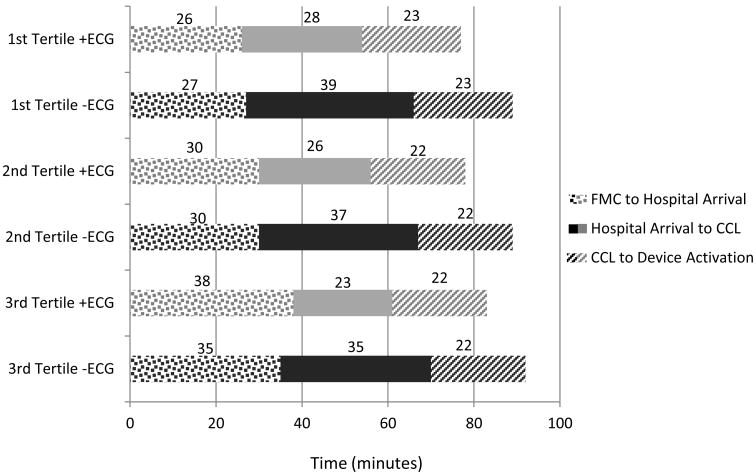
Results: Of the 29,506 STEMI patients, 19,690 (67%) received a prehospital ECG. The median patient home distance to the PCI center was 11.0 miles among patients with and 9.9 miles among those without a prehospital ECG. Prehospital ECGs were associated with a 10-minute reduction in the FMC2B time (P < .0001), which was consistent across distance tertiles (11 vs 11 vs 10 minutes). The association between prehospital ECGs and shorter FMC2B was attenuated by 0.8 minute for every 10-mile increase in distance (interaction P = .0002).
Conclusions: Prehospital ECGs are associated with a 10-minute reduction in the FMC2B time. However, patient home distance from a PCI center does not substantially change this association.
Copyright © 2014 Mosby, Inc. All rights reserved.
Figures
References
-
- De Luca G, Suryapranata H, Ottervanger JP, Antman EM. Time delay to treatment and mortality in primary angioplasty for acute myocardial infarction: every minute of delay counts. Circulation. 2004;109:1223–5. - PubMed
-
- Keeley EC, Boura JA, Grines CL. Primary angioplasty versus intravenous thrombolytic therapy for acute myocardial infarction: a quantitative review of 23 randomised trials. Lancet. 2003;361:13–20. - PubMed
-
- O'Gara PT, Kushner FG, Ascheim DD, et al. 2013 ACCF/AHA guideline for the management of ST-elevation myocardial infarction: executive summary: a report of the American College of Cardiology Foundation/American Heart Association Task Force on Practice Guidelines. J Am Coll Cardiol. 2013;61:485–510. - PubMed
-
- Bagai A, Jollis JG, Dauerman HL, et al. Emergency Department Bypass for ST-Segment-Elevation Myocardial Infarction Patients Identified With a Prehospital Electrocardiogram: A Report From the American Heart Association Mission: Lifeline Program. Circulation. 2013;128:352–9. - PubMed
Publication types
MeSH terms
Grants and funding
LinkOut - more resources
Full Text Sources
Other Literature Sources
Medical
Miscellaneous
