. 2014 Aug;105(8):1079-85.
doi: 10.1111/cas.12460.

Low-grade prostate cancer diverges early from high grade and metastatic disease

Affiliations

Low-grade prostate cancer diverges early from high grade and metastatic disease

David J VanderWeele et al. Cancer Sci. 2014 Aug.

Abstract

Understanding the developmental relationship between indolent and aggressive tumors is central to understanding disease progression and making treatment decisions. For example, most men diagnosed with prostate cancer have clinically indolent disease and die from other causes. Overtreatment of prostate cancer remains a concern. Here we use laser microdissection followed by exome sequencing of low- and high-grade prostate cancer foci from four subjects, and metastatic disease from two of those subjects, to evaluate the molecular relationship of coincident cancer foci. Seventy of 79 (87%) high-confidence somatic mutations in low-grade disease were private to low-grade foci. In contrast, high-grade foci and metastases harbored many of the same mutations. In cases in which there was a metastatic focus, 15 of 80 (19%) high-confidence somatic mutations in high-grade foci were private. Seven of the 80 (9%) were shared with low-grade foci and 65 (82%) were shared with metastatic foci. Notably, mutations in cancer-associated genes and the p53 signaling pathway were found exclusively in high-grade foci and metastases. The pattern of mutations is consistent with early divergence between low- and high-grade foci and late divergence between high-grade foci and metastases. These data provide insights into the development of high-grade and metastatic prostate cancer.

Keywords: Carcinoma/genetics; exomes; genetic heterogeneity; multiple primary neoplasms; prostatic neoplasms.


Figures

Fig. 1
Fig. 1
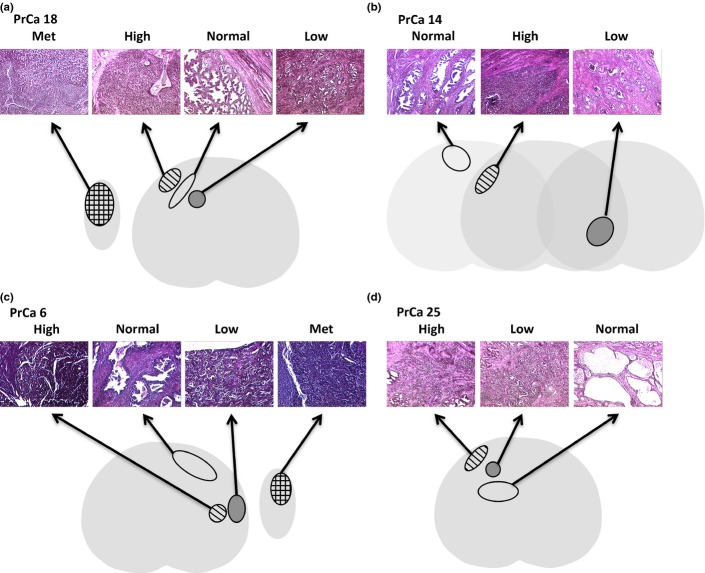
Histology of coincident prostate cancer foci. Representative H&E stains and illustrations representing the prostate cancer foci that were laser microdissected. Two cancer foci and uninvolved prostate glands were isolated from PrCa 18 (a), PrCa 14 (b), PrCa 6 (c) and PrCa 25 (d). In addition, a metastatic (Met) focus was isolated from PrCa 18 and PrCa 6. For PrCa 14 (b), the foci were from different levels of the prostate. For the other three specimens the foci were at the same level. Light gray, histologically normal prostate; dark gray, low-grade cancer focus; striped, high-grade cancer focus; checked, metastatic focus from a lymph node removed at the time of prostatectomy.
Fig. 2
Fig. 2
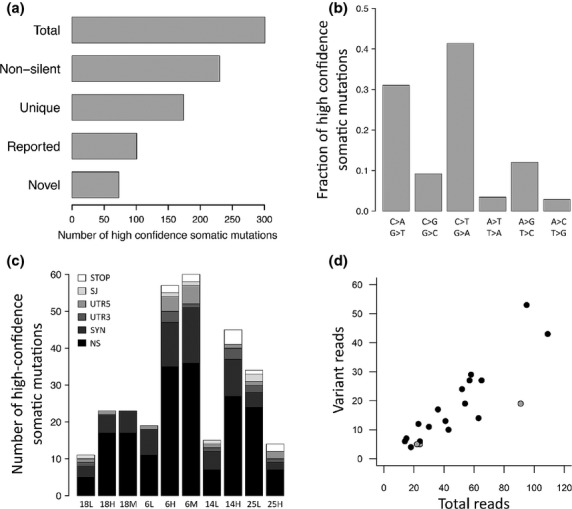
Mutation characteristics. (a) Number of high-confidence somatic mutations across all foci. Non-silent, non-silent mutations; Unique, number of unique genes harboring a non-silent mutation; Reported, gene reported to be mutated in references 9–12 and 14. (b) Spectrum of unique high confidence somatic mutations across all foci. (c) Number of high-confidence somatic mutation types in all prostate samples. L, low-grade focus; H, high-grade focus; M, metastatic focus; NS, nonsynonymous; SYN, synonymous; UTR3, 3′ untranslated region; UTR5, 5′ untranslated region; SJ, splice junction; STOP, premature stop codon. (d) Confirmation of high-confidence somatic mutations with capillary sequencing by number of total and variant reads (gray, not confirmed; black, confirmed). Confirmation rate, 0.85.
Fig. 3
Fig. 3
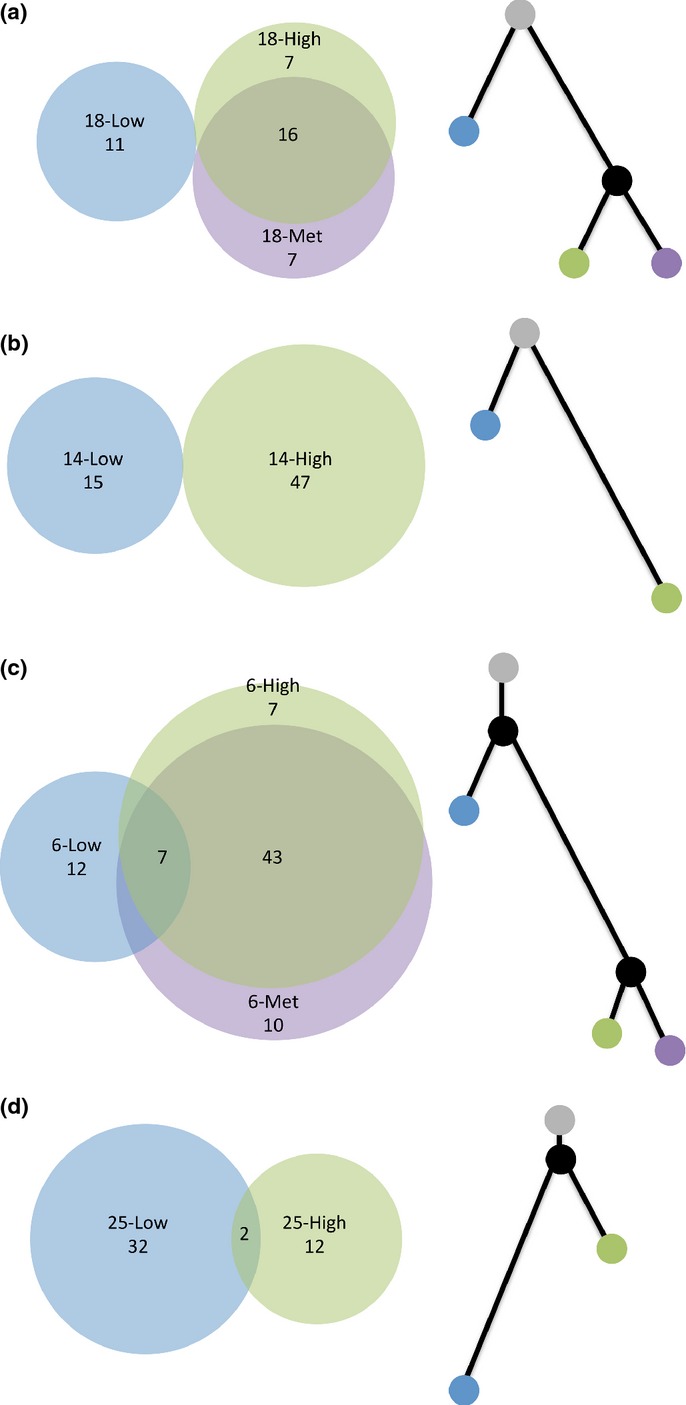
The molecular relationship of coincident foci. Venn diagrams (left) depicting the pattern of shared and private high-confidence somatic mutations and phylogenetic trees (right) depicting the relationship of coincident foci for PrCa 18 (a), PrCa 14 (b), PrCa 6 (c) and PrCa 25 (d). The number of high-confidence somatic mutations is labeled within each Venn diagram. In (c), there are no mutations that are shared between the low-grade focus and the metastatic focus and also not shared with the high-grade focus. Within each phylogenetic tree, branch length is proportional to the number of mutations. Gray, uninvolved prostate; blue, low-grade focus; green, high-grade focus; purple, metastatic focus; black, theoretical common progenitor.
Fig. 4
Fig. 4
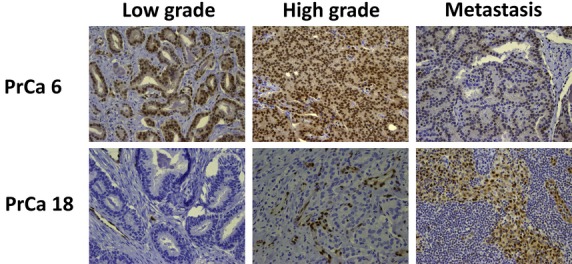
ERG expression. Immunohistochemical analysis for ERG in coincident foci from PrCa 6 and PrCa 18.
Fig. 5
Fig. 5
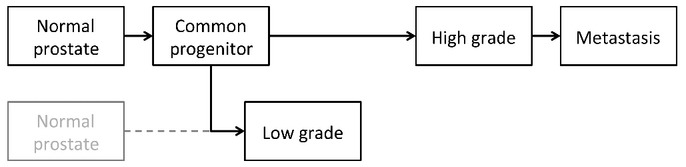
Model of prostate cancer evolution. Low-grade and high-grade cancer foci progress largely in parallel, diverging early from a common progenitor. Metastatic disease exhibits late divergence from high-grade disease. It cannot be ruled out that in some cases low- and high-grade diseases arise through independent origins.

References

    1. Vogelstein B, Kinzler KW. The multistep nature of cancer. Trends Genet. 1993;9:138–41. - PubMed
    1. Eggener SE, Scardino PT, Walsh PC, et al. Predicting 15-year prostate cancer specific mortality after radical prostatectomy. J Urol. 2011;185:869–75. - PMC - PubMed
    1. Ross HM, Kryvenko ON, Cowan JE, Simko JP, Wheeler TM, Epstein JI. Do adenocarcinomas of the prostate with Gleason score (GS) ≤6 have the potential to metastasize to lymph nodes? Am J Surg Pathol. 2012;36:1346–52. - PMC - PubMed
    1. Siegel R, Naishadham D, Jemal A. Cancer statistics, 2013. CA Cancer J Clin. 2013;63:11–30. - PubMed
    1. Andriole GL, Crawford ED, Grubb RL, 3rd, et al. Mortality results from a randomized prostate-cancer screening trial. N Engl J Med. 2009;360:1310–9. - PMC - PubMed

Publication types