


Surface-Bound Ruthenium Diimine Organometallic Complexes: Excited-State Properties
- PMID: 24891753
- PMCID: PMC4036732
- DOI: 10.1021/om401153x
Surface-Bound Ruthenium Diimine Organometallic Complexes: Excited-State Properties
Abstract
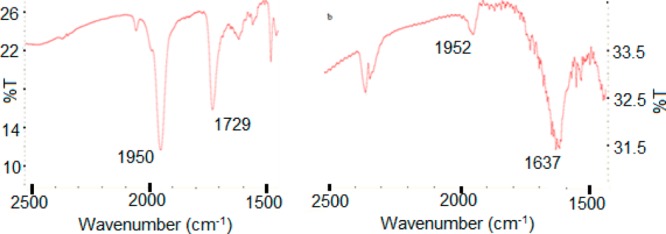
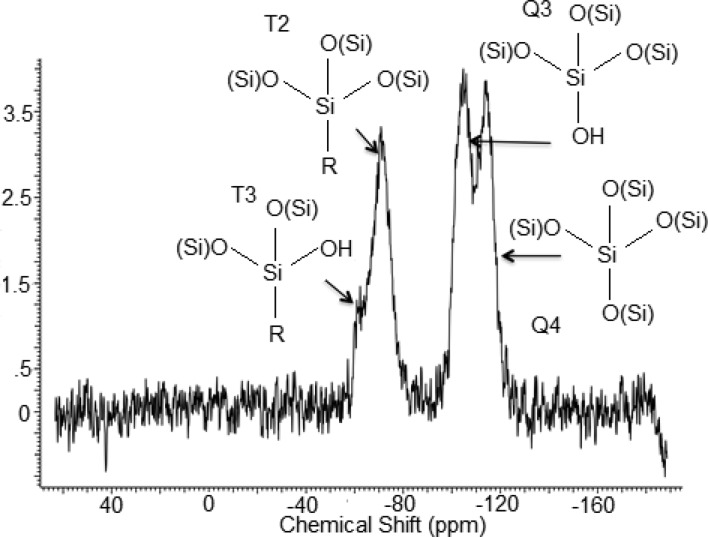
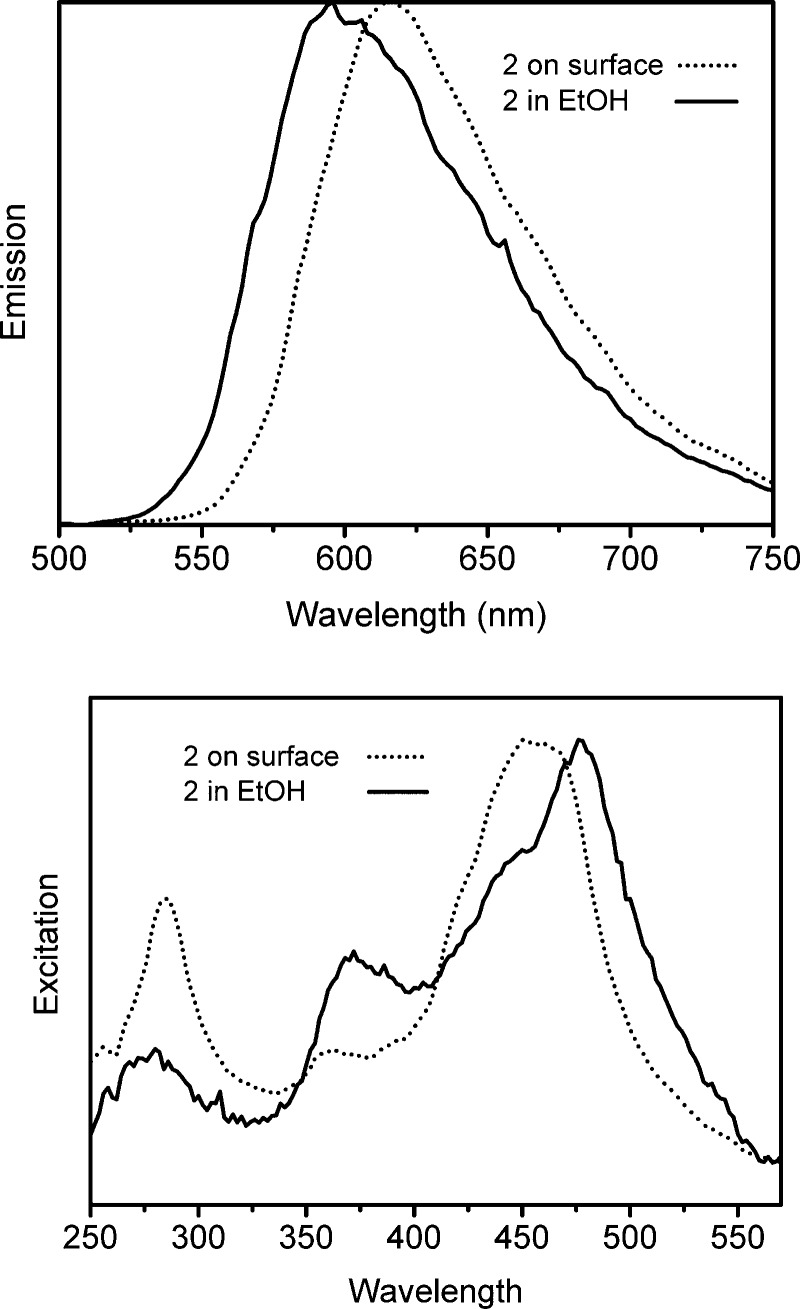
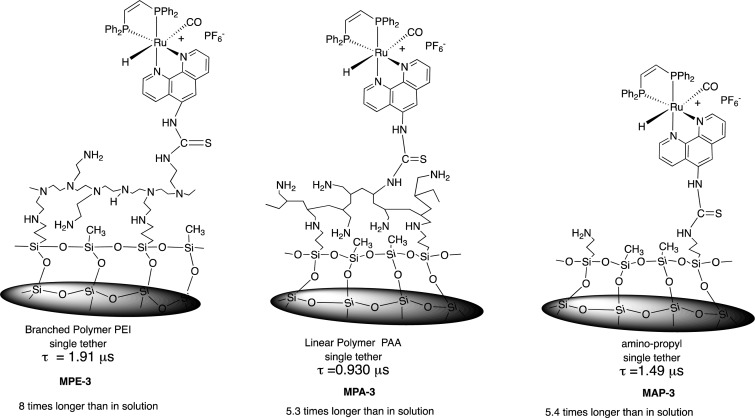
Ruthenium complexes of the general formula [Ru(CO)(H)(L2)(L'2)][PF6] (L2 = trans-2PPh3, L' = η2-4,4'-dicarboxybipyridine (1); L2 =trans-2Ph2PCH2CH2COOH, L'2 = bipyridine (2); L2 = Ph2PCHCHPPh2, L' = η2-5-amino-1,10-phenanthroline (3); L2 = trans-2PPh3, L'2 = η2-4-carboxaldehyde-4'-methylbipyridine (4)) have been shown to have longer emission lifetimes and higher quantum yields in solution compared with more symmetrical molecules such as [Ru(bpy)3][Cl]2. Compound 4 is obtained as a mixture with the corresponding acetal, 4'. These less symmetrical complexes have been covalently immobilized on the surface of silica polyamine composites, and their photophysical properties have been studied. The surface-bound complexes have been characterized by solid-state CPMAS 13C, 31P, and 29Si NMR, UV-vis, and FT-IR spectroscopies. Excited-state lifetime studies revealed that, in general, the lifetimes of the immobilized complexes are 1.4 to 8 times longer than in solution and are dependent on particle size (300-500 μm versus 10-20 nm average diameter silica gels), polymer structure (linear poly(allylamine) versus branched poly(ethylenimine)), and the type of surface tether. One exception to this trend is the previously reported complex [Ru(bpy)2(5-amino-1,10-phenanthroline)][PF6]2 (5), where only a slight increase in lifetime is observed. Only minor changes in emission wavelength are observed for all the complexes. This opens up the possibility for enhanced heterogeneous electron transfer in photocatalytic reactions.
Figures







References
-
- Allen J. J.; Rosenberg E.; Johnston E.; Hart C. ACS Appl. Mater. Interfaces 2012, 4, 1573–1584. - PubMed
-
- Jal P. Talanta 2002, 62, 1005–1028. - PubMed
-
- Allen J.; Rosenberg E.; Karakhanov E.; Kardashev S. V.; Maximov A.; Zolotukhina A. Appl. Organomet. Chem. 2011, 25, 245–254.
-
- Jurss J. W.; Concepcion J. C.; Norris M. R.; Templeton J. L.; Meyer T. J. . Inorg. Chem. 2010, 49, 3980–3982. - PubMed
-
- Lu X.; Manners I.; Winnik M. A. Macromolecules 2001, 34, 1917–1927.
Grants and funding
LinkOut - more resources
Full Text Sources
Other Literature Sources