Clinical Trial
. 2014 Sep;20(9):1426-34.
doi: 10.1016/j.bbmt.2014.05.023. Epub 2014 Jun 2.

Etanercept plus topical corticosteroids as initial therapy for grade one acute graft-versus-host disease after allogeneic hematopoietic cell transplantation

Affiliations
Clinical Trial

Etanercept plus topical corticosteroids as initial therapy for grade one acute graft-versus-host disease after allogeneic hematopoietic cell transplantation

Erin Gatza et al. Biol Blood Marrow Transplant. 2014 Sep.

Abstract

Clinical diagnosis of grade 1 acute graft-versus-host disease (GVHD) marks the beginning of a potentially progressive and fatal course of GVHD after hematopoietic stem cell transplantation (HSCT). However, interventional studies to treat early GVHD are lacking. We conducted a single-arm prospective phase II trial to test the hypothesis that treatment of newly diagnosed grade 1 acute GVHD with etanercept and topical corticosteroids would reduce progression to grade 2 to 4 within 28 days. Study patients (n = 34) had a median age of 51 years (range, 10 to 67 years) and had undergone unrelated (n = 22) or related (n = 12) donor HSCT. Study patients were treated with etanercept (.4 mg/kg, maximum 25 mg/dose) twice weekly for 4 to 8 weeks. Ten of 34 patients (29%) progressed to grade 2 to 4 acute GVHD within 28 days. The cumulative incidence of grade 2 to 4 and grade 3 to 4 acute GVHD at 1 year was 41% and 3%, respectively. Nonrelapse mortality was 19% and overall survival was 63% at 2 years. Among a contemporaneous control cohort of patients who were diagnosed with grade 1 acute GVHD and treated with topical corticosteroids but not etanercept during the study period, 12 of 28 patients (43%) progressed to grade 2 to 4 GVHD within 28 days, with a 1-year incidence of grade 2 to 4 GVHD and grade 3 to 4 GVHD of 61% (41% versus 61%, P = .08) and 18% (3% versus 18%, P = .05), respectively. Patients treated with etanercept also experienced less increase in GVHD plasma biomarkers suppression of tumorigenicity 2 (P = .06) and regenerating islet-derived 3-alpha (P = .01) 28 days after grade 1 acute GVHD diagnosis compared with contemporaneous control patients. This study was terminated early because of poor accrual. Future prospective studies are needed to identify patients with grade 1 acute GVHD at risk of swift progression to more severe GVHD and to establish consensus for the treatment of grade 1 acute GVHD. This trial is registered with ClinicalTrials.gov, number NCT00726375.

Keywords: Clinical trial; Etanercept; Grade 1 acute; Graft-versus-host disease; Hematopoietic stem cell transplantation.


Figures

Figure 1
Figure 1
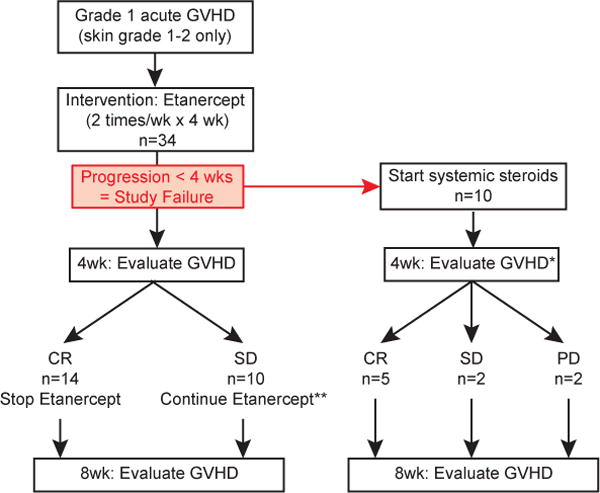
Study schema. Thirty-four patients diagnosed with skin grade 1–2 acute GVHD (overall grade 1) were treated with etanercept twice weekly for four weeks. Patients whose GVHD progressed to grade 2–4 within the first 28 days were considered study failures. In these patients, etanercept therapy was stopped and treatment with systemic steroids was initiated. GVHD was formally evaluated 4 and 8 weeks after diagnosis and onset of etanercept therapy. CR, complete resolution of GVHD; SD, stable disease; PD, progressive disease. *, 1 patient died of idiopathic pneumonia syndrome (IPS) before the 4 week GVHD evaluation; **, 7 of 10 patients with SD at the 4 week evaluation received an additional 4 week course of etanercept treatment.
Figure 2
Figure 2
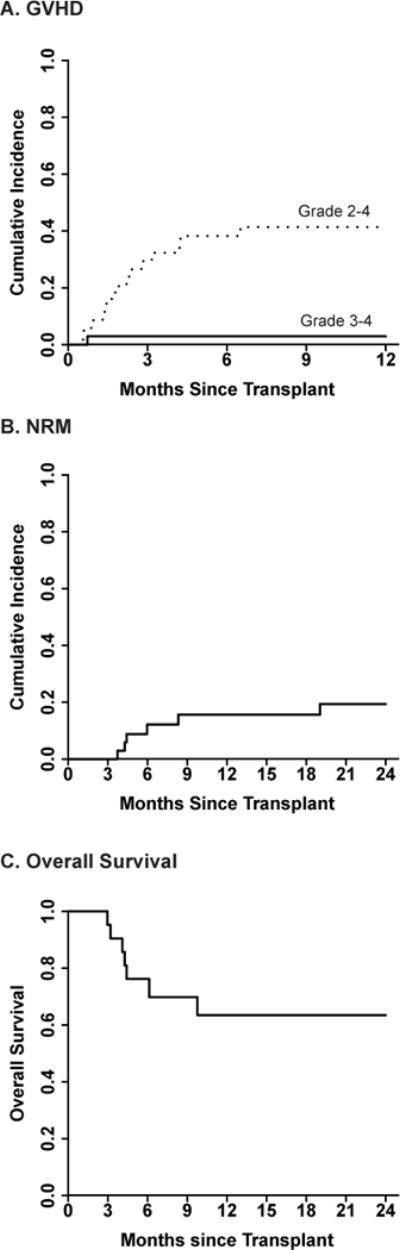
Incidence of acute graft-versus-host disease, NRM and OS in study patients (n=34). (A) 1-year cumulative incidence of acute GVHD. Dashed line, grade 2–4 acute GVHD; Solid line, grade 3–4 acute GVHD. (B) 2-year NRM. (C) 2-year OS.
Figure 3
Figure 3
Incidence of graft-verus-host disease in study (n=34) and contemporaneous control (n=26) patients. (A) Cumulative incidence of grade 2–4 acute GVHD. Study versus control, p=0.08. (B) Cumulative incidence of grade 3–4 acute GVHD. Study versus control, p=0.05. (C) Cumulative incidence of moderate-to-severe chronic GVHD. Study versus control, p=0.4. Dashed line, contemporaneous control patients; Solid line, study patients treated with etanercept.
Figure 4
Figure 4
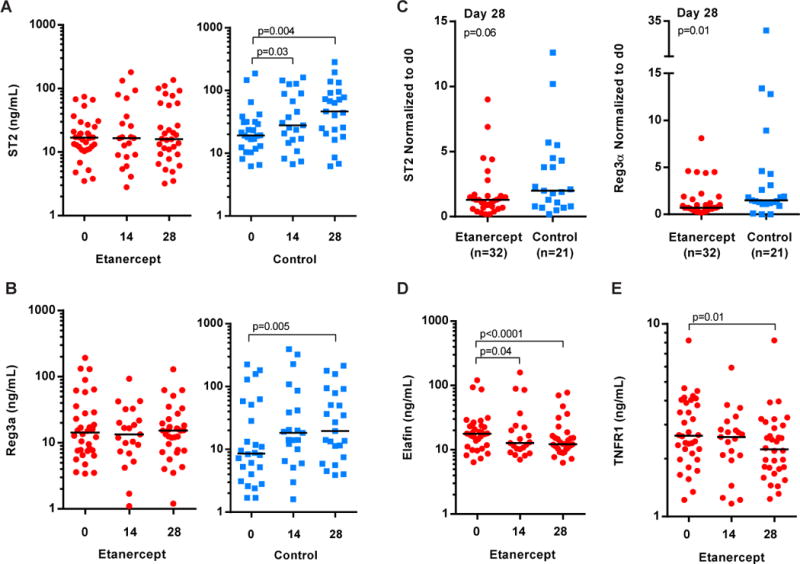
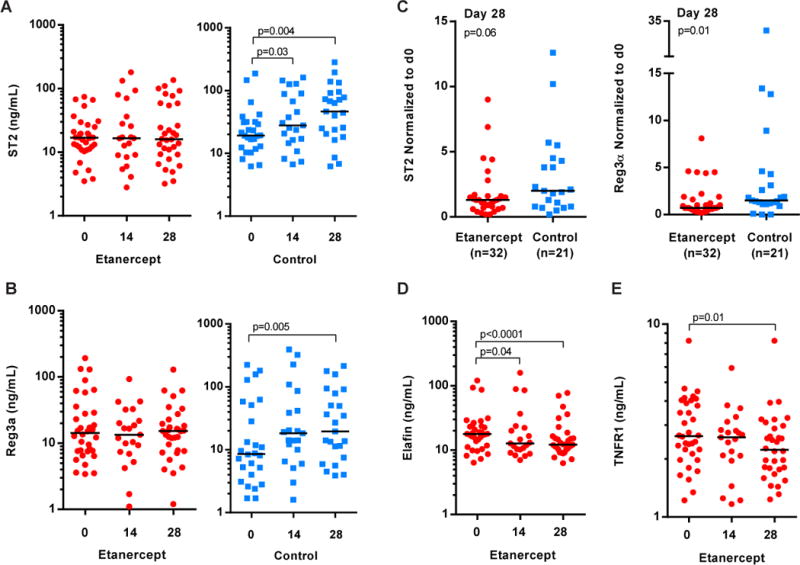
Biomarkers of acute GVHD in the plasma of study and contemporaneous control patients. Red circles denote patients in the study who received etanercept treatment. Blue squares are contemporaneous control patients. Horizontal black lines show the median values on each plot. (A and B) Plasma ST2 and Reg3α concentrations at the time of grade 1 diagnosis and treatment onset (day 0), day 14 and day 28. (A) Plasma ST2. (B) Plasma Reg3α. (C) Day 28 ST2 (left) and Reg3α (right) concentrations normalized to the concentration at GVHD diagnosis (ratio of day 28 over day 0). The number (n) of patients for whom samples were available to calculate the normalized value is indicated on each plot. Values plotted using linear-scale y-axis. (D) Plasma elafin. (E) Plasma TNFR1. (A, B, D, E) Study patient samples available for analysis: day 0, n=34; day 14, n=21; day 28, n=32. Control samples: day 0, n=26; day 14, n=21; day 28, n=23. Biomarker concentrations were plotted using a logarithmic-scale (Log10) y-axis to allow visualization of the full range of data at each time point.
Figure 5
Figure 5
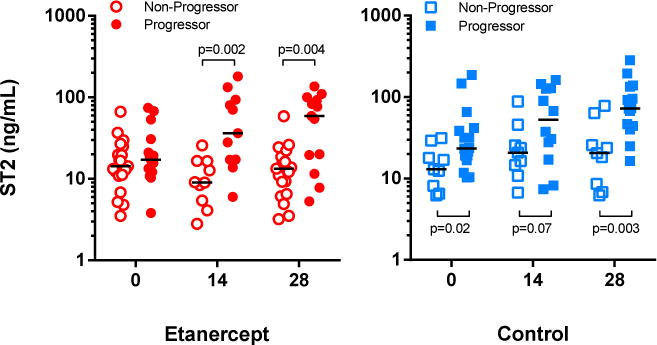
Patients whose acute GVHD progressed to grade 2–4 had higher plasma ST2 levels than patients whose GVHD did not progress. Plasma ST2 concentrations at the time of grade 1 diagnosis and treatment onset (day 0), day 14 and day 28 in patients whose GVHD remained grade 1 or resolved with treatment (Non-Progressor) and patients whose GVHD progressed to grade 2–4 (Progressor) at any time after diagnosis. (left) Study patients. Non-Progressors with samples available for analysis: day 0, n=19; day 14, n=10; day 28, n=19. Progressors: day 0, n=15; day 14, n=11; day 28, n=13. (right) Contemporaneous control patients. Non-Progressors with samples available for analysis: day 0, n=9; day 14, n=9; day 28, n=9. Progressors: day 0, n=17; day 14, n=12; day 28, n=14. Each plotted point represents a single patient. Horizontal black lines represent median ST2 concentrations plotted on a logarithmic-scale (Log10) y-axis.

References

    1. Copelan EA. Hematopoietic stem-cell transplantation. The New England journal of medicine. 2006;354:1813–26. - PubMed
    1. Ferrara JL, Levine JE, Reddy P, Holler E. Graft-versus-host disease. Lancet. 2009;373:1550–61. - PMC - PubMed
    1. Gooley TA, Chien JW, Pergam SA, Hingorani S, Sorror ML, Boeckh M, et al. Reduced mortality after allogeneic hematopoietic-cell transplantation. The New England journal of medicine. 2010;363:2091–101. - PMC - PubMed
    1. Jagasia M, Arora M, Flowers ME, Chao NJ, McCarthy PL, Cutler CS, et al. Risk factors for acute GVHD and survival after hematopoietic cell transplantation. Blood. 2012;119:296–307. - PMC - PubMed
    1. Nash RA, Antin JH, Karanes C, Fay JW, Avalos BR, Yeager AM, et al. Phase 3 study comparing methotrexate and tacrolimus with methotrexate and cyclosporine for prophylaxis of acute graft-versus-host disease after marrow transplantation from unrelated donors. Blood. 2000;96:2062–8. - PubMed

Publication types

MeSH terms

Associated data