Review
. 2014 Jun;124(6):2341-7.
doi: 10.1172/JCI72274. Epub 2014 Jun 2.

The inextricable role of the kidney in hypertension

Review

The inextricable role of the kidney in hypertension

Thomas M Coffman. J Clin Invest. 2014 Jun.

Abstract

An essential link between the kidney and blood pressure control has long been known. Here, we review evidence supporting the premise that an impaired capacity of the kidney to excrete sodium in response to elevated blood pressure is a major contributor to hypertension, irrespective of the initiating cause. In this regard, recent work suggests that novel pathways controlling key sodium transporters in kidney epithelia have a critical impact on hypertension pathogenesis, supporting a model in which impaired renal sodium excretion is a final common pathway through which vascular, neural, and inflammatory responses raise blood pressure. We also address recent findings calling into question long-standing notions regarding the relationship between sodium intake and changes in body fluid volume. Expanded understanding of the role of the kidney as both a cause and target of hypertension highlights key aspects of pathophysiology and may lead to identification of new strategies for prevention and treatment.


Figures
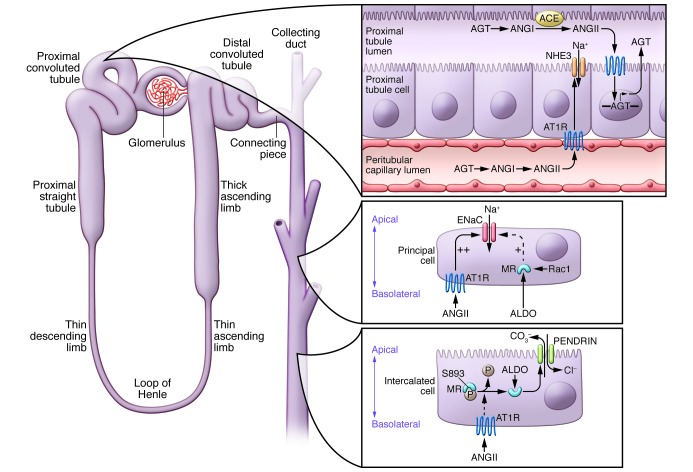
Figure 1
Figure 1. A model for local control of RAS activity within the kidney.
High levels of angiotensin II (ANGII) in circulation, derived from angiotensinogen (AGT) generated primarily by the liver, are associated with (i) increased ANGII in the kidney, (ii) upregulation of AGT in the proximal tubule epithelium, (iii) increased levels of AGT in the tubular lumen, (iv) generation of ANGII requiring angiotensin-converting enzyme (ACE) expression in the brush border of the proximal tubule (PT), and (v) increased excretion of AGT and ANG peptides in urine. Within the kidney circulation and the tubule lumen, ANGII binds to AT1 receptors (AT1Rs) stimulating AGT transcription in renal epithelial cells and influencing the synthesis and activity of epithelial solute transporters with critical actions to influence body fluid volume and blood pressure. These transporters include NHE3, the major luminal sodium transporter in PT epithelia, along with paracrine stimulation of downstream epithelial transporters such as ENaC and PENDRIN in the collecting duct. In the collecting duct, control of sodium transport involves complex interactions between ANGII, acting via AT1Rs, and aldosterone (ALDO), acting via the mineralocorticoid receptor (MR). In principal cells, ANGII and ALDO both stimulate the abundance and activity of ENaC, but direct effects of ANGII seem to predominate. Rac1 signaling may also stimulate ENaC, independent of ALDO. In intercalated cells, ANGII influences responsiveness of the MR to ALDO by regulating dephosphorylation of the MR at S893, allowing ALDO to bind, leading to activation of PENDRIN and enhanced chloride and sodium reabsorption.
Figure 2
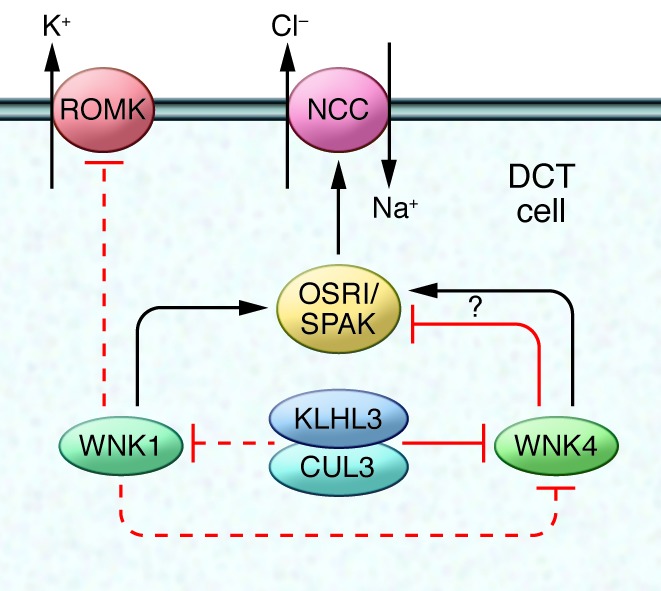
Figure 2. Mechanisms regulating sodium and potassium flux in the distal nephron.
WNK family kinases control the activity of the sodium chloride cotransporter (NCC) and the renal outer medullary potassium channel (ROMK) in distal convoluted tubule (DCT) cells in the kidney. WNK1 phosphorylates and stimulates the SPS1-related proline/alanine-rich kinase (SPAK) and oxidative stress-responsive kinase 1 (OSR1) protein kinases, which in turn, promotes NCC-dependent sodium transport. WNK1 may also inhibit ROMK. WNK4 inhibits ROMK but has been reported to have both stimulating and inhibitory actions on NCC depending on the experimental system used. Levels of WNK4 are regulated by the activity of the cullin 3-KLHL3 ubiquitin ligase, which has also been suggested to modulate WNK1. Individual mutations in WNK1, WNK4, cullin 3, and KLHL3 generate a similar phenotype: the syndrome of pseudo-hypoaldosteronism type II (PHAII), a Mendelian syndrome characterized by the unusual combination of hypertension and hyperkalemia, highlighting the continuity and importance of this pathway in the normal control of sodium and potassium handling in the distal nephron.

References

    1. Lawes CM, Vander Hoorn S, Rodgers A, International Society of Hypertension Global burden of blood-pressure-related disease, 2001. Lancet. 2008;371(9623):1513–1518. doi: 10.1016/S0140-6736(08)60655-8. - DOI - PubMed
    1. [No authors listed]. Effects of treatment on morbidity in hypertension. Results in patients with diastolic blood pressures averaging 115 through 129 mm Hg. JAMA. 1967202111028–1034. - PubMed
    1. [No authors listed]. Five-year findings of the hypertension detection follow-up program. I. Reduction in mortality of persons with high blood pressure, including mild hypertension. Hypertension Detection and Follow-up Program Cooperative Group. JAMA. 1979242232562–2571. - PubMed
    1. [No authors listed]. MRC trial of treatment of mild hypertension: principal results. Medical Research Council Working Party. Br Med J (Clin Res Ed). 1985291648897–104.10.1136/bmj.291.6488.97 - DOI - PMC - PubMed
    1. Gu Q, Burt VL, Dillon CF, Yoon S. Trends in antihypertensive medication use and blood pressure control among United States adults with hypertension: the National Health And Nutrition Examination Survey, 2001 to 2010. Circulation. 2012;126(17):2105–2114. doi: 10.1161/CIRCULATIONAHA.112.096156. - DOI - PubMed

Publication types