. 2014 Aug;27(6):295-304.
doi: 10.1089/vim.2013.0128. Epub 2014 Jun 3.

Phage neutralization by sera of patients receiving phage therapy

Phage neutralization by sera of patients receiving phage therapy

Marzanna Łusiak-Szelachowska et al. Viral Immunol. 2014 Aug.

Abstract

The aim of our investigation was to verify whether phage therapy (PT) can induce antiphage antibodies. The antiphage activity was determined in sera from 122 patients from the Phage Therapy Unit in Wrocław with bacterial infections before and during PT, and in sera from 30 healthy volunteers using a neutralization test. Furthermore, levels of antiphage antibodies were investigated in sera of 19 patients receiving staphylococcal phages and sera of 20 healthy volunteers using enzyme-linked immunosorbent assay. The phages were administered orally, locally, orally/locally, intrarectally, or orally/intrarectally. The rate of phage inactivation (K) estimated the level of phages' neutralization by human sera. Low K rates were found in sera of healthy volunteers (K ≤ 1.73). Low K rates were detected before PT (K ≤ 1.64). High antiphage activity of sera K > 18 was observed in 12.3% of examined patients (n = 15) treated with phages locally (n = 13) or locally/orally (n = 2) from 15 to 60 days of PT. High K rates were found in patients treated with some Staphylococcus aureus, Pseudomonas aeruginosa, and Enterococcus faecalis phages. Low K rates were observed during PT in sera of patients using phages orally (K ≤ 1.04). Increased inactivation of phages by sera of patients receiving PT decreased after therapy. These results suggest that the antiphage activity in patients' sera depends on the route of phage administration and phage type. The induction of antiphage activity of sera during or after PT does not exclude a favorable result of PT.


Figures

<b>FIG. 1.</b>
FIG. 1.
Patients treated locally with Staphylococcus aureus MS-1 phage cocktail: (A) case 1, (B) case 2, (C) case 3, (D) case 4, and (E) case 5. The rates of phage inactivation (K) by sera were determined in the neutralization test. S. aureus MS-1 phage cocktail is composed of three phages: S. aureus A5/80, S. aureus 676/Z, and S. aureus P4.
<b>FIG. 2.</b>
FIG. 2.
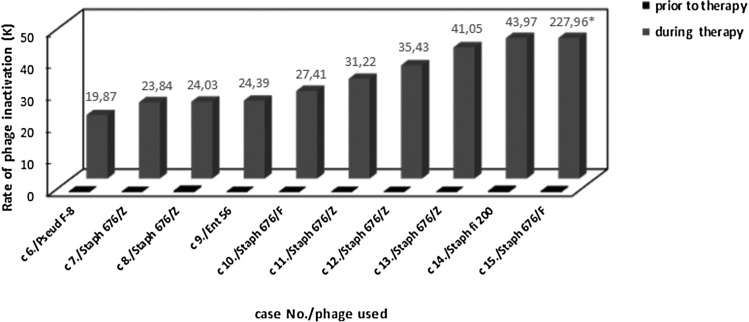
High phage inactivation by sera from patients receiving Pseudomonas, Staphylococcus, or Enterococcus phages. Cases 6–12 and 14, local administration; cases 13 and 15, local and oral administration. The rates of phage inactivation (K) by sera were determined in the neutralization test. The height of the last bar does not correspond to the value written on the bar.
<b>FIG. 3.</b>
FIG. 3.
Rates of phage inactivation (K) by serum of patient treated locally with S. aureus 676/Z phage (case 11). Specific phage means phage lysing definite bacterial strain causing patients' illness. The rates of phage inactivation (K) by sera were determined in the neutralization test.
<b>FIG. 4.</b>
FIG. 4.
Rates of K by serum of patient treated locally with S. aureus 676/Z phage (case 7). Specific phage means phage lysing definite bacterial strain causing patients' illness. The rates of K by sera were determined in the neutralization test.
<b>FIG. 5.</b>
FIG. 5.
Patients treated with S. aureus A3/R phage (local administration, patients 3 and 6 oral administration, 100-fold dilution of human sera). The level of antiphage antibodies (all human Igs) was determined in enzyme-linked immunosorbent assay (ELISA). Purified S. aureus phage preparations as antigens (108 pfu/mL) were used.
<b>FIG. 6.</b>
FIG. 6.
Patients treated with S. aureus 676/Z phage (local administration, 100-fold dilution of human sera). The level of antiphage antibodies (all human Igs) was determined in ELISA. Purified S. aureus phage preparations as antigens (108 pfu/mL) were used.
<b>FIG. 7.</b>
FIG. 7.
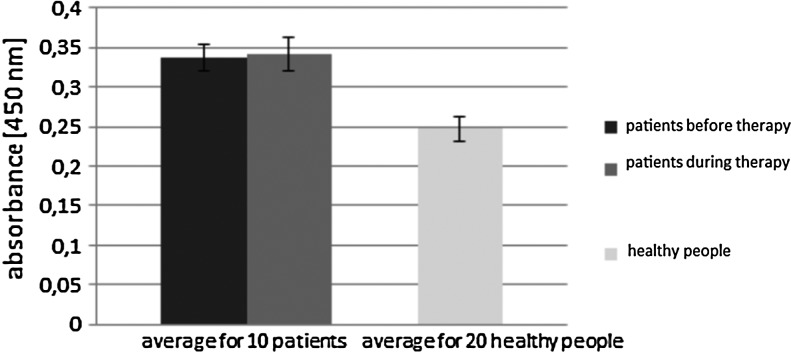
Patients treated with S. aureus A3/R phage and healthy people (100-fold dilution of human sera). The level of antiphage antibodies (all human Igs) was determined in ELISA. Purified S. aureus phage preparations as antigens (108 pfu/mL) were used.
<b>FIG. 8.</b>
FIG. 8.
Patients treated with S. aureus 676/Z phage and healthy people (100-fold dilution of human sera). The level of antiphage antibodies (all human Igs) was determined in ELISA. Purified S. aureus phage preparations as antigens (108 pfu/mL) were used.

References

    1. Adams MH. Antigenic properties. In: Bacteriophages. New York: Interscience, 1959a:96–119
    1. Adams MH. Methods of study of bacterial viruses. In: Bacteriophages. New York: Interscience, 1959b:443–522
    1. Bruttin A, and Brüssow H. Human volunteers receiving Escherichia coli phage T4 orally: a safety test of phage therapy. Antimicrob Agents Chemother 2005;49:2874–2878 - PMC - PubMed
    1. Górski A, Borysowski J, Międzybrodzki R, and Weber-Dąbrowska B. Bacteriophages in medicine. In: McGrath S. and van Sinderen D, eds. Bacteriophage. Genetics and Molecular Biology. Norfolk, United Kingdom: Caister Academic Press, 2007:125–157
    1. Górski A, Międzybrodzki R, Borysowski J, et al. . Phage as a modulator of immune responses: practical implications for phage therapy. Adv Virus Res 2012;83:41–71 - PubMed

Publication types

Substances