


On a dhole trail: examining ecological and anthropogenic correlates of dhole habitat occupancy in the Western ghats of India
- PMID: 24893166
- PMCID: PMC4043888
- DOI: 10.1371/journal.pone.0098803
On a dhole trail: examining ecological and anthropogenic correlates of dhole habitat occupancy in the Western ghats of India
Erratum in
- PLoS One. 2014;9(8):e106213
Abstract
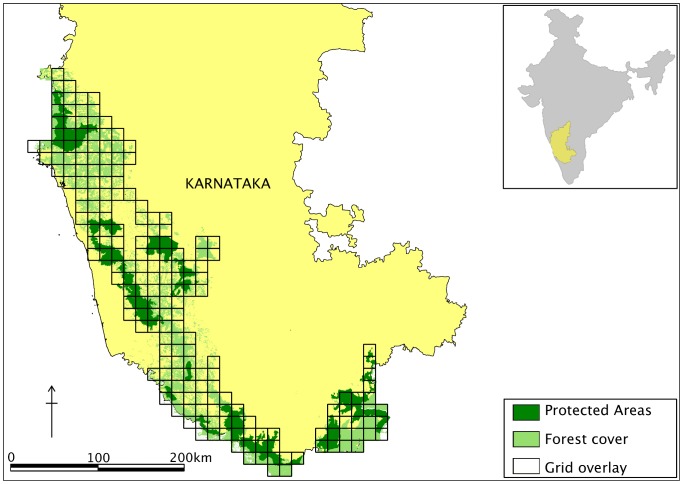
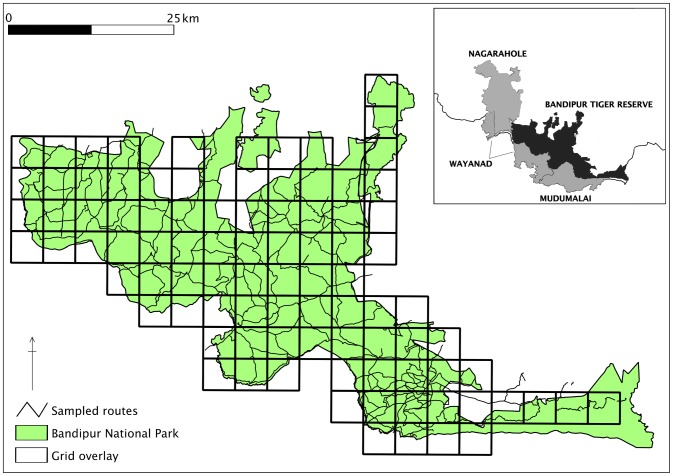
Although they play a critical role in shaping ecological communities, many threatened predator species are data-deficient. The Dhole Cuon alpinus is one such rare canid with a global population thought to be <2500 wild individuals. We assessed habitat occupancy patterns of dholes in the Western Ghats of Karnataka, India, to understand ecological and anthropogenic determinants of their distribution and habitat-use. We conducted spatially replicated detection/non-detection surveys of dhole signs along forest trails at two appropriate scales: the entire landscape and a single wildlife reserve. Landscape-scale habitat occupancy was assessed across 38,728 km(2) surveying 206 grid cells of 188-km(2) each. Finer scale habitat-use within 935 km2 Bandipur Reserve was studied surveying 92 grid cells of 13-km(2) km each. We analyzed the resulting data of dhole signs using likelihood-based habitat occupancy models. The models explicitly addressed the problematic issue of imperfect detection of dhole signs during field surveys as well as potential spatial auto-correlation between sign detections made on adjacent trail segments. We show that traditional 'presence versus absence' analyses underestimated dhole habitat occupancy by 60% or 8682 km2 [naïve = 0.27; ψL(SE) = 0.68 (0.08)] in the landscape. Addressing imperfect sign detections by estimating detection probabilities [p(t)(L) (SE) = 0.12 (0.11)] was critical for reliable estimation. Similar underestimation occurred while estimating habitat-use probability at reserve-scale [naïve = 0.39; Ψs(SE) = 0.71 (0.06)]. At landscape scale, relative abundance of principal ungulate prey primarily influenced dhole habitat occupancy. Habitat-use within a reserve, however, was predominantly and negatively influenced by anthropogenic disturbance. Our results are the first rigorous assessment of dhole occupancy at multiple spatial scales with potential conservation value. The approach used in this study has potential utility for cost-effectively assessing spatial distribution and habitat-use in other species, landscapes and reserves.
Conflict of interest statement
Figures


References
-
- Wikramanayake ED, Dinerstein E, Robinson JG, Karanth U, Rabinowitz A, et al. (1998) An ecology-based method for defining priorities for large mammal conservation: The tiger as case study. Conserv Biol 12: 865–878 10.1111/j.1755-263X.2010.00162.x - DOI
Publication types
MeSH terms
LinkOut - more resources
Full Text Sources
Other Literature Sources
