


White matter development in the early stages of psychosis
- PMID: 24893908
- PMCID: PMC4250450
- DOI: 10.1016/j.schres.2014.05.021
White matter development in the early stages of psychosis
Abstract
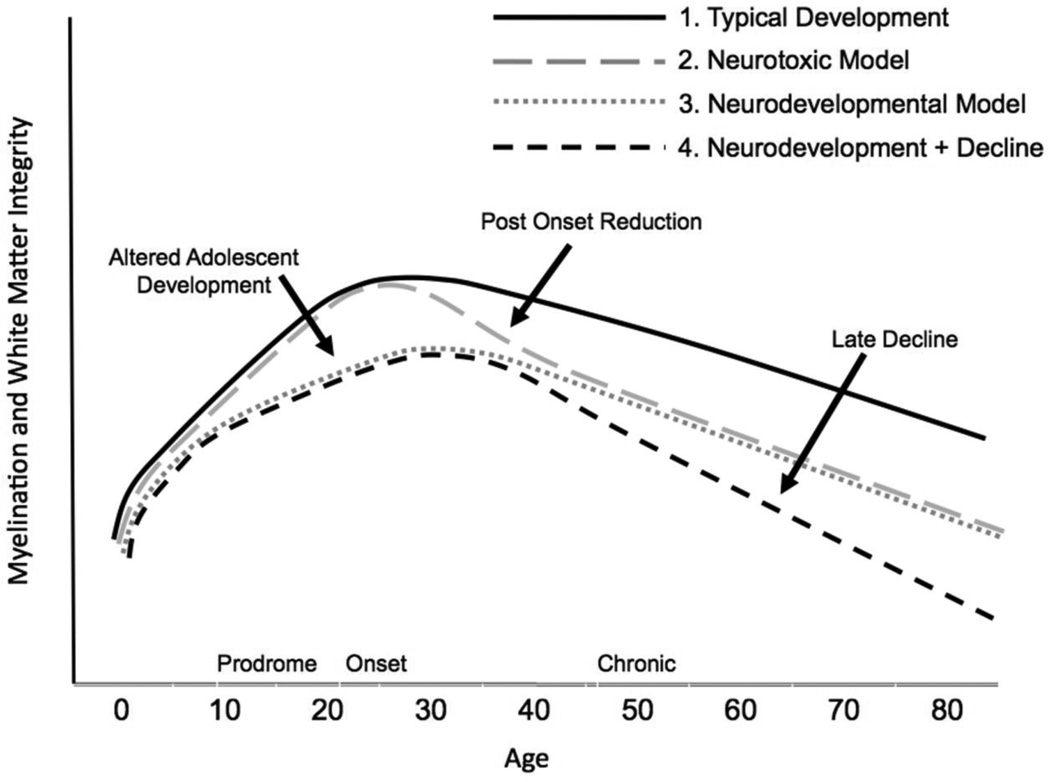
Schizophrenia has been conceptualized as a disorder of both neurodevelopment and a disorder of connectivity. One important aspect of the neurodevelopmental hypothesis is that schizophrenia is no longer thought to have discrete illness time points, but rather a long trajectory of brain changes, spanning many years, across a series of stages of the disease including the prodrome, first episode, and chronic period. As the disease progresses, there is a complex relationship between age related changes and disease related changes. Therefore, neural changes, and specifically white matter based connectivity changes, in schizophrenia may be best conceptualized based on a lifespan trajectory. In this selective review, we discuss healthy changes in white matter integrity that occur with age, as well as changes that occur across illness stages. We further propose a set of models that might explain lifespan changes in white matter integrity in schizophrenia, with the conclusion that the evidence most strongly supports a pattern of disrupted maturation during adolescence, with the potential for later changes that may be a result of disease neurotoxicity, abnormal or excessive aging effects, as well as medication, cohort or other effects. Thus, when considering white matter integrity in psychosis, it is critical to consider age in addition to other contributing factors including disease specific effects. Discovery of the factors driving healthy white matter development across the lifespan and deviations from the normal developmental trajectory may provide insights relevant to the discovery of early treatment interventions.
Keywords: Development; Diffusion tensor imaging; Prodrome; Schizophrenia; White matter.
Copyright © 2014 Elsevier B.V. All rights reserved.
Conflict of interest statement
Dr. Peters has received compensation from ProPhase. Dr Karlsgodt does not report any conflict of interest.
Figures
References
-
- Addington AM, Gornick MC, Shaw P, Seal J, Gogtay N, Greenstein D, Clasen L, Coffey M, Gochman P, Long R, Rapoport JL. Neuregulin 1 (8p12) and childhood-onset schizophrenia: susceptibility haplotypes for diagnosis and brain developmental trajectories. Molecular psychiatry. 2007;12(2):195–205. - PubMed
-
- Amminger GP, Henry LP, Harrigan SM, Harris MG, Alvarez-Jimenez M, Herrman H, Jackson HJ, McGorry PD. Outcome in early-onset schizophrenia revisited: findings from the Early Psychosis Prevention and Intervention Centre long-term follow-up study. Schizophrenia research. 2011;131(1–3):112–119. - PubMed
-
- Amminger GP, Schafer MR, Papageorgiou K, Klier CM, Cotton SM, Harrigan SM, Mackinnon A, McGorry PD, Berger GE. Long-chain omega-3 fatty acids for indicated prevention of psychotic disorders: a randomized, placebo-controlled trial. Archives of general psychiatry. 2010;67(2):146–154. - PubMed
-
- Arvindakshan M, Ghate M, Ranjekar PK, Evans DR, Mahadik SP. Supplementation with a combination of omega-3 fatty acids and antioxidants (vitamins E and C) improves the outcome of schizophrenia. Schizophrenia research. 2003;62(3):195–204. - PubMed
Publication types
MeSH terms
Grants and funding
LinkOut - more resources
Full Text Sources
Other Literature Sources
Medical
Research Materials
