


Oesophageal varices, schistosomiasis, and mortality among patients admitted with haematemesis in Mwanza, Tanzania: a prospective cohort study
- PMID: 24894393
- PMCID: PMC4065539
- DOI: 10.1186/1471-2334-14-303
Oesophageal varices, schistosomiasis, and mortality among patients admitted with haematemesis in Mwanza, Tanzania: a prospective cohort study
Abstract
Background: Upper gastrointestinal bleeding (UGIB) is a common cause of hospital admissions worldwide. Aetiologies vary by sociodemographics and geography. Retrospective studies of endoscopies in much of Africa have documented oesophageal varices as a leading cause of UGIB. Prospective studies describing outcomes and associations with clinical factors are lacking.
Methods: We conducted a prospective cohort study at a referral hospital in Mwanza, Tanzania where schistosomiasis is endemic. Adults admitted with haematemesis underwent laboratory workup, schistosomiasis antigen testing and elective endoscopy, and were followed for two months for death or re-bleeding. We assessed predictors of endoscopic findings using logistic regression models, and determined prediction rules that maximised sensitivity and positive predictive value (PPV).
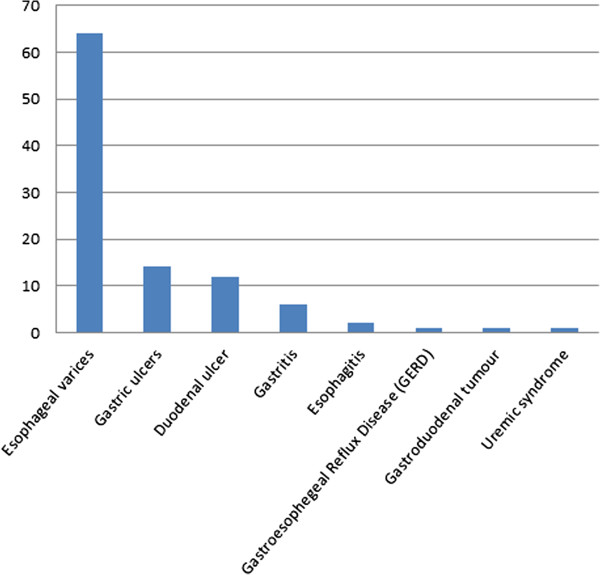
Results: Of 124 enrolled patients, 13 died within two months (10%); active schistosomiasis prevalence was 48%. 64/91(70%) patients had oesophageal varices. We found strong associations between varices and numerous demographic or clinical findings, permitting construction of simple, high-fidelity prediction rules for oesophageal varices applicable even in rural settings. Portal vein diameter ≥ 13 mm or water sourced from the lake yielded sensitivity, specificity, PPV and NPV >90% for oesophageal varices; presence of splenomegaly or water sourced from the lake maintained sensitivity and PPV >90%.
Conclusions: Our results guide identification of patients, via ultrasound and clinical examination, likely to have varices for whom referral for endoscopy may be life-saving. Furthermore, they support empiric anti-schistosome treatment for patients with UGIB in schistosome-endemic regions. These interventions have potential to reduce UGIB-related morbidity and mortality in Africa.
Figures
References
-
- Bush EL, Shapiro ML. Gastrointestinal Bleeding: A Practical Approach to Diagnosis and Management. New York: Springer: Pryor AD, Pappas TN, Branch MS; 2010. p. 223.
-
- Laine L. In: Harrison’s Principles of Internal Medicine. 17. Fauci A, Kasper D, Longo D, Braunwald E, Hauser S, Jameson J, Loscalzo J, editor. New York: McGraw-Hill; 2008. p. 2958.
-
- Theocharis GJ, Thomopoulos KC, Sakellaropoulos G, Katsakoulis E, Nikolopoulou V. Changing trends in the epidemiology and clinical outcome of acute upper gastrointestinal bleeding in a defined geographical area in Greece. J Clin Gastroenterol. 2008;14:128–133. doi: 10.1097/01.mcg.0000248004.73075.ad. - DOI - PubMed
-
- Van Leerdam ME, Vreeburg EM, Rauws EAJ, Geraedts AAM, Tijssen JGP, Reitsma JB, Tytgat GNJ. Acute upper GI bleeding: did anything change? Time trend analysis of incidence and outcome of acute upper GI bleeding between 1993/1994 and 2000. Am J Gastroenterol. 2003;14:1494–1499. - PubMed
Publication types
MeSH terms
Grants and funding
LinkOut - more resources
Full Text Sources
Other Literature Sources
Medical
